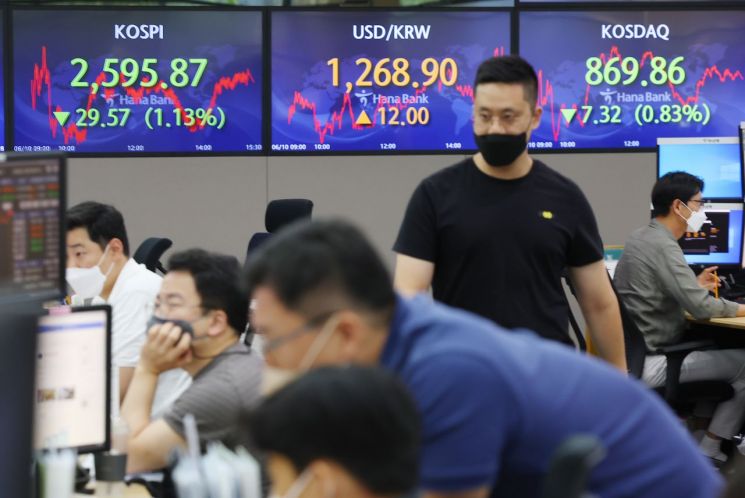
[Asia Economy Reporter Lee Seon-ae] The KOSPI index plunged sharply amid the 'high inflation shock,' breaking through its yearly low. On the 13th, the KOSPI opened at 2,550.21, down 45.66 points (1.76%) from the previous session, and then fell over 2% to settle in the 2,540 range. Early in the session, it dropped to 2,541.79, surpassing the yearly low of 2,546.80 recorded intraday on May 12.
The New York stock market, which plunged sharply due to the largest surge in U.S. consumer prices in over 40 years, weighed heavily on the KOSPI. Prolonged inflation has raised expectations that the U.S. central bank, the Federal Reserve (Fed), will raise interest rates more aggressively, putting pressure on financial markets. On the 10th (local time), the Dow Jones Industrial Average closed at 31,392.79, down 880.00 points (2.73%) from the previous session. The Standard & Poor's (S&P) 500 index fell 116.96 points (2.91%) to 3,900.86, and the tech-heavy Nasdaq index dropped 414.20 points (3.52%) to 11,340.02.
This marks the first time in over two years since March 22-23, 2020, during the early days of the COVID-19 pandemic, that the S&P 500 index has fallen more than 2% for two consecutive days. The announcement just before the market opened that the U.S. Consumer Price Index (CPI) for May surged 8.6% year-over-year?the largest increase since December 1981?sharply dampened investor sentiment. Market expectations are gradually rising that the June Federal Open Market Committee (FOMC) meeting could see a 'giant step' of a 0.75 percentage point rate hike at once. The Fed has never implemented such a rapid rate increase since 1994.
The supply and demand environment is also unfavorable. Foreign investors are selling, while individuals are buying, but it is insufficient to offset the selling pressure. Foreign investors have been net sellers in both the KOSPI and KOSDAQ markets since early in the session. As of 9:17 a.m., foreign investors sold approximately 88.7 billion KRW and 11.1 billion KRW in the two markets, respectively. Individuals are net buyers with about 57.5 billion KRW and 19.4 billion KRW purchases. Institutions are net buyers of about 25.9 billion KRW in the KOSPI market but net sellers of about 7.8 billion KRW in the KOSDAQ market.
Most of the top market capitalization stocks are declining. Samsung Electronics is down more than 2%. During the session, Samsung Electronics fell to 62,300 KRW, setting a new 52-week low. LG Energy Solution, SK Hynix, and Samsung Biologics are also down. Among the top 30 market capitalization stocks, only S-OIL is trading higher.
Seo Sang-young, Head of Media Content at Mirae Asset Securities, said, "The U.S. stock market plunged after the CPI announcement as expectations for inflation easing weakened, and the sustained high inflation raises the possibility of a slowdown in U.S. consumption, bringing recession concerns, which burdens the Korean stock market," adding, "We expect significant fluctuations as the market awaits the FOMC."
Han Ji-young, a researcher at Kiwoom Securities, also said, "The Korean stock market has been under downward pressure since early this week due to the shock from the sharp rise in U.S. consumer prices in May. It will continue to experience increased volatility influenced by major economic indicators such as U.S. and China retail sales and industrial production, as well as the June FOMC event," advising, "Although there is a possibility of a sell-off, considering the market valuation attractiveness and favorable earnings outlook, it is more appropriate to respond with a wait-and-see approach rather than joining the sell-off."
© The Asia Business Daily(www.asiae.co.kr). All rights reserved.
![Clutching a Stolen Dior Bag, Saying "I Hate Being Poor but Real"... The Grotesque Con of a "Human Knockoff" [Slate]](https://cwcontent.asiae.co.kr/asiaresize/183/2026021902243444107_1771435474.jpg)















