"LNG Unbanseon and Other Eco-Friendly Ships Establish Leadership Position"
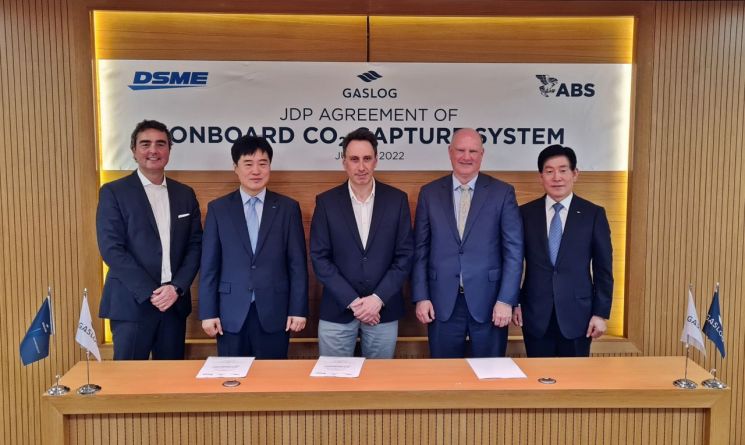 At the Greece Poseidonia Exhibition, Park Doo-sun, President of Daewoo Shipbuilding & Marine Engineering (far right), along with representatives from three companies, pose for a commemorative photo after signing an "Agreement for the Development of Carbon Dioxide Capture and Storage Technology." (Photo by Daewoo Shipbuilding)
[Asia Economy Reporter Moon Chaeseok] Daewoo Shipbuilding & Marine Engineering (DSME) announced on the 10th that it has signed a 'Carbon Dioxide Capture and Storage Technology (OCCS) Development Agreement' with Greek shipping company GasLog and American classification society ABS. With strong interest in orders for liquefied natural gas (LNG) carriers, DSME plans to accelerate technology development to take the lead in the eco-friendly ship sector.
DSME revealed that the agreement was signed at 'Posidonia,' the world's largest ship and marine exhibition held in Greece. OCCS technology essentially functions to safely expel carbon dioxide from exhaust gases outside the ship. It absorbs and regenerates carbon dioxide emitted during ship operation, then separates it. Afterwards, the CO2 is returned inside the ship and stored as a byproduct before being discharged onshore after docking. This reduces carbon dioxide emissions while also contributing to operational cost savings necessary for ship operation.
The three companies agreed to form a joint working committee to design the optimal OCCS system to be applied to DSME's LNG carriers. They plan to conduct risk analysis and testing required for OCCS installation and operation to verify its functionality. The goal is to obtain Approval in Principle (AIP) for the OCCS basic concept. DSME already holds core OCCS technology, related patents, and intellectual property rights through joint development with domestic equipment suppliers. They will comprehensively review the basic design of key OCCS equipment and share related technical data and drawings. Various verification tasks will be conducted to assess the feasibility of OCCS installation and operation. The joint development of OCCS is expected to be completed by the first quarter of next year, with the system installed on GasLog LNG carriers built by DSME.
Last year, DSME secured an order for four LNG carriers from GasLog. The ships are scheduled to be delivered sequentially starting in the first half of 2024. The OCCS developed through this project will be installed on these vessels. Accordingly, GasLog will be responsible for the technical requirements related to OCCS installation and operation and will provide ship operation know-how necessary for design evaluation. ABS, one of the world's leading major classification societies, will guide overall rules and regulations for OCCS development and provide technical advice. In particular, ABS will conduct various risk assessments and oversee the evaluation process for obtaining AIP.
Recently, the shipbuilding and shipping industries have been actively developing carbon-neutral technologies centered around the International Maritime Organization (IMO). OCCS technology is gaining attention as a representative eco-friendly technology that can proactively respond to global environmental regulations. Seon Jun-ryong, Executive Vice President and Head of Technology at DSME, said, "We are pleased to establish a platform for eco-friendly technology cooperation in Greece, one of our largest customers in shipbuilding," adding, "The company will leverage this cooperation to establish itself as a leader in eco-friendly ship technology." Karatanos, Chief Operating Officer (COO) of GasLog, stated, "Through collaboration with industry leaders like DSME and ABS, we are playing a key role in realizing 'decarbonization,'" and added, "We are confident this technology will be a major solution to reduce carbon dioxide emissions from ship exhaust gases and contribute to mitigating global climate change."
© The Asia Business Daily(www.asiae.co.kr). All rights reserved.
![Clutching a Stolen Dior Bag, Saying "I Hate Being Poor but Real"... The Grotesque Con of a "Human Knockoff" [Slate]](https://cwcontent.asiae.co.kr/asiaresize/183/2026021902243444107_1771435474.jpg)
















