Confusion Among Financial Consumers Worsens Due to 'Gomujul Ija' Amid Rising Interest Rates
Bond Yields Fluctuate, Affecting Market Interest Rates
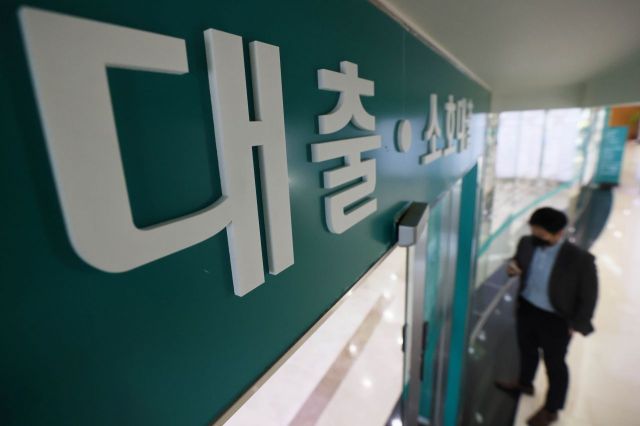
[Asia Economy Reporter Sim Nayoung] Financial consumers are struggling due to the so-called 'rubber band interest rates' amid rising interest rates. As bond yields fluctuate, mortgage loan interest rates have increased and decreased by tens of thousands of won annually within just a few days. Financial consumers, distressed by the rapidly rising interest rates, face a double burden of interest depending on the loan execution date. In the case of home purchase loans, the loan is usually executed on the payment day, making it difficult to monitor interest rate trends and adjust the loan date. Financial consumers have no choice but to bear the risk caused by uncertainty.
According to an analysis by a commercial bank on the 28th, when borrowing 350 million won in a mortgage loan with a mixed interest rate (5 years fixed rate followed by variable rate), the monthly interest payment fluctuated within May alone depending on the borrowing date: 700,750 won (6th, 4.01%) → 753,668 won (9th, 4.27%) → 698,731 won (20th, 4.00%) → 731,117 won (23rd, 4.16%).
The reason why the mixed mortgage interest rate changes moment by moment is that it is linked to the 5-year financial bond yield trend. Banks raise funds to lend through issuing bank bonds and accepting deposits. For example, mixed-rate loans are lent to consumers using funds raised by issuing 5-year financial bonds that change daily.
This is also why mixed interest rates change more frequently than variable rates, which are influenced by the monthly announced COFIX. Although the methods differ slightly, banks calculate mixed interest rates weekly by adding a spread to the 5-year financial bond yield set on a specific day of the week. This rate is then applied to mortgage loans for the following week.
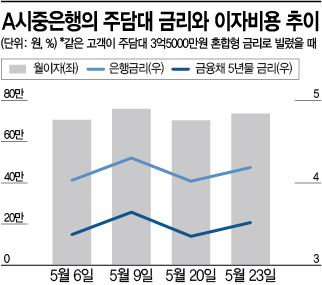
A bank official explained, "On an annual basis, depending on when the loan is taken, there can be a difference of up to 600,000 won within ten days," adding, "In May, every time the mixed interest rate was newly set weekly, the 5-year financial bond yield fluctuated by 0.2 to 0.3 percentage points, causing the mixed interest rate to fluctuate as well." The 5-year financial bond yields used as the basis for mixed interest rate calculation were 3.38% in the first week of May, 3.64% in the second week, 3.36% in the third week, and 3.52% in the fourth week. This volatility was greater than in April, when weekly fluctuations were within 0.2 percentage points.
On the 26th, the Bank of Korea raised the base interest rate once again to 1.75%. This marks the fifth increase over nine months since August 2021. The problem is that interest rate hikes are expected to continue. The financial sector is confident that the base rate will be raised 2 to 3 more times within this year. At a press conference following the regular Monetary Policy Committee meeting, Bank of Korea Governor Lee Chang-yong stated, "We judge that the inflation risk is significant under the current circumstances," and regarding market expectations that the base rate will reach 2.25 to 2.50% by the end of the year, he called it a "reasonable expectation."
© The Asia Business Daily(www.asiae.co.kr). All rights reserved.
![Clutching a Stolen Dior Bag, Saying "I Hate Being Poor but Real"... The Grotesque Con of a "Human Knockoff" [Slate]](https://cwcontent.asiae.co.kr/asiaresize/183/2026021902243444107_1771435474.jpg)
















