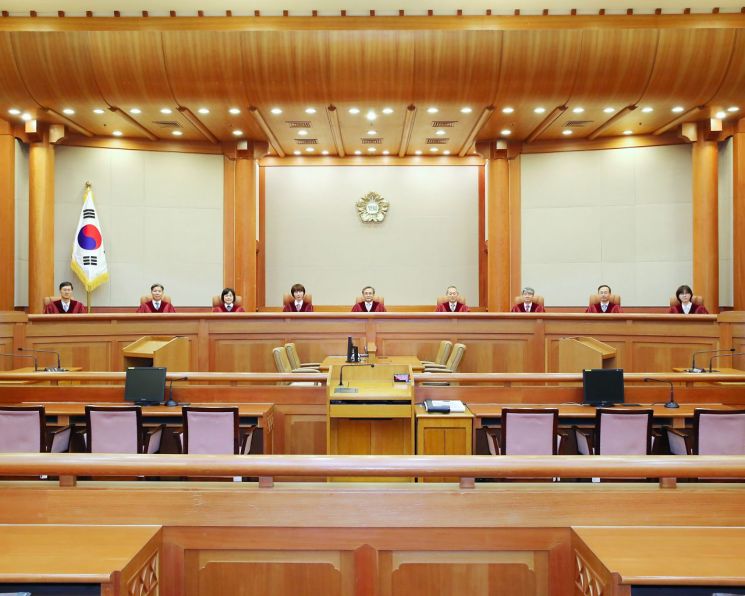
[Asia Economy Reporter Choi Seok-jin, Legal Affairs Specialist] The Constitutional Court has ruled unconstitutional certain provisions of the "Regulations on Lawyer Advertising," revised last year by the Korean Bar Association (President Lee Jong-yeop) to restrict lawyers from joining online legal platforms such as 'Lotok.'
The Constitutional Court judged that since advertising by lawyers is generally permitted under the Attorney-at-Law Act, lawyers should also be allowed to pay advertising fees to advertisers and advertise.
With the Constitutional Court's ruling of unconstitutionality, the Korean Bar Association, which had persisted in disciplining lawyers registered with Lotok despite three no-indictment decisions by investigative agencies and a legal judgment by the Ministry of Justice, will find it difficult to continue blocking lawyer advertising through legal platforms like Lotok.
On the 26th, the Constitutional Court ruled in a constitutional complaint case filed by Lotok operator Law&Company (CEO Kim Bon-hwan) along with 60 lawyers against the lawyer advertising regulations, stating, "Article 4, Clause 14 of the Lawyer Advertising Regulations concerning 'advertisements contrary to the Association's authoritative interpretation,' Article 5, Paragraph 2, Subparagraph 1 concerning 'acts of advertising, promoting, or introducing lawyers,' and Article 8, Paragraph 2, Subparagraph 4 concerning 'acts conducted for the purpose or means of violating the Association's authoritative interpretation' are unconstitutional."
The Korean Bar Association revised the "Regulations on Lawyer Advertising" in May last year amid escalating conflicts with Lotok.
Following consecutive no-indictment decisions by the prosecution in 2015 and 2017 regarding Lotok's alleged violations of the Attorney-at-Law Act, and with the Ministry of Justice repeatedly stating that "Lotok is constitutional," the number of lawyers joining Lotok gradually increased. To prevent this, the Bar Association established grounds to discipline lawyers who join Lotok.
The most notable provision was Article 5 (Restrictions on Advertising Methods), Paragraph 2, Subparagraph 1, known as the "Prohibition on Advertising for Economic Compensation," which banned acts of advertising, promoting, or introducing lawyers in exchange for economic compensation.
The revised Article 5 (Restrictions on Advertising Methods), Paragraph 2 states that "lawyers and others shall not request, participate in, or cooperate with any person (individual, corporation, or other organization) who engages in the following acts of advertising, promotion, or introduction," listing prohibited advertising methods.
The prohibited advertising methods include ▲ acts of connecting lawyers and consumers or advertising, promoting, or introducing lawyers in exchange for money or other economic compensation (such as referral fees, brokerage fees, commissions, membership fees, registration fees, advertising fees, regardless of name or regularity) received from lawyers or consumers for the purpose of legal consultation or case introduction (Subparagraph 1), and ▲ other advertising acts violating laws, the Code of Ethics for Lawyers, or the rules of the Association and local bar associations (Subparagraph 6).
Article 5, Paragraph 2, Subparagraph 1 was specifically aimed at legal service intermediary sites like Lotok. Lotok does not charge membership fees but receives advertising fees, and this provision prohibited requesting advertising or promotion from corporations that advertise lawyers in exchange for advertising fees.
On this day, the Constitutional Court ruled that such a prohibition on advertising for economic compensation violates the principle of proportionality, infringing on the freedom of expression and freedom of occupation of Lotok and the lawyers who filed the constitutional complaint, thus deeming it unconstitutional.
The Court stated, "It is difficult to view the prohibition on advertising for economic compensation as merely regulating the introduction, referral, or solicitation acts prohibited by the Attorney-at-Law Act again," adding, "Acts of simultaneously advertising, promoting, or introducing an unspecified number of lawyers for the purpose of introducing or soliciting legal consultations or cases are also included within the scope of the prohibition under the regulation."
It continued, "While reasonable regulation of lawyer advertising is necessary, considering the fundamental rights nature of advertising expressions, it is desirable to broadly allow advertising except for necessary limits in terms of content or method," emphasizing, "In light of the purpose of Article 23, Paragraph 1 of the Attorney-at-Law Act, which principally permits lawyer advertising through various media, lawyers paying advertising fees to advertisers across diverse media and advertising should be allowed. Therefore, the blanket prohibition in the regulation lacks appropriateness in means."
The Court also noted, "Even without the prohibition on advertising for economic compensation, legislative objectives can be achieved through the Attorney-at-Law Act or other regulations, and the same legislative goals can be met by relaxed measures such as restricting advertisements that harm fair client order or cause consumer damage."
Finally, the Court concluded, "While it is unclear whether the legislative purpose can be achieved by the regulation, lawyers are effectively prohibited from commissioning paid advertisements to advertisers, severely restricting the petitioners' freedom of expression and occupation. Therefore, the regulation fails to meet the requirements of minimal infringement and balance of interests," concluding that the prohibition on advertising for economic compensation violates the principle of proportionality and infringes on the petitioners' freedom of expression and occupation.
There was a dissenting opinion from Justices Lee Seon-ae, Lee Eun-ae, and Lee Jong-seok, who argued that the prohibition should be interpreted as constitutional on the premise that it does not ban general lawyer advertising but only prohibits advertising requests involving economic compensation linked to introducing, referring, or soliciting cases to specific lawyers.
Meanwhile, regarding the part of Article 4, Subparagraph 14, which prohibits "advertisements contrary to the Association's authoritative interpretation," and Article 8, Paragraph 2, Subparagraph 4, which prohibits acts conducted for the purpose or means of violating the Association's authoritative interpretation,
The Constitutional Court pointed out, "These provisions only label 'violations of the Association's authoritative interpretation' without limiting the content or methods of advertisements prohibited accordingly, and it is difficult to know what content falls under this by examining the Attorney-at-Law Act or related rules."
It added, "Considering that violations of the prohibition on advertisements contrary to authoritative interpretations can be grounds for disciplinary action, at least the lawyers subject to regulation should be able to roughly know the prohibited content through authoritative interpretations. However, the predictability of regulation is significantly low, and arbitrary interpretations by law enforcement agencies cannot be excluded."
For these reasons, the Court concluded, "Therefore, the prohibition on advertisements violating authoritative interpretations does not clearly define the scope of regulation within the delegated authority of the law, violating the principle of legal reservation and infringing on the petitioners' freedom of expression and occupation."
Earlier, following the Seoul Bar Association and the Korean Bar Association, the Lawyers for Professional Protection Group also filed complaints against Lotok for violations of the Attorney-at-Law Act and the Personal Information Protection Act. However, in December last year, the police decided not to prosecute, and the prosecution, upon reviewing the case after the complainants' objection, recently issued a third no-indictment decision.
On the other hand, the Fair Trade Commission, which investigated the Korean Bar Association following a report by Lotok, sent review reports in November and December last year stating that the Bar Association violated the Fair Trade Act and the Act on Labeling and Advertising.
© The Asia Business Daily(www.asiae.co.kr). All rights reserved.
![Clutching a Stolen Dior Bag, Saying "I Hate Being Poor but Real"... The Grotesque Con of a "Human Knockoff" [Slate]](https://cwcontent.asiae.co.kr/asiaresize/183/2026021902243444107_1771435474.jpg)
















