Starbucks, Twosome Place, and Coffee Bean Join Major Coffee Franchise Beverage Price Increases
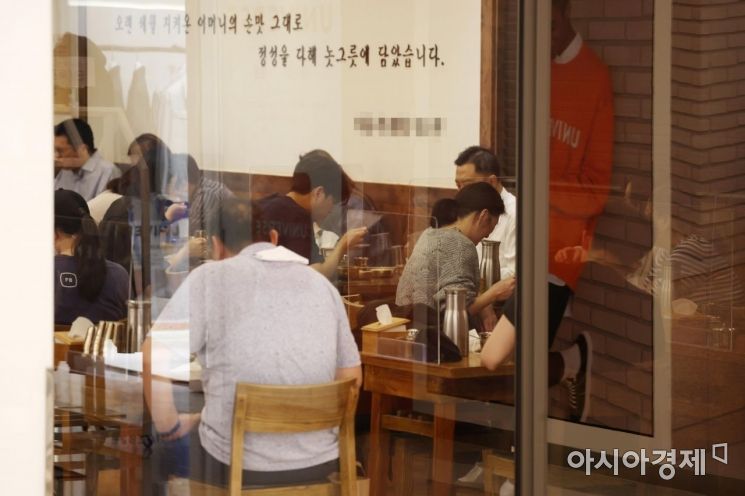
[Asia Economy Reporter Heo Midam] # Kim, a worker in his 30s, worked from home for a year after the COVID-19 pandemic but started going to the office last month. Kim said, "Prices have risen a lot compared to before COVID. Since there is no cafeteria, I use meal vouchers to eat at nearby restaurants, but many menu items cost over 10,000 won," adding, "The company provides meal vouchers worth 8,000 won, but since the restaurant menus cost over 10,000 won, I always have to pay the difference." He continued, "After lunch, when I have coffee, money quickly leaves my wallet."
Recently, dining-out prices have soared sharply, with the price of a lunch meal approaching 10,000 won. Office workers returning to the office after a long period of remote work are expressing concerns about the increased lunch prices compared to two years ago. On top of that, with coffee prices rising, a new term "Lunchflation" (Lunch + Inflation) has emerged among workers, combining lunch and inflation.
According to the Korea Consumer Agency's comprehensive price information portal "Chamgagyeok" on the 26th, the price of one serving of cold noodles in Seoul last month was 10,192 won. This is a 9.5% increase compared to April last year (9,308 won) and a 2.3% increase from the previous month. The price of one serving of jajangmyeon also surged 14.1% to 6,146 won compared to the same period last year (5,385 won). Additionally, popular dishes among office workers such as kalguksu (8,269 won) rose 11%, and gimbap (2,908 won) and bibimbap (9,538 won) each increased by about 8%.
As restaurants that used to offer relatively affordable meals like gimbap have consecutively raised their prices, office workers are feeling a considerable burden.
On the anonymous office worker community "Blind," employees responded with comments such as, "If you have lunch and coffee, you usually spend between 17,000 and 20,000 won," "I never thought the era of 10,000 won lunches would come," and "Eating out and having coffee adds up to a significant amount, so I want to save money but don't know how."
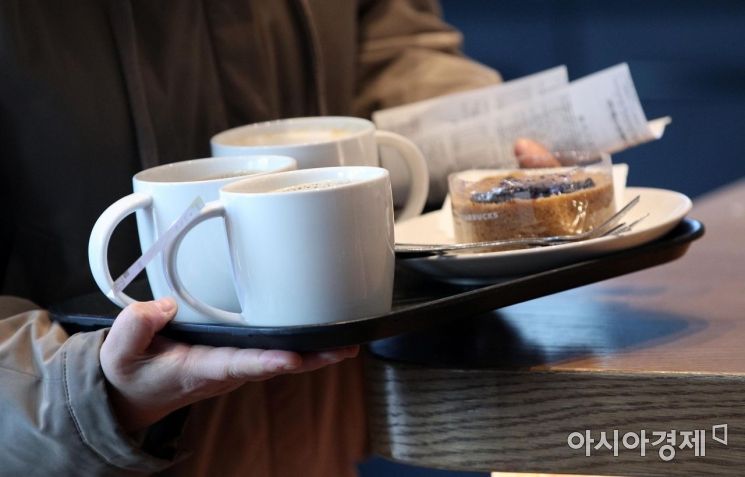 A customer is transferring coffee in a mug at a franchise coffee shop in Seoul. Photo by Hyunmin Kim kimhyun81@
The rise in dining-out prices appears to be influenced by a combination of soaring ingredient costs, increased labor costs, and increased dining demand following the lifting of social distancing measures. According to the Statistics Korea National Statistical Portal (KOSIS), the dining-out price index in April rose 6.6% compared to a year ago. This is the highest level in 24 years since April 1998 (7.0%) during the International Monetary Fund (IMF) crisis. Unlike prices of agricultural, livestock, and fishery products, once dining-out prices rise, they rarely fall, so they are expected to remain high for some time and act as a burden on overall inflation.
Among these, the price of Americano coffee, an essential beverage for office workers, has also increased over the past few months, adding to their financial burden.
Recently, major coffee franchise companies have been raising beverage prices one after another, citing rising international coffee bean prices. Coffee Bean raised prices of about 50 major products, excluding some tea drinks, by 100 to 300 won starting from the 10th. As a result, the price of a small Americano increased from 4,900 won to 5,000 won.
Earlier, Starbucks Korea also raised the price of Americano from 4,100 won to 4,500 won in January, a 400 won increase. Currently, the Americano prices at major companies are as follows: Tom N Toms 4,900 won, Paul Bassett 4,700 won, Hollys 4,500 won, Twosome Place 4,500 won, and Angel-in-us 4,500 won.
Professor Lee Eunhee of Inha University's Department of Consumer Studies said, "Rising labor and material costs have affected dining-out prices. The increased prices are unlikely to decrease again, and price hikes are expected to continue in the second half of the year. For office workers, wages remain the same, but with rising prices, real income has decreased. This inevitably lowers quality of life and leads to considering ways to reduce expenses. One such method is using cafeterias or convenience store lunch boxes," she explained.
© The Asia Business Daily(www.asiae.co.kr). All rights reserved.
![Clutching a Stolen Dior Bag, Saying "I Hate Being Poor but Real"... The Grotesque Con of a "Human Knockoff" [Slate]](https://cwcontent.asiae.co.kr/asiaresize/183/2026021902243444107_1771435474.jpg)

















