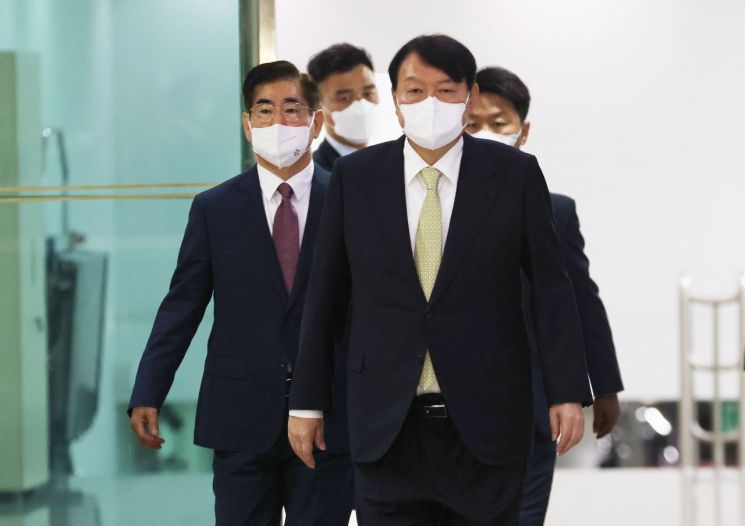
[Asia Economy Yang Nak-gyu, Military Specialist Reporter] President Yoon Suk-yeol’s convening of the National Security Council (NSC) immediately after North Korea’s successive ballistic missile launches on the 25th is interpreted as a serious recognition of North Korea’s provocations. Since North Korea’s missile launches followed the intrusion of Chinese and Russian military aircraft into the Korea Air Defense Identification Zone (KADIZ) the previous day, these incidents cannot be seen as separate matters. Military authorities are focusing on the fact that provocations from China, Russia, and North Korea followed U.S. President Joe Biden’s Asia tour, including visits to South Korea and Japan, and are preparing to respond, viewing this as the beginning of coordinated actions by North Korea, China, and Russia.
The Presidential Office and the government each issued statements on the 25th, which itself is interpreted as a serious stance toward North Korea’s provocations. A Presidential Office official told reporters that issuing a separate government statement in addition to the NSC statement "also happened in December 2017," adding, "Issuing a separate government statement also carries significance." In the statement, the government strongly criticized, saying, "North Korea’s continued provocations inevitably lead to stronger and faster combined South Korea-U.S. deterrence and only bring about North Korea’s international isolation."
In particular, analyses suggest that the missile show of force was a response to agreements reached during the South Korea-U.S. summit and other meetings, where pressure messages against North Korea were sent and issues such as the timely deployment of strategic assets and expansion of combined South Korea-U.S. exercises?criticized by North Korea as a ‘hostile policy’?were agreed upon.
The Presidential Office also noted that this provocation occurred before President Joe Biden’s return to the U.S. after the South Korea-U.S. summit. South Korea and U.S. authorities had detected signs of liquid fuel being loaded into an ICBM by North Korea early last week and had been monitoring the possibility of provocations while President Biden was in South Korea or Japan. Ultimately, North Korea launched the ICBM ‘behind Biden’s back.’
A Presidential Office official said, "Ultimately, the South Korea-U.S. alliance has been strengthened and various achievements have been made in the process, but the missile launch is considered a signal or message from North Korea."
Attention is also drawn to the fact that six Chinese and Russian military aircraft sequentially entered and then exited the Dokdo KADIZ the previous day. It is unusual for Chinese and Russian military aircraft to jointly intrude into the KADIZ.
There is also a need to watch for the possibility of additional provocations by North Korea. Previously, South Korea-U.S. authorities assessed that North Korea would proceed with a seventh nuclear test to develop miniaturized nuclear weapons (tactical nuclear weapons) that can be mounted on various delivery systems. There are also speculations that North Korea might carry out military provocations around the end of this month to commemorate the U.S. Memorial Day (May 30).
South Korea and the U.S. jointly responded to North Korea’s ballistic missile launches. In particular, the South Korea-U.S. military authorities conducted combined ground-to-ground missile firings in response to North Korea’s military provocations. The South Korean military launched one Hyunmoo-2 missile, and the U.S. military fired one ATACMS missile each into the East Sea, countering North Korea’s provocations. This joint response between South Korea and the U.S. is the first in about 4 years and 10 months since July 2017.
Additionally, the South Korean Air Force conducted an Elephant Walk training exercise involving about 30 F-15K fighter jets for the first time in about two months. Elephant Walk is a training exercise where fighter jets, fully armed, taxi on the runway in close formation just before takeoff.
If North Korea escalates the level of its missile launches and provocations, joint South Korea-U.S. countermeasures are expected to be implemented for the first time in about 4 years and 10 months since July 2017. After the summit with U.S. President Joe Biden on the 21st, President Yoon said at a press conference, "The two leaders agreed to reactivate the High-Level Extended Deterrence Strategy Committee (EDSCG) as soon as possible."
Once the EDSCG is reactivated, the deployment of U.S. strategic assets to the Korean Peninsula will be promoted. Strategic bombers such as the B-52H ‘Stratofortress,’ B-1B ‘Lancer,’ and B-2 ‘Spirit’ are expected to be the first to be deployed. In addition, strategic assets include the nuclear-powered aircraft carrier known as the ‘floating base,’ which carries about 70 aircraft, and nuclear-powered attack submarines equipped with Tomahawk cruise missiles with a range of 2,500 km, which will also be dispatched to the Korean Peninsula.
Along with this, high-intensity South Korea-U.S. combined exercises are expected to be discussed as part of the extended deterrence action plan. In particular, practical bombing exercises involving U.S. strategic assets are mentioned as a means that can exert strong effects.
A military official said, "After President Biden’s Asia tour, South Korea-U.S. cooperation on North Korea policy is expected to become firmer and more resolute, and North Korea’s level of provocations is also expected to increase, so we are closely monitoring the situation."
© The Asia Business Daily(www.asiae.co.kr). All rights reserved.
![Clutching a Stolen Dior Bag, Saying "I Hate Being Poor but Real"... The Grotesque Con of a "Human Knockoff" [Slate]](https://cwcontent.asiae.co.kr/asiaresize/183/2026021902243444107_1771435474.jpg)
















