Corporate Tax Rate Cut Likely to Be Included in July Tax Reform Bill
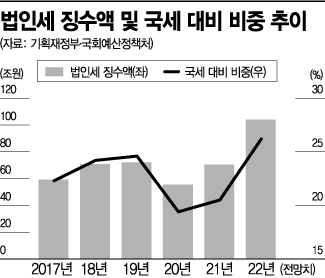
[Asia Economy Sejong=Reporter Son Seon-hee] This year, corporate tax revenue is expected to surpass 100 trillion won for the first time. Its share of total national tax revenue is also projected to soar to the 26% range, setting a new record high. This confirms with actual figures the criticism that corporate tax burdens are excessive compared to major advanced countries. Accordingly, the new government’s plan to lower the top corporate tax rate is expected to proceed with increased momentum.
According to the second supplementary budget review report by the National Assembly Budget Office on the 24th, the Ministry of Economy and Finance estimates this year’s corporate tax revenue at 104.0662 trillion won, which is about 1.5 times the amount collected last year (70.3963 trillion won). Corporate tax accounts for 26.2% of the total annual national tax revenue (396.6498 trillion won), marking the highest proportion ever recorded. Historically, the corporate tax share hovered between 20% and 25%, but it dropped to 19.4% in 2020 due to the direct impact of the COVID-19 pandemic. After recording 20.5% last year, it is expected to jump nearly 6 percentage points within just one year. If the government’s forecast holds true, the corporate tax burden relative to nominal Gross Domestic Product (GDP) will approach 5% this year, which is the highest level among OECD member countries.
With corporate tax revenue expected to far exceed initial predictions, the Yoon Seok-yeol administration’s plan to reduce the top corporate tax rate is also anticipated to gain speed. This comes five years after the Moon Jae-in administration raised the top rate from 22% to 25% (effective from 2018). As of last year, the average top corporate tax rate among OECD countries was 21.5%, placing South Korea’s current rate of 25% eighth among the 38 OECD member countries. The top corporate tax rate among the Group of Seven (G7) countries is 20.9%, which is even lower than the OECD average. Notably, both the OECD and G7 have been lowering their corporate tax rates over the past decade (OECD from 23.7% to 21.5%, G7 from 26.7% to 20.9%), while South Korea raised its rate in 2018, drawing consistent criticism for moving in the opposite direction.
The Ministry of Economy and Finance, which is currently reviewing corporate tax reduction measures internally, has been tight-lipped about specific adjustment rates but is reportedly considering reverting to the pre-2018 rate of 22%. In addition to lowering rates, efforts to simplify the excessively complex tax brackets are expected to proceed simultaneously. Currently, corporate tax rates are applied as follows: 10% for taxable income up to 2 billion won, 20% for 2 billion to 20 billion won, 22% for 20 billion to 300 billion won, and 25% for amounts exceeding 300 billion won. Proposals include reducing these brackets to two or applying a single flat rate. Related details are expected to be included in the tax reform bill to be announced around July.
© The Asia Business Daily(www.asiae.co.kr). All rights reserved.
![Clutching a Stolen Dior Bag, Saying "I Hate Being Poor but Real"... The Grotesque Con of a "Human Knockoff" [Slate]](https://cwcontent.asiae.co.kr/asiaresize/183/2026021902243444107_1771435474.jpg)















