2021 Greenhouse Gas Concentration Reaches Record High of 413.2ppm
Despite La Ni?a, Last 7 Years Are the Hottest Summers in History
WMO: "Breaking the Record for the Hottest Year Ever Is Now a Matter of Time"
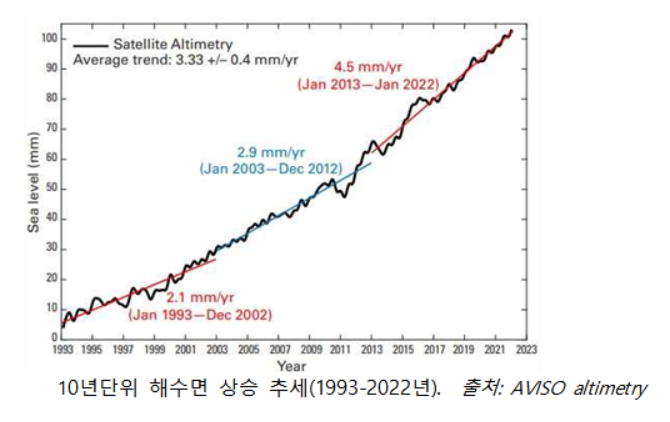 The World Meteorological Organization announced on the 18th (local time) that the average annual sea level rose by 4.5mm between 2013 and 2021.
[Asia Economy Reporter Han Jinju] Last year, key indicators of climate change such as greenhouse gas concentrations, sea level rise, sea temperature, and ocean acidity reached record highs.
According to the Global Climate Status Report released on the 18th (local time) by the World Meteorological Organization (WMO), the past seven years were recorded as the hottest seven years on record. Despite a temporary temperature drop due to the La Ni?a phenomenon, the global average temperature rose. Last year, the global average temperature was 1.11 (±0.13)℃ higher than pre-industrial levels.
Greenhouse gas concentrations reached 413.2 ppm as of 2021, which is 149% of pre-industrial levels. At certain points, it continued to increase until early 2022. The monthly average concentration at the Mauna Loa Observatory in Hawaii was 416.45 ppm in April 2020, 419.05 ppm in April 2021, and 420.23 ppm last April.
Sea levels rose by an average of 4.5 mm per year from 2013 to 2021, reaching a record high in 2021. This rate is more than double compared to the rise from 1993 to 2002. Rapid glacier melting is significantly impacting populations living along coasts and making them more vulnerable to tropical cyclones.
Sea temperatures also reached record highs. The upper 2000 meters of the ocean continue to warm and are expected to remain so. The rate of ocean warming has accelerated over the past 20 years and is penetrating into the deep ocean layers.
About 23% of annual carbon dioxide emissions are absorbed by the oceans, which leads to ocean acidification. Ocean acidification threatens ecosystems and affects food security, tourism, and coastal protection. As the ocean’s pH decreases, its capacity to absorb atmospheric carbon dioxide also diminishes.
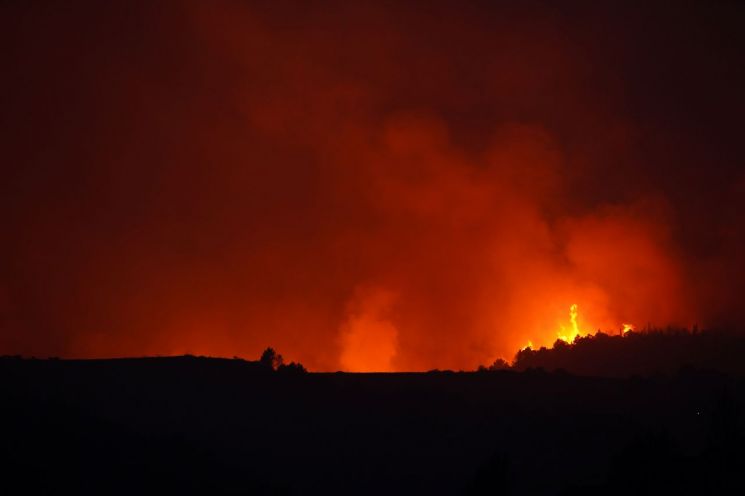
Unprecedented heatwaves in the western United States and the Mediterranean recorded all-time high temperatures. On July 9 last year, Death Valley National Park in California, USA, recorded 54.4℃. Syracuse on the island of Sicily, Italy, recorded 48.8℃. British Columbia, Canada, recorded 49.6℃ on June 29, with over 500 deaths caused by the heatwave.
Floods and droughts also occurred in various regions. Henan Province in China suffered economic losses amounting to $17.7 billion due to flooding. In mid-July, Western Europe experienced its worst flooding on record, causing over $20 billion in economic losses and many fatalities in Germany. Droughts occurred in northeastern Africa, Canada, the western United States, Iran, Afghanistan, Pakistan, and Turkey, while droughts in the tropical regions of South America caused significant damage to crop production. Drought damage in northeastern Africa appears to be worsening this year as well.
Climate change threatens terrestrial, coastal, and marine ecosystems, with severe damage also occurring to mountain ecosystems that serve as the world's water towers. Rising temperatures have caused irreversible damage to marine and coastal ecosystems such as seagrass meadows and seaweed forests. Areas covered by coral reefs are expected to lose 70-80% if global temperatures rise by 1.5℃. Depending on the rate of sea level rise, 20-90% of coastal wetlands are at risk of disappearing by the end of this century.
Antonio Guterres, UN Secretary-General, stated, "This is a grim report about humanity’s failure to address the climate collapse issue," emphasizing, "The world must take efforts within the next decade to stop the worsening climate change and keep temperature rise below 1.5℃ compared to pre-industrial levels."
He urged starting with declaring the end of fossil fuels and transitioning to a new energy system. To achieve this, he proposed expanding renewable energy technologies and supply, tripling private and public investments in the renewable energy sector, and ending fossil fuel subsidies.
© The Asia Business Daily(www.asiae.co.kr). All rights reserved.
![Clutching a Stolen Dior Bag, Saying "I Hate Being Poor but Real"... The Grotesque Con of a "Human Knockoff" [Slate]](https://cwcontent.asiae.co.kr/asiaresize/183/2026021902243444107_1771435474.jpg)
















