2021 Survey on Out-of-School Youth
6 out of 10 Quit During High School
Elementary School Dropout Rate Up by 3.4%p
8 out of 10 Prepare for GED After Leaving School
More Respondents (58.1%) Say They Have No Regrets
[Asia Economy Reporter Han Jinju] A survey found that 6 out of 10 out-of-school youth drop out during high school. The proportion of youth who drop out during elementary and middle school has also increased compared to three years ago.
On the 17th, the Ministry of Gender Equality and Family announced the results of the "2021 Out-of-School Youth Survey," conducted from April to December last year on 3,291 individuals, including 2,489 out-of-school youth and 802 youth who took the qualification exam.
Increase in Youth Dropping Out During Elementary and Middle School
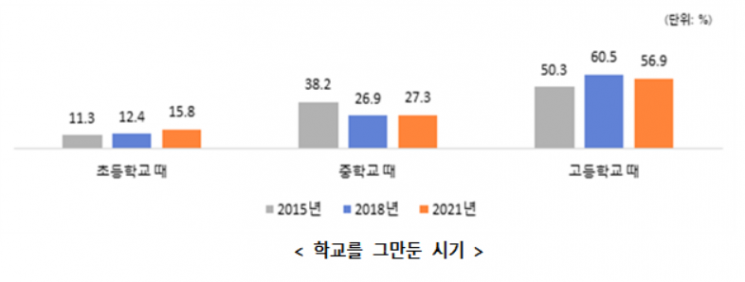
The timing when out-of-school youth drop out is most frequently during high school (56.9%), followed by middle school (27.3%) and elementary school (15.8%). Compared to the survey three years ago, the proportion dropping out during high school decreased by 3.6 percentage points, while those dropping out during middle school increased by 0.4 percentage points, and during elementary school increased by 3.4 percentage points.
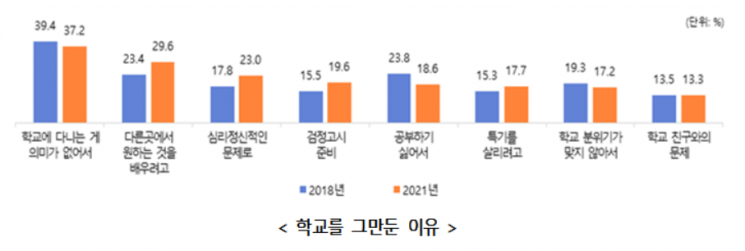
Among the reasons for dropping out, the most common were "attending school felt meaningless" (37.2%), "to learn what they wanted elsewhere" (29.6%), and "psychological or mental health issues" (23.0%). The proportion of students dropping out to learn something else increased by 6.2 percentage points compared to three years ago, while those dropping out due to school atmosphere or problems with friends slightly decreased.
For elementary and middle school age groups, the highest reason for dropping out was "to learn what they wanted elsewhere." For high school age groups, the most common response was "attending school felt meaningless."
8 out of 10 Prepare for the Qualification Exam
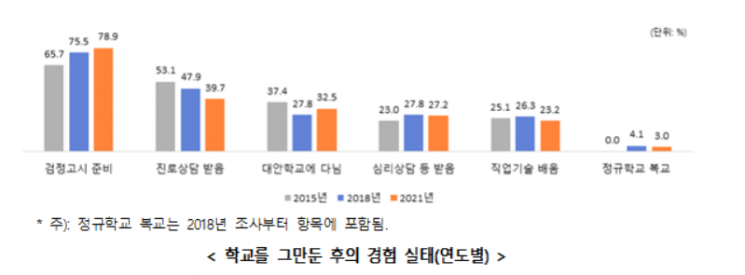
About 8 out of 10 youth prepare for the qualification exam after dropping out. The rate of preparing for the qualification exam increased from 65.7% in 2015 to 78.9% last year.
Among youth who dropped out, 58.3% planned to prepare for the qualification exam at the time of dropping out. Next were preparing for university admission (22.7%), enrolling in alternative schools (22.4%), and part-time work or jobs (22.1%).
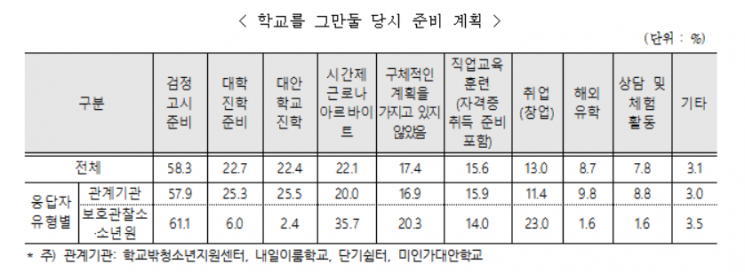
Among youth using out-of-school youth support centers or Naeil Irum schools, a higher proportion had academic plans such as enrolling in alternative schools (25.5%) or preparing for university admission (25.3%). In contrast, youth in probation centers or juvenile detention centers had higher rates of planning economic activities such as part-time jobs (35.7%) or employment/entrepreneurship (23.0%).
The proportion of youth who perceived receiving emotional and financial support from their parents when dropping out increased. The score for parental support, on a 4-point scale, was 3.08, 0.21 points higher than in 2018 (2.87). Perceptions of neglect and abuse decreased compared to 2018 (abuse 1.91, neglect 1.58), with abuse perception at 1.72 and neglect at 1.40.
Increase in Youth Who "Do Not Regret Dropping Out"
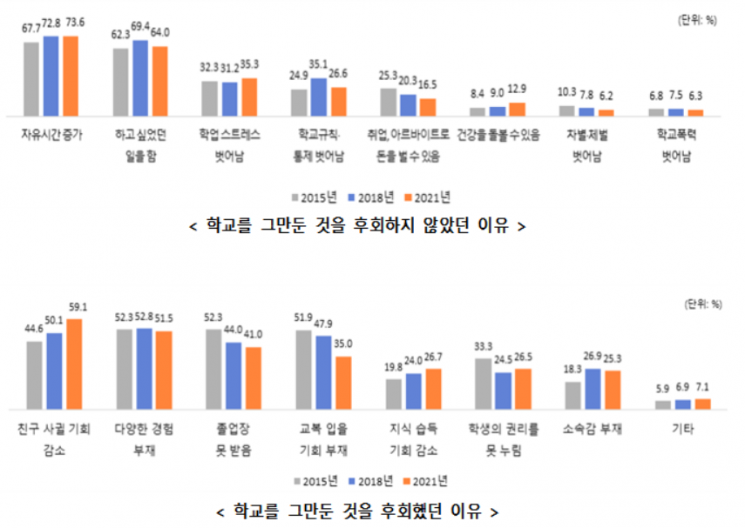
The number of youth who do not regret dropping out is increasing. More respondents said they never regretted dropping out (58.1%) than those who had regrets (41.4%). The proportion of those who did not regret increased from 42.8% in 2015 to 58.1% in 2021.
They expressed satisfaction due to increased free time (73.6%), being able to do what they wanted (64.0%), relief from academic stress (35.3%), and freedom from school rules and control (26.6%). Reasons for regret included fewer opportunities to make friends (59.1%), lack of diverse experiences (51.5%), and not receiving a diploma (41.0%).
Three out of ten out-of-school youth said they would have dropped out regardless of any support. Other out-of-school youth responded that if there had been classes to develop their talents (36.7%), support services to learn or connect them with what they wanted (27.2%), or career exploration and experience opportunities (24.9%), they would not have dropped out.
Female youth were more likely than male youth to say they would not have dropped out if there had been a school culture free from bullying and school violence (19.4%), skills to make and maintain friendships (21.9%), and effective psychological and emotional support (18.2%). Male youth cited a school culture free from school violence at 9.5% and psychological and emotional support at 8.4%, about half the female rates.
1 in 4 Out-of-School Youth Live "Outside the Home"
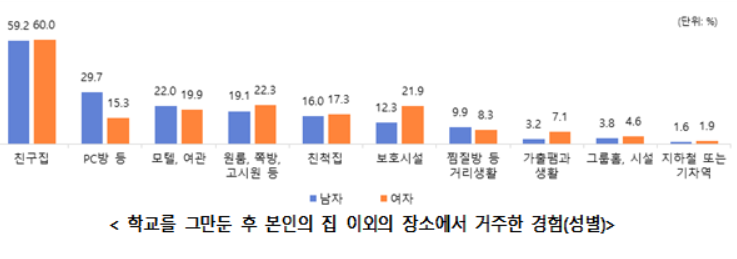
After dropping out, 1 in 4 youth had experiences living outside the home, such as at friends' houses, PC rooms, lodging facilities, or protective facilities. This proportion has been steadily decreasing. Among male youth, 3 out of 10, and among female youth, 2 out of 10, have lived outside the home. Male youth were more likely to live in PC rooms (29.7%), while female youth were more likely to live in protective facilities (21.9%).
Regarding difficulties faced after dropping out, the most common were prejudice, bias, and disregard (26.1%) and difficulty finding a career path (24.2%), though these rates are gradually decreasing. The proportion reporting no difficulties increased by 10.8 percentage points from 25.8% in 2015 to 36.6%.
Disadvantages experienced after dropping out included paying higher fees due to lack of student ID when boarding buses or entering amusement parks (17.3%), restrictions on participating in contests (9.1%), disadvantages in university admission (7.2%), and employment restrictions (4.7%). The rate of experiencing disadvantages is decreasing.
31.8% of out-of-school youth experienced unfair treatment during part-time work. The most common issues were overtime work (24.7%), unpaid wages (17.1%), unpaid overtime pay (16.7%), verbal abuse and humiliation (15.0%), and tasks different from the contract (10.2%).
Expansion of Information Linkage for Dropout Students to Include 'High School Students'
The policies most desired by out-of-school youth were health checkups (79.3%), provision of admission information (78.4%), support for qualification exam preparation (78.2%), and career exploration experiences (77.3%). Particularly, support for transportation costs to use Dream Center services (84.0%) was the highest response, reflecting the burden of public transportation use when visiting support centers established one per city or county.
Based on this survey, the Ministry of Gender Equality and Family plans to strengthen the support system for out-of-school youth. The scope of students whose information can be linked to support centers without prior consent will be expanded to include high school students. They will also promote the establishment of an information transmission system for dropout students linked with the Ministry of Education's 4th generation NEIS system.
The ministry will increase staff at out-of-school youth support centers and develop online learning programs and content for younger youth. To strengthen tailored support for youth undecided about their career paths, they will develop career motivation enhancement programs for middle and high school age groups, expand vocational competency programs, and strengthen rights education for working youth.
Kim Kwon-young, Director of Youth Policy at the Ministry of Gender Equality and Family, said, "It is positive that social perceptions of out-of-school youth are gradually improving through this survey. We will strengthen customized support reflecting the needs of out-of-school youth so that they can seriously explore and systematically plan their studies and careers even outside of school."
© The Asia Business Daily(www.asiae.co.kr). All rights reserved.
![Clutching a Stolen Dior Bag, Saying "I Hate Being Poor but Real"... The Grotesque Con of a "Human Knockoff" [Slate]](https://cwcontent.asiae.co.kr/asiaresize/183/2026021902243444107_1771435474.jpg)

















