Separate quarantine by province keeps return home impossible for nearly a year
Stricter quarantine extends customs clearance time and hinders local hiring
Parts supply cut off causing snowballing damage
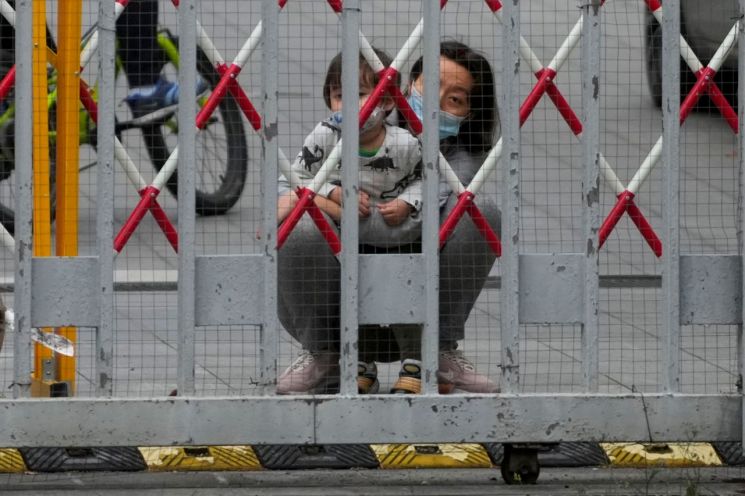 A resident looking out from behind a barricade in a residential area under COVID-19 lockdown in Shanghai, China.
 [Photo by Yonhap News]
[Asia Economy Reporters Kim Jong-hwa, Choi Dong-hyun, Kwak Min-jae] Neither people nor parts have a clear timeline. Employees sent on business trips to China cannot return, and parts ordered from China are unable to depart from the ports.
To prevent the spread of COVID-19, China locked down Shanghai on March 28 and on April 21, major cities including Beijing, Guangzhou, Suzhou, and Fuyang were also locked down. The Shanghai lockdown has lasted 51 days as of the 17th, and the lockdown of major cities has been ongoing for 27 days. Although there are signs that some lockdown measures in China may be eased, the damage to domestic small and medium-sized enterprises (SMEs) due to the prolonged lockdown has already snowballed.
A domestic SME that supplies display equipment to Chinese display panel manufacturer BOE and others is struggling with employees’ extended stays. Display equipment requires Korean staff to complete setup locally for compatibility installation and fine-tuning optimization with other equipment. The problem arose when China locked down major cities like Shanghai to prevent COVID-19 spread. Upon entering China, a minimum 3-week quarantine is mandatory, and moving between provinces also requires a 3-week quarantine. There are no flights to major cities like Shanghai or Beijing. This company delivers products to 7-8 provinces within China. CEO Ko Jae-min (pseudonym, 45) explained, "Our employee who went on a business trip last year has been entering cities with available flights, quarantining there, then moving to other cities or provinces and quarantining again, repeatedly, while performing equipment setup. Having not returned to Korea for nearly a year, we are experiencing disruptions in workforce management domestically."
Employees in China Cannot Return, Local Hiring Also Difficult
S Company, which operates display processing equipment factories in Suzhou and Dongguan, is struggling to hire local staff. The Suzhou factory operates equipment that processes TV display panels by inch, while the Dongguan factory operates equipment that laminates and processes copper foil. While the headquarters handles technically demanding processing steps, local technicians have performed simpler processing tasks. The problem is that local recruitment has become difficult. Before the lockdown, applicants from neighboring provinces could be hired, but now recruitment is limited to the local area, resulting in filling less than half of the required workforce. CEO Seo Jin-bong (pseudonym, 53) said, "Companies that need to perform core technical processes in China are experiencing snowballing damage."
With stricter quarantine measures, customs clearance times have also increased. CEO Seo said, "During equipment delivery, quarantine procedures have become very strict, and sometimes they even request videos of the quarantine process. Customs clearance, which used to take less than an hour, now takes from 4-5 hours to several days."
Parts supply is similarly affected. SME CEOs watching their parts boxes run empty are deeply worried. Solux, a KOSDAQ-listed lighting equipment manufacturer, is concerned as its prepared parts inventory has recently run low. Production of some products is already disrupted. Solux imports bolts, nuts, and mold materials from China that are not competitively produced domestically. In some regions of China, parts supply has completely stopped. CEO Kim Bok-deok of Solux said, "If even one out of 1,000 parts is missing, the finished product cannot be made. Even we, who prepared in advance, are experiencing production disruptions for some products, and I have heard that other companies that were unprepared are in very difficult situations. Essential LED chips for lighting fixtures are 90% imported from China, but that supply has been blocked, and exports have also started facing problems." Solux imports LED chips not only from Chinese companies but also from Seoul Semiconductor, Samsung Electronics, and Cree in the U.S. After the Chinese lockdown, Solux placed additional orders with Cree, but shipments that used to arrive in about two weeks now take over three months.
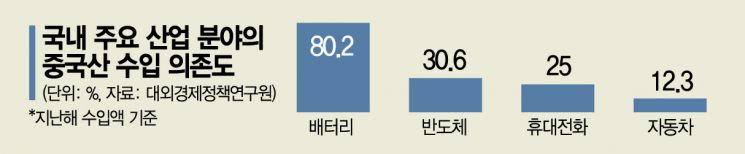
No Clear Solution... "Diversification of Core Items Needed"
Companies manufacturing kitchen appliances such as frying pans are also facing parts supply emergencies. Some parts used in producing kitchen appliances like pots are imported from China, but with Shanghai’s port and air traffic locked down, parts supply has completely stopped. Although parts prices have already been paid, parts are stuck at the port, causing delays in producing new products in the final development stages to meet scheduled release dates.
Regarding this, a Ministry of Trade, Industry and Energy official said, "Earlier this year, lockdown measures in Shandong Province caused wiring harness supply issues for automotive parts, but with active support from China’s central and local governments, the problem was resolved smoothly. Ultimately, export diversification is necessary, and we are currently preparing an amendment to the Special Act on Materials, Parts, and Equipment to diversify core items and stabilize supply chains."
Heo Jae-cheol, a senior researcher at the Korea Institute for International Economic Policy (KIEP), advised, "Diplomatic relations are fundamentally based on the principle of reciprocity. While respecting the quarantine rules the government is implementing, it is necessary to negotiate and request that China accommodate Korean companies’ convenience and provide benefits in a reciprocal manner, just as Korea treats Chinese nationals." However, Heo also noted, "Quarantine measures are a matter of sovereignty, so it is realistically difficult for the Korean government to intervene. Ultimately, the corporate issues can only be resolved when China’s zero-COVID policy is resolved."
© The Asia Business Daily(www.asiae.co.kr). All rights reserved.
![Clutching a Stolen Dior Bag, Saying "I Hate Being Poor but Real"... The Grotesque Con of a "Human Knockoff" [Slate]](https://cwcontent.asiae.co.kr/asiaresize/183/2026021902243444107_1771435474.jpg)
















