Q2 Dining-Out Market Recovery Gains Momentum... Earnings Expected to Rebound Together
[Asia Economy Reporter Eunmo Koo] CJ Freshway, Hyundai Green Food, and Shinsegae Food, three major food ingredient companies, received mixed results in the first quarter of this year. However, from the second quarter onward, as the dining-out market recovery gains momentum, major companies are expected to see profits together.
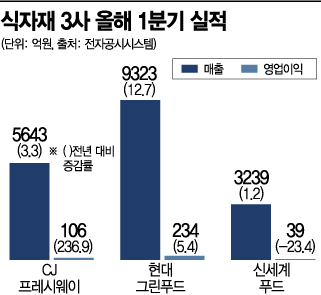
According to the distribution industry on the 13th, CJ Freshway's consolidated operating profit for the first quarter was 10.6 billion KRW, a 237.1% increase compared to the same period last year. Sales during the same period also rose by 3.3% to 564.3 billion KRW. The food ingredient distribution sector led the performance growth by significantly improving profitability, influenced by increased demand for food ingredients following the government's easing of social distancing guidelines. Additionally, subsidiaries such as Songlim Food, a sauce specialist, and J Farms, an agricultural product preprocessing company, also contributed by increasing operating profits thanks to the expansion of the home meal replacement market. In particular, proactive responses to external environmental changes such as price increases and raw material procurement were evaluated as effective.
Hyundai Green Food also succeeded in improving its performance as its core businesses normalized. Sales increased by 12.7% year-on-year to 932.3 billion KRW, and operating profit rose by 5.4% to 23.4 billion KRW. Although the number of meals served in group catering did not recover due to reasons such as continued remote work, the company benefited from price increases in meal plans by major clients. The food ingredient distribution sector also contributed to performance improvement as the business conditions of existing clients such as hospitals and distributors recovered and new orders expanded.
On the other hand, Shinsegae Food posted sales of 323.9 billion KRW, a slight increase of 1.2% compared to a year ago, but operating profit fell by 23.4% to 3.9 billion KRW, resulting in disappointing results. The spread of Omicron led to sluggish dining-out and catering food ingredient distribution, and the company could not avoid cost burden due to rising raw material prices. However, it defended its performance by closing loss-making stores in the dining-out sector and increasing Starbucks sales by more than 20%.
Although first-quarter results were somewhat mixed, from the second quarter onward, the recovery of the dining-out market is expected to lead to a simultaneous rebound in performance. Food ingredient distribution is sensitive to the dining-out market; due to COVID-19, dining-out demand was sluggish, causing a sharp decline in food ingredient orders from dining establishments, which negatively affected the performance of food ingredient companies. However, from the second quarter, with the full lifting of social distancing, food ingredient order volumes are expected to increase, raising expectations for performance growth.
According to the Korea Agro-Fisheries & Food Trade Corporation (aT), the outlook for the dining-out market index in the second quarter is 90.99, the highest figure since COVID-19. Ji-hye Jang, a researcher at DS Investment & Securities, predicted, "In the second quarter, the reopening effect will be in full swing, and with the implementation of small business support policies following the new government’s inauguration, economic recovery is expected, leading to significant performance growth for food ingredient companies."
© The Asia Business Daily(www.asiae.co.kr). All rights reserved.
![Clutching a Stolen Dior Bag, Saying "I Hate Being Poor but Real"... The Grotesque Con of a "Human Knockoff" [Slate]](https://cwcontent.asiae.co.kr/asiaresize/183/2026021902243444107_1771435474.jpg)















