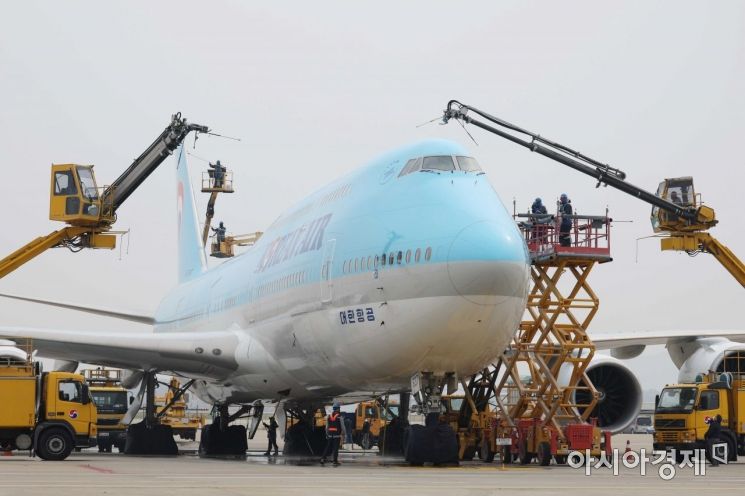
 Korean Air is making thorough preparations for customers to travel overseas again, emerging from the dark tunnel of COVID-19. On the 18th, officials were cleaning the Boeing 747-8i aircraft in celebration of spring at the Korean Air maintenance hangar in Unseo-dong, Jung-gu, Incheon. Photo by Moon Honam munonam@
[Asia Economy Reporter Choi Dae-yeol] Korean Air announced on the 4th that its operating profit for the first quarter of this year reached 788.4 billion KRW, a 533% increase compared to the same period last year.
Previously, in the fourth quarter of last year, it recorded an all-time high of 704.4 billion KRW, and it broke the record again in just one quarter. Sales amounted to 2.8052 trillion KRW, a 60% increase compared to the same period last year.
Passenger route sales for the first quarter were recorded at 359.8 billion KRW, a 128% increase compared to the same period. Although passenger demand has been sluggish due to the spread of Omicron, the company stated that demand is gradually increasing as countries around the world ease entry restrictions.
Cargo route sales for the first quarter reached 2.1486 trillion KRW. The company said, "Volatility in the air cargo market has increased due to external factors such as disruptions in global production and logistics networks, reduced supply on European routes, and the ongoing high oil prices," adding, "We are minimizing supply losses through proactive operational stabilization measures and flexible route management." They increased cargo aircraft utilization and deployed idle passenger planes on cargo routes to boost sales further.
The company expects passenger demand recovery to accelerate gradually this year. Since there may be some differences depending on routes or regions, they plan to respond flexibly according to changes in quarantine guidelines at each destination.
The company stated, "With the recovery of passenger demand, air cargo supply is also expected to increase gradually; however, due to lockdowns in major Chinese cities and the prolonged Ukraine war, instability in air cargo demand and supply by region will continue," and added, "We will respond to the expanding uncertainties in the air cargo market through fast and flexible route management and operational stabilization."
The financial structure has also improved. The debt ratio was around 814% at the end of 2019 but was reduced to 255% in the first quarter of this year. This is the lowest level since the adoption of International Financial Reporting Standards (IFRS) in 2011. As of the end of the first quarter, cash equivalents exceed 4 trillion KRW.
© The Asia Business Daily(www.asiae.co.kr). All rights reserved.
![Clutching a Stolen Dior Bag, Saying "I Hate Being Poor but Real"... The Grotesque Con of a "Human Knockoff" [Slate]](https://cwcontent.asiae.co.kr/asiaresize/183/2026021902243444107_1771435474.jpg)















