Minister of Science and ICT Candidate Lee Jong-ho
Lawmakers Also Say "Must Consider Reality"
Telecom 3 Companies' Obligation Fulfillment Rate 11%
US and Japan Also Shift to Mid-Low Frequency
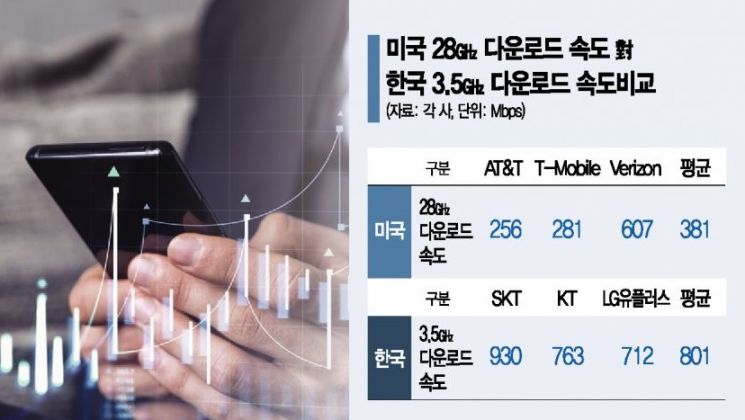
[Asia Economy Reporter Lim Hye-seon] Voices are growing to shift the 5G 28㎓ band frequency policy, which has become a "gyeruk (chicken rib)"?something of little value despite effort?toward feasible alternatives. Lee Jong-ho, the nominee for Minister of Science and ICT, and members of the Science, Technology, Information and Broadcasting and Communications Committee also share a consensus on policy transition considering market and technological realities.
28㎓ Mandatory Implementation Rate at 11.3%
According to the status of 5G mobile communication frequency deployment performance submitted by the three telecom companies, disclosed by the Ministry of Science and ICT on the 3rd, the average mandatory implementation rate for 5G 28㎓ network deployment by the three telecom companies stands at about 11.3%. LG Uplus deployed 1,868 units, SK Telecom 1,605 units, and KT 1,586 units. Compared to the mandatory deployment quantity of 15,000 units, these correspond to 12.5%, 10.7%, and 10.6%, respectively. However, in the 5G 3.5㎓ band, all three telecom companies recorded deployment performances two to three times the mandatory quantity. In the 3.5㎓ band, SK Telecom deployed the most with 77,876 base stations out of 22,500 required, followed by LG Uplus (66,367 stations) and KT (65,918 stations). Compared to the mandatory deployment quantity of 22,500 stations, these are 3.46 times, 2.95 times, and 2.93 times, respectively.
Yang Jeong-suk, a member of the Science, ICT, Broadcasting and Communications Committee, stated, "Countries like the US and Japan, which first declared commercialization of 28㎓ 5G, have shifted from ultra-high frequencies to using mid-to-low frequencies to secure 5G service speed and coverage," emphasizing, "To devise feasible and realistic alternatives, a policy transition considering market and technological realities is necessary before the frequency usage period expires next year." Minister nominee Lee also responded to a pre-hearing inquiry on the ‘28㎓ band frequency activation measures’ by saying, "The utilization of 28㎓ has not met initial expectations," and added, "We will comprehensively review technical characteristics, overseas trends, and service demand."
US and Japan Shift 28㎓ Policies
Overseas, the 28㎓ policy shift has long been underway. Verizon and AT&T, the top two US mobile carriers, commercialized broadband (28㎓ and 39㎓) 5G in April 2019 and July 2021, respectively. According to OpenSignal, a US wireless network research firm, as of September last year, the user reach rate for 28㎓ 5G was 0.5%, with AT&T (0.3%) and T-Mobile (0.3%) falling below that. Particularly, Verizon, which primarily used the 28㎓ frequency band, had an availability rate of less than 1%. The US Defense Innovation Board also proposed shifting 5G investment strategy from the 28㎓ band to mid-band in its 5G ecosystem report.
Japan’s situation is similar. According to the Digital Power City National Infrastructure Maintenance Plan announced by the Ministry of Internal Affairs and Communications last March, the 28㎓ band was excluded from the coverage target of 95% population coverage and base station number goals for 5G by the end of next year. Japanese carriers are promoting coverage expansion using the ‘DSS method,’ which allows LTE and 5G to be used together in LTE frequency bands. According to the telecommunications industry, NTT Docomo plans to operate 28㎓ services only in limited locations such as inside some of its own stores.
© The Asia Business Daily(www.asiae.co.kr). All rights reserved.
![Clutching a Stolen Dior Bag, Saying "I Hate Being Poor but Real"... The Grotesque Con of a "Human Knockoff" [Slate]](https://cwcontent.asiae.co.kr/asiaresize/183/2026021902243444107_1771435474.jpg)















