[Asia Economy reporters Seon-ae Lee and Myeong-hwan Lee] In April, as the global stock markets fluctuated wildly, both Donghak and Seohak retail investors received their worst performance reports. The market was hit hard by the Federal Reserve's (Fed) interest rate hikes amid soaring inflation, China's COVID-19 lockdowns, and the prolonged Russia-Ukraine war, causing market optimism to vanish completely and leading to a sharp decline. Compared to the market collapse, the retail investors' results were at their worst level. The returns of their top net purchase stocks were all negative. This is why it is pointed out that 'stock selection' had a greater impact. A common feature is that their top net purchase stocks are filled with 'growth stocks.' Growth stocks, which soared during the COVID-19 pandemic, suffered from valuation pressure due to inflation and rising interest rates this year. Experts warn that unless retail investors are cautious in 'stock selection,' their woes will deepen in May as well.
◆Naver and Kakao's Betrayal: 'Individuals at the Bottom'
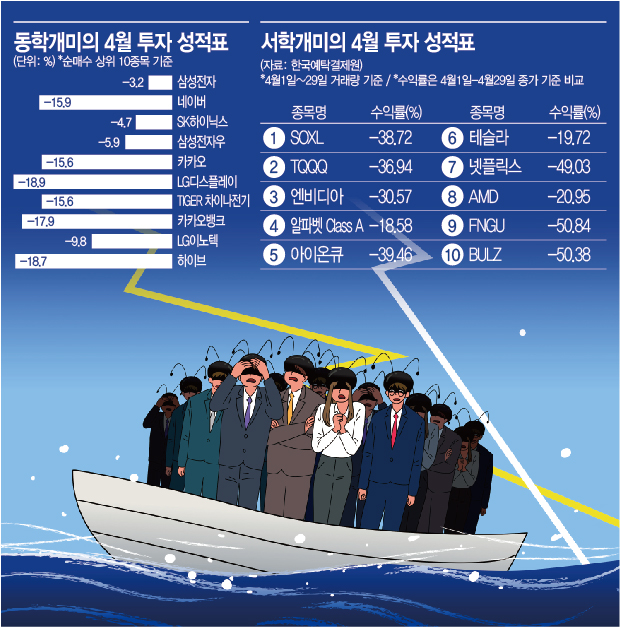
On the 3rd, Asia Economy analyzed the returns of the top 10 domestic stocks by net purchases of individuals in April, finding an average return of -12.6%. All 10 stocks recorded losses. Compared to foreigners and institutions who earned 3.3% and 3.2% respectively during the same period, this is disastrous. Experts pointed out that growth stocks were the cause of individuals' setbacks. While foreigners and institutions built portfolios focused on earnings stocks and secured profits, individuals failed by focusing on growth stocks.
Platform and content companies such as Naver (-15.9%), Kakao (-15.6%), and HYBE (-18.7%) saw their stock prices plunge, cutting returns by about 15%. Naver and Kakao's stock prices had sharply risen during the low-interest and liquidity-driven market following the COVID-19 pandemic. Last year, Naver reached an intraday high of 465,000 KRW on July 26, and Kakao hit 173,000 KRW on June 24, both marking their highest prices since listing.
However, this year, as the Fed's tightening accelerated and regulatory issues emerged, warning signs appeared in the rally. Growth stocks focus on the future rather than the present. When interest rates are low, the discount rate on future earnings is low, justifying high valuations relative to earnings. But as inflation pressures and rising interest rates globally caused valuation burdens and corrections in global growth stocks, Naver and Kakao's momentum began to falter. Their stock prices fell from 378,500 KRW at the end of last year to 286,500 KRW on the 29th of last month, a 24.31% drop. During the same period, Kakao's stock price also fell from 112,500 KRW to 89,900 KRW, a 20.09% decline.
◆"Thought It Was the Bottom" SOXL and TQQQ Plummet
The performance of Seohak retail investors in April was even more dismal. They bet on overseas markets, leaving the sluggish domestic market behind, but were hit hard by the sharp decline in growth stocks. According to the Korea Securities Depository, the average return of the top 10 overseas stocks by net purchases of individuals in April was -35.52%. All 10 stocks recorded losses; none made a profit.
The Seohak retail investors' portfolios were also composed entirely of semiconductor and technology stocks, all classified as growth stocks. Leveraged ETFs tracking three times the Philadelphia Semiconductor Index, such as 'Direxion Daily Semiconductor Bull 3X Shares (SOXL),' and ETFs tracking three times the Nasdaq index composed of top technology stocks, such as 'ProShares UltraPro QQQ (TQQQ),' plunged 38.7% and 36.9% respectively, maximizing investment losses. Leveraged ETNs tracking technology stocks, FNGU and BULZ, also shrank by 50.84% and 50.38% respectively.
Among individual stocks, Netflix fell 49.03%, halving its value. The stock sharply declined in a short period due to the so-called 'Netflix shock' caused by subscriber losses. Other growth stocks representing semiconductors and technology, such as IonQ (-39.46%), Nvidia (-30.57%), AMD (-20.95%), Tesla (-19.72%), and Alphabet (-18.58%), also fell sharply, causing losses.
◆Challenging May's Inverse Financial Market: "Careful Selection"
The stock market in May is expected to be even tougher. With no optimism at all, volatility is likely to increase. Uncertainty is expected to continue until the Federal Open Market Committee (FOMC) meeting in June.
Shin Seung-jin, a researcher at Samsung Securities, analyzed, "The global market is currently transitioning from the liquidity and earnings-driven markets of 2020-2021 to an inverse financial market in 2022," emphasizing, "Due to concerns about uncertainty in future earnings, stock price movements vary greatly by stock, and as the sustainability of earnings becomes more important, investment difficulty is increasing." He added, "At a time when concerns about earnings peak-out are widespread, stock selection must be cautious," and "Portfolios should be concentrated on companies without valuation burdens, undervalued but with potential for earnings improvement."
Han Ji-young, a researcher at Kiwoom Securities, also said, "Despite the overall market's reduced earnings improvement momentum, the earnings momentum concentrated in small-cap stocks indicates that stock-specific responses are important," emphasizing, "When looking at sectors, despite slowed earnings momentum and profitability outlook, stocks with sustained earnings momentum within semiconductors, automobiles, and raw materials sectors, where earnings momentum and operating profit margin forecasts are still improving, should be selected to prepare for volatility."
Seohak retail investors are also expected to need caution in their May investment strategies. Moon Nam-jung, a researcher at Daishin Securities, diagnosed, "U.S. technology stocks are undergoing a selection process for big tech companies that will grow in the post-COVID era, returning to pre-COVID levels based on earnings standards." However, he predicted that the decline would gradually ease. Moon forecasted, "The sharp decline in U.S. technology stocks that led the U.S. stock market drop in April will gradually ease."
Kim Il-hyeok, a researcher at KB Securities, also advised, "U.S. growth stocks have already priced in concerns about earnings not only for Q1 but also for Q2, and except for Netflix, they have the ability to defend stock prices based on shareholder return policies," adding, "After the FOMC, it could be an opportunity to increase the proportion of growth stocks."
© The Asia Business Daily(www.asiae.co.kr). All rights reserved.
![Clutching a Stolen Dior Bag, Saying "I Hate Being Poor but Real"... The Grotesque Con of a "Human Knockoff" [Slate]](https://cwcontent.asiae.co.kr/asiaresize/183/2026021902243444107_1771435474.jpg)















