Building Own Online Platform Next Year to Expand Across Seoul
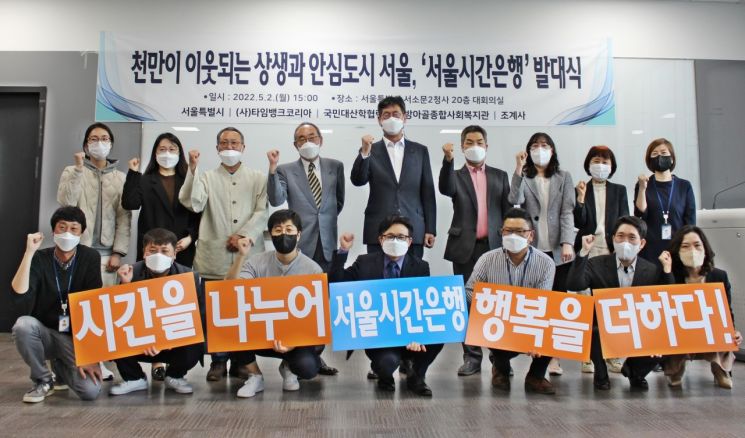
[Asia Economy Reporter Lim Cheol-young] Seoul City announced on the 3rd that it will launch a new concept of mutual aid called the ‘Seoul Time Bank,’ where individuals use their time and talents to help others in need, accumulate ‘time currency’ equivalent to the time they have spent, and use it to receive help when needed.
The Seoul Time Bank can be applied to almost all everyday exchanges of help, from simple home repairs to carpooling, sharing side dishes, and walking pets. For example, a university student who teaches elderly people how to use smartphones and accumulates time currency can later use that time currency when they need help with moving their dormitory belongings or repairing a bicycle.
Seoul City aims to develop the Seoul Time Bank, which is driven by voluntary citizen participation, into a metropolitan community model that restores social networks and complements blind spots in public welfare in response to the post-COVID era and digital transformation. Recently, as traditional families and local communities have rapidly disintegrated, more than 3 out of 10 households in Seoul (34.9%) are single-person households. According to the Seoul City Urban Policy Indicator Survey, 21.8% of Seoul citizens reported having no one to turn to in times of difficulty, reflecting a lonely society. Although the public sector has introduced various measures to prevent isolated individuals from falling into crisis, there are limits to addressing the increasing quantitative and qualitative demand for public services solely through public finances.
Seoul City will first start pilot projects at four hubs this year and plans to analyze and verify the project’s effectiveness through private specialized institutions by the end of the year. In 2023, it will launch its own online platform and expand the project citywide to enter the full-scale phase.
Before the pilot project, Seoul City derived three types and six operational models: ▲institutional resource linkage type ▲living area-based type ▲problem-solving type, and will implement them at four hubs with the concept of bank branches: ▲Kookmin University-Jeongneung ▲Bangagol Comprehensive Social Welfare Center-Banghak 2-dong ▲Time Bank House-Hong Eun-dong ▲Seoul City Hall.
At the ‘Kookmin University-Jeongneung Branch,’ students from Kookmin University and residents of the Jeongneung-dong area participate together. Students are expected to have opportunities to engage in creating social value, which they have studied theoretically, by utilizing their spare time, while local residents will gain opportunities to utilize university resources. Furthermore, this aims to promote regional revitalization through a win-win model where the school and local residents recognize themselves as an organically connected community and develop together.
The ‘Bangagol Comprehensive Social Welfare Center Branch’ plans to create a ‘generation-integrated’ and ‘virtuous cycle’ structure where all generations?including the elderly, children, youth, middle-aged, and housewives?can help each other by leveraging the space’s characteristic as a place used by all generations. Since neighborly help exchange activities were restricted due to COVID-19, this Seoul Time Bank pilot project will serve as an opportunity to actively promote community activities.
The ‘Time Bank House Branch’ is located in Hong Eun-dong, which has the highest elderly population, and will focus on ‘No-No (老老) care’ activities where elderly people care for other elderly people, enhancing their self-efficacy and expanding isolated social networks. The nonprofit organization Time Bank Korea will participate as a key partner, and the ‘Time Bank House,’ a hub space for time bank activities, will open in the Pobangteo Market in Hong Eun-dong in June.
The ‘Seoul City Hall Branch’ is based on existing trust relationships among colleagues at the same workplace and expects high demand for childcare support activities that help balance work and parenting. Activities can range from carpooling for daycare drop-offs and pick-ups, weekend childcare mutual aid, to everyday help such as carpooling, one-on-one mentoring, sharing work know-how, and lending items.
Seoul City plans to analyze and verify the pilot project’s effectiveness through private specialized institutions by the second half of this year and expand the ‘Seoul Time Bank’ project to all regions and sectors by 2023. To this end, it will also launch a dedicated online platform that ensures public trust while offering convenience similar to private trading apps like Danggeun Market.
Meanwhile, on the 2nd, Seoul City signed a memorandum of understanding (MOU) for win-win cooperation with major institutions participating in the pilot project and held a kickoff ceremony for successful project implementation. Lee Won-mok, Director of the Seoul City Citizen Cooperation Bureau, said, “It is time to establish a new form of community model to alleviate individual isolation and loneliness and to maintain the sustainability of modern metropolitan cities. We will work with various citizens to ensure that the Seoul Time Bank becomes the foundation of a voluntary and reciprocal win-win city Seoul through expanded participation and restored trust.”
© The Asia Business Daily(www.asiae.co.kr). All rights reserved.
![Clutching a Stolen Dior Bag, Saying "I Hate Being Poor but Real"... The Grotesque Con of a "Human Knockoff" [Slate]](https://cwcontent.asiae.co.kr/asiaresize/183/2026021902243444107_1771435474.jpg)















