Woori Financial Research Institute's Report on 'Hyper-Personalized Banking by Global Banks'
15% Revenue Increase, 30% Cost Reduction
Ability to Cancel Unused Services in Bank Apps
Introducing Death Tech for Financial Inquiry Upon Family Member's Death
Monthly Credit Score Improvement Notifications
Card Discount Benefit Texts Wherever You Go
 Source: Woori Financial Research Institute, "Cases and Implications of Hyper-Personalized Banking by Global Banks" Report
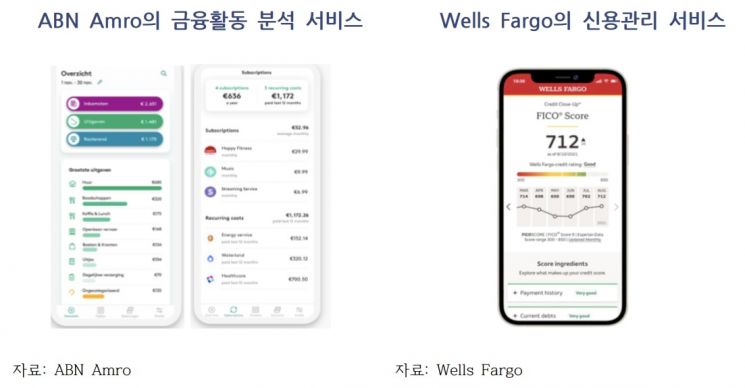
[Asia Economy Reporter Sim Nayoung] The Dutch bank ABN AMRO organizes subscription service lists and amounts, such as Netflix and YouTube, by month, quarter, and scheduled payment amounts. Customers can view them at a glance and immediately cancel services they rarely use through the bank application (app). This is not the only service available in the bank app. In the event of a family member's death, they also introduced Death Tech, which allows users to identify financial products subscribed to during their lifetime and recent payment details all at once.
How far have global bank apps evolved?
Global banks' MyData services are evolving. MyData refers to collecting scattered personal financial information in one place, analyzing it, and supporting services such as asset management. The report "Cases and Implications of Hyper-Personalized Banking by Global Banks," released by Woori Financial Research Institute on the 27th, cited consulting firm McKinsey's analysis that "the effect of expanding bank profits through hyper-personalized banking is 5-15%, and marketing cost reduction effects reach 10-30%," and stated, "Domestic banks, which took their first step into MyData in January this year, still remain at the level of recommending financial products and need to evolve toward analyzing data, predicting, and managing customers."
The U.S. bank Wells Fargo's representative platform is the "Smart Credit Center," which focuses solely on debt management. It is characterized by managing credit scores, which have the greatest impact on loan applications. It provides monthly personal financial activity data linked to credit score improvement plans and shows monthly grade chart graphs. It also suggests optimal choices customers can take, such as interest rate reductions, early repayment, term extensions, and refinancing loans.
There is also an example of applying Netflix's characteristic "subscription" to banking services. Bank of Ireland switched from charging fees for transfers or account maintenance to a subscription model, collecting monthly fees. For customers who want to subscribe to a "Rainy Day Fund" to prepare for crisis situations like unemployment, the app provides services that derive and display monthly essential living expenses, savable amounts, and expected fund preparation periods.
The path domestic banks starting MyData must take
They also recommend appropriate card benefits wherever customers go. The U.S. bank Capital One partnered with fintech Foursquare to send messages informing customers of credit card discounts or coupons available at stores near cafes or restaurants when their location is detected. The NOMI (know me) service, which allows customers to see scheduled weekly expenses such as apartment management fees, insurance premiums, real estate loan repayments, and communication charges at a glance, was introduced by Canada's Royal Bank of Canada (RBC) and has established itself with a customer churn rate of about 1%.
Domestic banks currently operate MyData services that organize assets, consumption, and expenditures by category and suggest investment plans to achieve customer-set goals such as car purchases or travel, but the report points out that there is still a long way to go. The report emphasized, "There is still a lack in global banks' financial behavior prediction and real-time recommendations," and "Focus should be on launching services that predict and respond to customers' future financial behaviors."
© The Asia Business Daily(www.asiae.co.kr). All rights reserved.
![Clutching a Stolen Dior Bag, Saying "I Hate Being Poor but Real"... The Grotesque Con of a "Human Knockoff" [Slate]](https://cwcontent.asiae.co.kr/asiaresize/183/2026021902243444107_1771435474.jpg)















