Gyeongnam Office of Education Holds Korean Language Proper Usage Committee Meeting
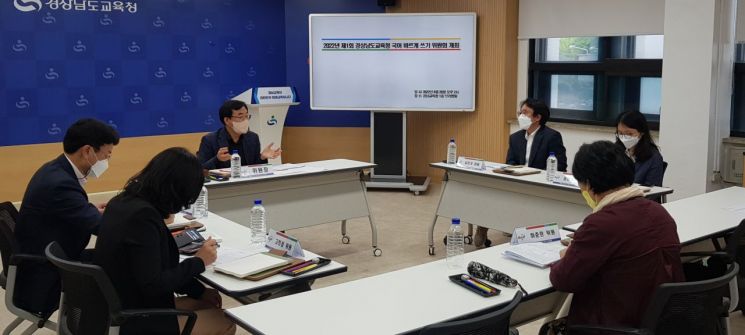 The Gyeongnam Office of Education's Korean Language Correct Usage Committee proposed replacing about 10 administrative terms with more refined expressions.
[Asia Economy Yeongnam Reporting Headquarters Reporter Lee Seryeong] On the afternoon of the 26th, the Korean Language Proper Usage Committee of the Gyeongnam Office of Education proposed changing about 10 administrative terms, including Japanese loanwords, difficult Chinese characters, and English, into refined words at the briefing room on the first floor of the main office.
Refined words are those that have been simplified from excessively difficult or non-standard words, foreign words, etc., into easy-to-understand and standardized forms or native Korean words.
Before the committee meeting, the Gyeongnam Office of Education collected administrative terms and project names that needed improvement from each department of the main office, and on this day, encouraged the use of easy and proper public language by refining difficult administrative terms.
They suggested changing difficult and clich?d Chinese character expressions such as ‘manjeon (萬全) eul gihada’ (to make every possible effort) to ‘do one’s best’ or ‘examine thoroughly,’ and ‘ganju (看做) hada’ (to consider) to ‘see’ or ‘regard as.’
The term ‘consulting,’ which means experts in a certain field providing detailed advice and assistance to clients, was recommended to be expressed as ‘advice,’ ‘consultation,’ or ‘counsel.’ ‘Seondo (先導)’ was suggested to be replaced with ‘leading,’ and ‘inryeok-pool (人力-pool)’ with ‘human resource network’ or ‘collection of manpower,’ recommending native Korean expressions.
The term ‘jori-gyo (校),’ meaning a school equipped with cooking facilities, was decided to be refined to ‘cooking meal service school,’ since ‘gyo (校)’ is not registered as a noun or suffix and is considered a Korean spelling error.
The ‘yellow carpet,’ installed to prevent children’s traffic accidents, and ‘maker education,’ an educational program where participants realize their ideas and share knowledge through making, will be explained in an easy-to-understand way for local residents.
The Office of Education plans to share the results of the refined administrative terms selection and actively utilize them in official document writing.
In June last year, the Gyeongnam Office of Education fully revised the Gyeongsangnam-do Office of Education Korean Proper Usage Ordinance, and in August of the same year, signed a research service contract with the Gyeongsang National University Korean Language Culture Center to conduct a survey on the status of public language use in the Gyeongsangnam-do Office of Education.
They appointed nine members to the Korean Language Proper Usage Committee and hired a Korean language expert earlier this year to strengthen roles such as proofreading official documents.
At the committee’s first meeting this year, they reviewed refined administrative terms, announced the 2021?2025 Korean Proper Usage Promotion Plan, the 2022 detailed Korean Proper Usage Plan of the Gyeongsangnam-do Office of Education, and provided advice on key matters.
This year, they plan to ▲ provide error guidance and sentence revision by official document type ▲ additionally designate Korean language officers and assign Korean language personnel by department ▲ conduct on-site public language workplace education for faculty and staff ▲ develop easy and proper official document guidelines, tentatively named the Palm-sized Official Document Writing Method, among other initiatives.
© The Asia Business Daily(www.asiae.co.kr). All rights reserved.
![Clutching a Stolen Dior Bag, Saying "I Hate Being Poor but Real"... The Grotesque Con of a "Human Knockoff" [Slate]](https://cwcontent.asiae.co.kr/asiaresize/183/2026021902243444107_1771435474.jpg)
















