Recommendation for Appropriate Scaling of Universities with Low Retention Rates Next Year
Consulting for Universities Below 50% in 수도권 and 30% in Non-수도권
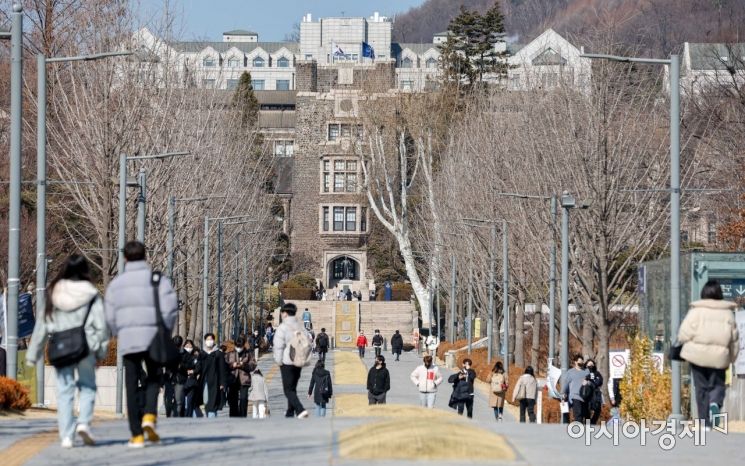 On the 2nd, students who started the new semester at Yonsei University in Seodaemun-gu, Seoul, are moving forward./Photo by Jinhyung Kang aymsdream@
The deadline for universities to submit their student enrollment rates to the Ministry of Education is just over a month away.
According to the Ministry of Education and various universities on the 25th, the Ministry has required universities participating in the University Innovation Project to submit their target maintenance enrollment rates by the 20th of next month. The Ministry's own investigation revealed that less than 70% of the participating universities intend to submit their target maintenance enrollment rates.
The maintenance enrollment rate refers to the enrollment rate of new and continuing students that universities must maintain at a certain level to receive financial support. It is calculated by multiplying the average new student enrollment rates of the evaluation year and the previous year by 0.6, and adding it to the product of the average continuing student enrollment rates of the evaluation year and the previous year multiplied by 0.4. Based on the target maintenance enrollment rates and the results of the autonomous innovation performance evaluation, 100 billion KRW will be provided this year to 153 general universities selected in last year's University Basic Competency Diagnosis Project, and 40 billion KRW to 104 vocational colleges.
The timing for recommending appropriate scaling based on the targets submitted by universities will begin next year. In October, the Ministry of Education will conduct consultations for universities with low maintenance enrollment rates based on the targets submitted. The consultation scope will be limited to universities that request it: for metropolitan area universities, those in the bottom 50%, and for non-metropolitan universities, those below 30%. Since the Moon Jae-in administration, the Ministry has encouraged universities to autonomously adjust their enrollment quotas. This is because, with the declining school-age population, if the current university admission quota of about 470,000 is maintained, a shortage of over 100,000 students is expected by 2024.
There are concerns that non-metropolitan universities will have higher enrollment rate targets compared to metropolitan universities, which face relatively fewer difficulties in enrollment. A Ministry of Education official explained, "Metropolitan universities face relatively less risk of enrollment crises, so even if it is difficult to promote appropriate scaling, it must be proactively pursued," adding, "For metropolitan universities, where it is difficult to reduce quotas significantly, the consultation scope has been broadly set at 50%."
The Ministry of Education has also decided to reflect the actual enrollment quota reductions applied from this year in the appropriate scaling plans. Recently, Hankuk University of Foreign Studies (HUFS) faced internal conflicts while promoting structural reorganization by merging similar and overlapping departments. HUFS announced a revision of academic regulations to integrate four departments of the College of Interpretation and Translation and four departments of the College of International and Area Studies at the Yongin Global Campus into the Seoul Campus, with a review scheduled for May 4th. After restructuring, the university plans to establish the Global Liberal Arts Department (Humanities) and the Global Liberal Arts Department (Natural Sciences), selecting 210 students out of the existing department admission quota of 331, and distributing the remaining 121 students approximately 10% each among 26 departments.
HUFS explained, "The core purpose is to actively respond to changes in the educational environment in preparation for the declining school-age population and the Fourth Industrial Revolution era, resolve similarities among foreign language-related departments, and establish advanced departments to secure future competitiveness."
By utilizing the deficit in enrollment to establish advanced departments, a separate correction formula is applied when calculating the continuing student enrollment rate, allowing the university to achieve effects similar to reducing quotas without significantly lowering them.
A Ministry of Education official stated, "The establishment of advanced departments is encouraged in various Ministry projects, so a separate correction formula is applied," and added, "While it is difficult to conclude that HUFS's restructuring is solely due to this project, department mergers and consolidations could positively affect maintenance enrollment rates."
© The Asia Business Daily(www.asiae.co.kr). All rights reserved.
![Clutching a Stolen Dior Bag, Saying "I Hate Being Poor but Real"... The Grotesque Con of a "Human Knockoff" [Slate]](https://cwcontent.asiae.co.kr/asiaresize/183/2026021902243444107_1771435474.jpg)















