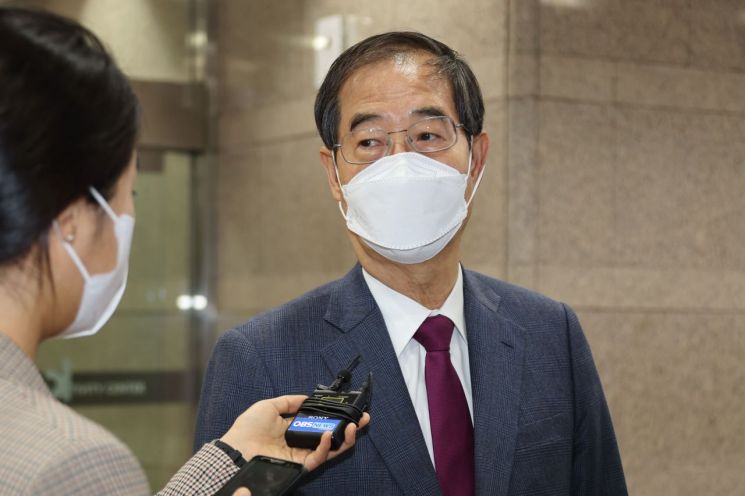
[Asia Economy Reporter Jin-ho Kim] Han Duck-soo, the nominee for Prime Minister, said on the 23rd, "There may be side effects of price instability when redevelopment and reconstruction regulations are eased."
In a written response submitted to the National Assembly's Personnel Hearing Special Committee, including Democratic Party lawmaker Kim Hoe-jae, Han stated, "It is necessary to normalize real estate regulations to restore the market functions damaged by excessive regulation-centered policies so far and to achieve fundamental market stability," while emphasizing the need for a cautious and systematic approach.
Regarding the 'Lease 3 Acts,' Han said, "The system was established with good intentions to protect the housing rights of tenants, who are vulnerable in housing, but I understand that some side effects have occurred in the process of applying the system to the actual market, contrary to the original intent. Since the lease system is directly related to people's lives and has a significant impact on the market, a cautious approach is necessary."
He added, "It is necessary to comprehensively consider market conditions and expert opinions and review improvement measures from multiple perspectives."
On property holding taxes such as the comprehensive real estate holding tax, he responded, "The tax burden on actual buyers is rapidly increasing, so there is a need for improvement." He also said, "If appointed as Prime Minister, I will prepare a reasonable real estate tax reform plan through in-depth discussions with related ministries to ensure that the comprehensive real estate holding tax is operated according to tax principles such as tax capacity and equity."
Regarding capital gains tax on housing, he said, "Currently, the housing capital gains tax causes market distortion by suppressing transactions due to excessive tax burdens such as heavy taxation on multiple homeowners, so improvement is needed."
When asked about the necessity to expand the application of the 'Price Ceiling System' nationwide and without distinction between private and public sectors, Han replied, "The scope of application of the price ceiling system should be reviewed according to market conditions, housing supply trends, and supply-demand situations."
Regarding the Moon Jae-in administration's real estate policy, he pointed out, "Excessive strengthening of regulations to suppress speculative demand and delayed promotion of housing supply expansion caused rapid house price increases, increased tax burdens, and asset polarization." In particular, he diagnosed, "The recent surge in house prices is the result of a complex combination of excessive regulation to manage demand leading to transaction shrinkage, delayed supply expansion, and abundant liquidity due to low interest rates."
On household debt management during the interest rate hike period, Han said, "We will encourage borrowing only as much as loans can be repaid through measures such as the Debt Service Ratio (DSR) and improve the soundness of household debt firmly through practices such as fixed-rate installment repayments."
Regarding the new Governor of the Bank of Korea, Lee Chang-yong, stating the need to continue loan regulations such as Loan-to-Value (LTV) and DSR, Han responded, "While normalizing excessive loan regulations implemented during the real estate price surge, I think a careful and gradual approach is necessary so that the normalization of loan regulations does not become another source of instability in the real estate market."
© The Asia Business Daily(www.asiae.co.kr). All rights reserved.
![Clutching a Stolen Dior Bag, Saying "I Hate Being Poor but Real"... The Grotesque Con of a "Human Knockoff" [Slate]](https://cwcontent.asiae.co.kr/asiaresize/183/2026021902243444107_1771435474.jpg)















