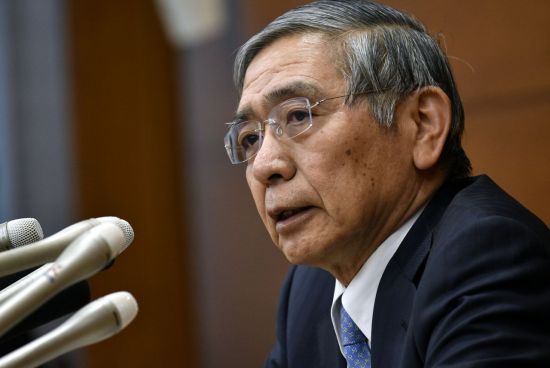
 Haruhiko Kuroda, Governor of the Bank of Japan
 Photo by Yonhap News
[Asia Economy Reporter Byunghee Park] Haruhiko Kuroda, Governor of the Bank of Japan (BOJ), the central bank of Japan, appeared before the parliament on the 18th (local time) and mentioned the negative impact of the recent yen depreciation, stating that it could disrupt corporate business plans, according to major foreign media reports on the same day. This marks a notable shift from his previous stance that yen depreciation was overall beneficial to the Japanese economy.
Governor Kuroda appeared before the House of Representatives’ Budget Committee and pointed out that the yen exchange rate, which was 115-116 yen per dollar just a month ago, recently dropped to 125-126 yen per dollar, indicating a level of volatility that could harm companies. He said, "The yen has fallen about 10 yen per dollar in just one month," adding, "The increased exchange rate volatility may make it difficult for companies to formulate business plans." He further stated, "In this regard, it is necessary to carefully examine the negative effects of yen depreciation."
Previously, Governor Kuroda had said that yen depreciation was generally beneficial to the Japanese economy.
In contrast to Governor Kuroda, Japanese Finance Minister Shunichi Suzuki said last week that the recent yen decline might not be good for the Japanese economy. At the parliament on the same day, Finance Minister Suzuki said, "Yen depreciation is undesirable in the current situation where companies have not yet sufficiently raised prices or wages," and added, "Yen depreciation is not good at this time." When asked whether the government is prepared to intervene in the market regarding yen depreciation, Finance Minister Suzuki declined to answer.
Takashi Minami, Chief Economist at Norinchukin Research Institute, said, "Governor Kuroda may have adjusted his stance closer to that of the Finance Minister to avoid giving the market the impression that the Finance Minister and the central bank governor have differing views on yen depreciation." Economist Minami added, "I do not expect the BOJ to intervene in the foreign exchange market," noting, "Market intervention is beyond the BOJ’s mandate."
While acknowledging the negative effects of yen depreciation, Governor Kuroda maintained his view that yen depreciation is overall beneficial to the Japanese economy because it increases the value of profits earned by Japanese companies overseas. He also emphasized that the BOJ must continue large-scale stimulus measures to support the fragile economy.
On the day, the yen slightly weakened against the dollar, trading at 126.25 yen per dollar. Unlike the BOJ, the U.S. central bank, the Federal Reserve (Fed), shifted its monetary policy to tightening last month by raising the benchmark interest rate for the first time in over three years. This divergence in monetary policy directions has caused yen depreciation and dollar strength. The yen depreciation is causing Japan’s current account deficit, which in turn is deepening the yen’s weakness. Japan’s current account has been in deficit since December last year.
The market expects the yen’s value to fall to 130 yen per dollar soon. Bloomberg reported, citing data from the U.S. Commodity Futures Trading Commission (CFTC), that asset managers’ yen selling reached a record high last week.
The yen’s value against the dollar has fallen about 9% this year, marking the largest decline among the currencies of the top 10 countries.
© The Asia Business Daily(www.asiae.co.kr). All rights reserved.
![Clutching a Stolen Dior Bag, Saying "I Hate Being Poor but Real"... The Grotesque Con of a "Human Knockoff" [Slate]](https://cwcontent.asiae.co.kr/asiaresize/183/2026021902243444107_1771435474.jpg)














