Comparison of Savings Bank Loan Interest Rates by Channel
Branch Credit Loans at 12.8%, Non-face-to-face at 14.7%
Other Secured Loans Sometimes 11%P Cheaper at Branch
Using Non-face-to-face Recklessly Raises Interest Burden Sharply
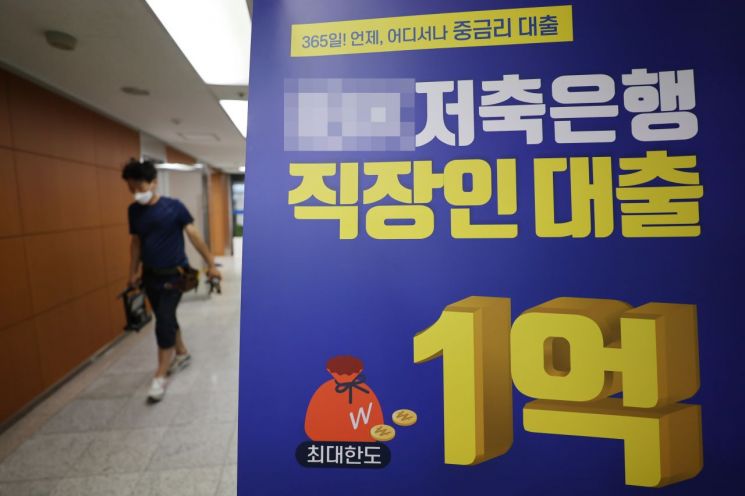
It has been revealed that the secondary financial sector set loan interest rates at physical branches up to 11 percentage points lower than those via mobile channels. This statistic contradicts the common belief that non-face-to-face financial products usually have lower interest rates. As loan interest rates across all financial sectors are rising due to the base rate hike trend, experts advise consumers to carefully compare interest rates rather than blindly opting for non-face-to-face financial products.
On the 18th, an analysis of new loans executed last month by savings banks by channel showed that loans through branches had the lowest average interest rates. Household credit loans were issued at an average interest rate of 12.8% at branches, whereas internet and mobile loans were 14.7%, which is 1.9 percentage points higher. Similarly, secured loans (other secured loans) had lower interest rates at branches at 4.5%, compared to 5.6% for internet and mobile channels.
This trend was more pronounced among small and medium-sized companies. Seram Savings Bank, based in the Gyeonggi region, had an internet and mobile credit loan interest rate of 17.38%, but 16.9% at branches. In contrast, the relatively larger Welcome Savings Bank had branch rates slightly higher at 15.5% compared to 15.4% for internet and mobile. For other secured loans, Yegaram Savings Bank’s rates were 5.6% (internet and mobile) and 3.6% (branch), while Korea Investment & Securities had 3.9% and 4.4%, with branch rates higher.
The company with the largest interest rate gap between internet/mobile and branch loans was Smart Savings Bank. When executing other secured loans, the internet and mobile rate was 15.5%, but only about 4.3% at branches. Simply put, the interest rate difference was 11.2 percentage points. Samho Savings Bank also showed a 10.7 percentage point difference, with 15.4% for internet/mobile and 4.7% at branches.
Convenience of 'Non-face-to-face' Loans May Increase Interest Burden
This is considered an unusual phenomenon even within the savings bank industry. Under the same conditions, mobile loans, which incur almost no costs, should be cheaper than branch loans. A savings bank official said, "A 1-2 percentage point difference in loan interest rates is quite significant," adding, "We speculate this occurs because each company faces different circumstances and the characteristics of loan products handled vary by channel."
There is an analysis that small, regionally based savings banks still engage in relational banking. Relational banking is a business model that focuses on targeting local residents where the branch is located. Large savings banks have currently built financial platforms that allow easy loans without visiting branches, leveraging their financial strength. Small-scale companies, lacking competitiveness in non-face-to-face channels, reportedly offer low-interest loans to local customers visiting branches as part of their business strategy.
There is also a claim that the activation of fintech loan comparison platforms has influenced this trend. As more financial consumers borrow through loan comparison platforms, many savings banks have partnered with fintech companies. When loans are made through other companies’ platforms, fees must be paid to fintech firms, which may have contributed to the rise in loan interest rates for consumers. Another savings bank official explained, "The fees fintech companies charge for using loan comparison platforms vary widely," adding, "They are gradually becoming more expensive, and this burden could be passed on to consumers."
The channel with the highest average interest rate for household credit loans was loan solicitors, at 15.4%, even more expensive than phone loans at 14.3%. The highest interest rate across all savings banks, 19.4%, was also from Dongwon Jeil Savings Bank through solicitors. For other secured loans, phone loans accounted for 10.5%, though solicitor loans were close at 10.3%.
This is why warnings are being issued that during a period of rapidly rising base rates and increasing interest burdens, blindly favoring convenient loan methods could lead financial consumers to bear expensive interest costs. The Bank of Korea raised the base rate from 1.25% to 1.50% on the 14th. Nevertheless, it has indicated through reports and other means that further rate hikes are possible due to inflation concerns.
© The Asia Business Daily(www.asiae.co.kr). All rights reserved.
![Clutching a Stolen Dior Bag, Saying "I Hate Being Poor but Real"... The Grotesque Con of a "Human Knockoff" [Slate]](https://cwcontent.asiae.co.kr/asiaresize/183/2026021902243444107_1771435474.jpg)















