Average Corporate Tax Burden Rate of Korean Companies 25.7%
Higher Corporate Tax Burden Rate Compared to Global Competitors
[Asia Economy Reporters Sunmi Park and Jinho Kim] Although Korean companies lag behind global competitors in sales, assets, market capitalization, and research and development (R&D) investment, their average tax burden is 10 percentage points higher, indicating a need for improvement.
On the 14th, the Federation of Korean Industries (FKI) announced that a comparison of the 2021 business performance of Korean companies in export-driven industries and their global competitors showed that in 2021, global competitors’ sales were 2.2 times those of Korean companies, and their assets were 1.3 times larger.
Excluding Samsung Electronics and LG Electronics, which are global leaders in semiconductors and home appliances, the gap widened further, with sales reaching three times and assets 1.8 times those of Korean companies. Market valuation also favored global competitors, whose market capitalization was 3.1 times that of Korean companies.
In 2021, R&D investment by global competitors was $8.4 billion, 1.4 times the Korean companies’ average of $5.8 billion. Among the surveyed items, only facility investment was higher for Korean companies, at 1.7 times that of global competitors.
While global competitors significantly outperformed Korean companies in sales, assets, and market capitalization, the corporate tax burden rate for Korean companies averaged 25.7%, which is 10 percentage points higher than the global competitors’ average of 15.7%.
Analysis shows that despite Korean representative companies in seven major export-driven industries lagging behind global competitors in sales and market capitalization, their average tax burden is 10 percentage points higher. The semiconductor sector accounts for an overwhelming share of this tax burden. Samsung Electronics and SK Hynix, the top two semiconductor companies, paid 17.2 trillion won in corporate taxes last year alone. To foster the semiconductor industry, there is growing demand for tax incentives that reduce the tax burden to encourage active facility and R&D investments.
Top Corporate Taxpayers in Korea Are Semiconductor Companies
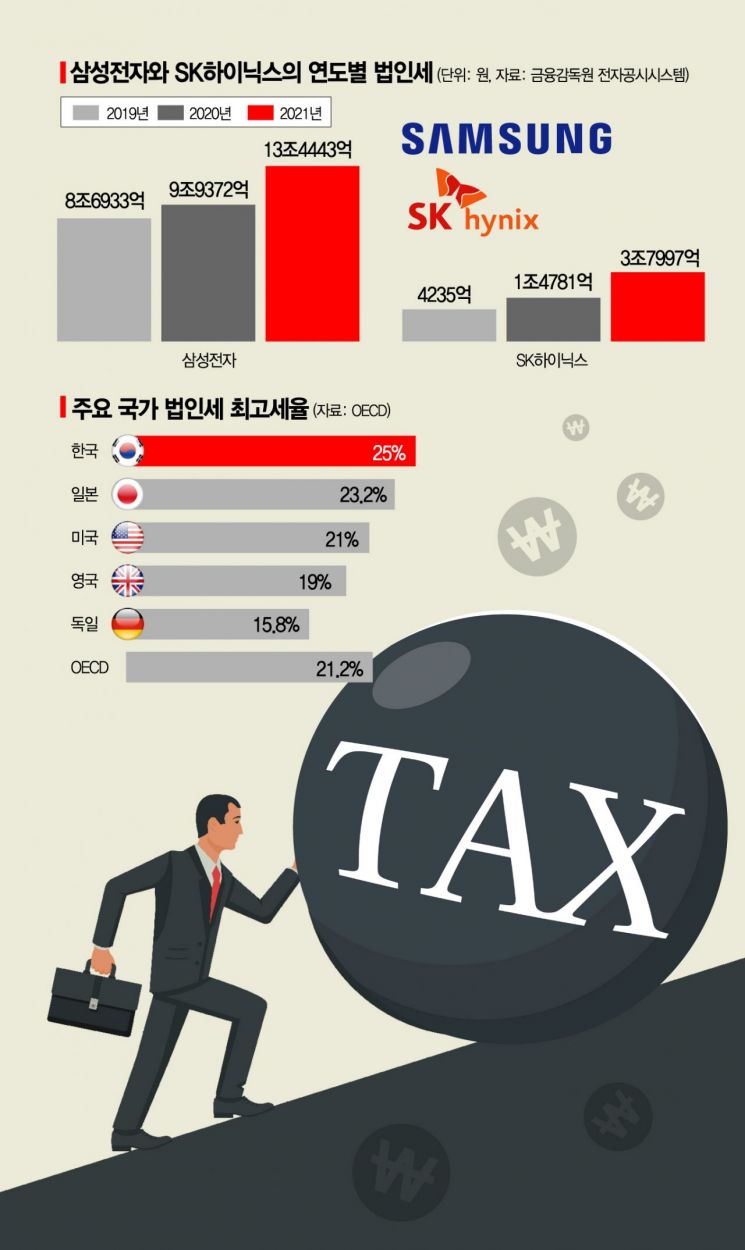
According to the Financial Supervisory Service’s electronic disclosure system, Samsung Electronics paid 13.4443 trillion won in corporate tax last year, surpassing 10 trillion won for the first time. This is over 3.5 trillion won more than the 9.9372 trillion won paid in 2020. SK Hynix also paid 3.7997 trillion won in corporate tax last year, double the 1.4781 trillion won in 2020 and nine times the 423.5 billion won in 2019. Given Korea’s large semiconductor export share, semiconductor companies have played a key role in increasing corporate tax revenues.
The tax burden on Korea’s semiconductor industry is clearly evident compared to competitors. Applying Samsung Electronics’ semiconductor division sales ratio of 33.7% and comparing it with global competitor Intel, Samsung’s corporate tax burden rate was 25.2%, while Intel’s was 8.5%, a difference of 16.7 percentage points.
High corporate tax burdens are not limited to the semiconductor sector. According to the office of Yoo Kyung-joon, a member of the People Power Party, the top 100 KOSPI companies paid 54.8613 trillion won in corporate tax last year, about 26.3 trillion won more than in 2020?roughly double. Notably, 95% of last year’s excess corporate tax revenue came from the top 10 large corporations. Samsung Electronics, SK Hynix, Hyundai Motor, POSCO, and other top 10 companies recorded an increase of 16.2797 trillion won in corporate tax expenses, totaling 32.0656 trillion won last year. The increase from the top 10 companies accounts for 95% of the government’s projected corporate tax revenue increase of 17.079 trillion won.
Concerns that Korea’s corporate tax burden is excessively high compared to the OECD average have been raised consistently for years, but progress has been slow. Korea’s top corporate tax rate is currently 25%, exceeding the OECD average of 21.2%. It is also higher than Japan (23.2%), the United States (21%), the United Kingdom (19%), and Germany (15.8%).
Other Countries Lower Tax Burdens to Foster Industry... Korea’s Discussion Still in ‘Starting’ Phase
Reducing corporate tax burdens allows companies to increase facility and R&D investments, which in turn boosts production, employment, and industrial competitiveness. The United States implemented the Tax Cuts and Jobs Act (TCJA) proposed by the Republican Party in 2017, effective from January 2018, lowering the corporate tax rate from a maximum of 35% to 21%.
The effects were immediate. During the first three years of TCJA implementation (2018?2020), an average annual tax revenue loss of $76 billion occurred due to the tax cut, but from last year, tax revenues began to surge. The corporate tax rate reduction stimulated corporate production and job creation. Last year, U.S. corporate tax revenue was $372 billion, a 25% increase from 2017, and it is projected to increase by 53% compared to 2017 by 2025. The proven effects of TCJA have benefited companies, workers, and the government alike.
The recent moves by countries worldwide to lower corporate tax rates for semiconductor companies and increase tax credit rates for semiconductor R&D and facility investments are rooted in this context. China’s State Council introduced a policy last September to exempt semiconductor companies from the 25% corporate tax for the next 10 years. The U.S. Senate has also proposed legislation to raise the tax credit rate for semiconductor facility investments to a maximum of 25%.
Korea’s semiconductor industry is demanding expanded tax benefits for facility investments if the corporate tax rate cannot be lowered immediately. Currently, the tax credit rates for semiconductor facility investments are 6% for large corporations, 8% for mid-sized companies, and 16% for small and medium-sized enterprises. Including an additional 4% credit for increased investment amounts compared to previous years, the total credit ranges from 10% to 20%. The Korea Chamber of Commerce and Industry has officially requested a significant expansion of these rates to 20% for large corporations, 25% for mid-sized companies, and 30% for small and medium-sized enterprises.
Lee Sang-ho, head of the FKI’s economic policy team, said, “Korea’s corporate tax burden rate is higher than that of competitors such as the U.S., China, and Germany, which is a major factor undermining the global competitiveness of domestic companies. Although tax revenues may decrease in the short term, in the medium term, expanded facility investments and job creation will increase added value and ultimately boost tax revenues.”
President-Elect Yoon’s Plan to Remove ‘Sandbags’... Will Reform Accelerate?
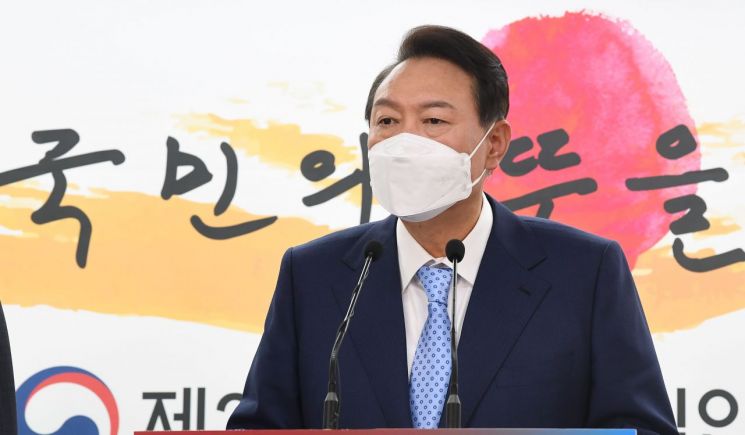
A key element of President-elect Yoon Seok-yeol’s economic policy is to “unshackle” companies. The first key to this is a corporate tax cut. This reflects the judgment that under the Moon Jae-in administration, various tax burdens caused companies to relocate overseas, resulting in serious side effects. Since President-elect Yoon is firmly committed to returning to full “market principles,” corporate tax reform is expected to accelerate.
According to political and business circles, the Presidential Transition Committee is reportedly reviewing plans to reform the corporate tax system.
In particular, the nomination of Choo Kyung-ho, a member of the People Power Party, as Deputy Prime Minister and Minister of Economy and Finance is expected to speed up corporate tax reform. Choo, who has consistently emphasized “private sector-led growth,” is regarded as a representative market-oriented figure who, like President-elect Yoon, believes in creating a business-friendly environment to drive growth.
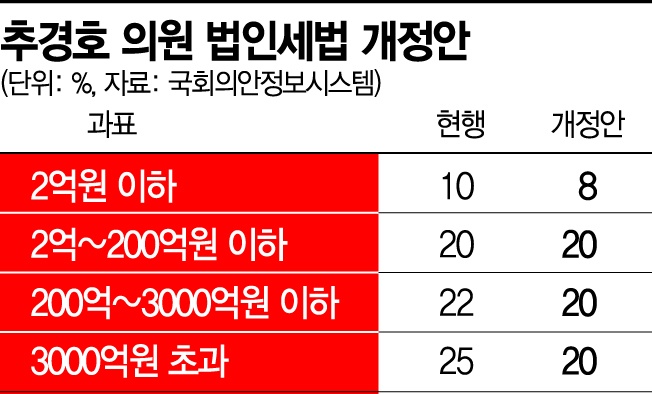
At a press conference held on the 10th after his nomination, Choo expressed strong enthusiasm for corporate tax reform, saying, “We will unshackle companies.” Previously, in 2020, he proposed a bill to simplify the current four-tier corporate tax brackets into two tiers and reduce the top rate from 25% to 20%.
The business community has long pointed out that Korea’s corporate tax rate is excessively high compared to major advanced countries, hindering corporate competitiveness, and thus holds high expectations for President-elect Yoon.
A business representative said, “It is time to consider lowering corporate taxes in line with global standards,” adding, “We hope this will be positively reviewed as a measure to boost corporate vitality.” Korea’s corporate tax rate is currently 25%, which is considerably higher than Japan (23.2%), the U.S. (21%), and the U.K. (19%).
Before the Moon Jae-in administration, Korea’s corporate tax rate had been steadily lowered to encourage investment. The top rate, which reached 28% before the 2000s, was reduced to 22% during the Lee Myung-bak administration but reversed to 25% under Moon Jae-in’s administration, influenced by calls for “increased taxation on large corporations.”
When Korea raised its corporate tax rate by 3 percentage points, the U.S. lowered its rate from 35% to 21%, a 14 percentage point drop. Major European countries such as France, the U.K., and Belgium also competed to reduce corporate taxes to create a business-friendly environment. Consequently, the market has continuously criticized Korea for going against global standards and providing an excuse for companies to leave due to “taxes.” This contrasts with the U.S., where significant corporate tax cuts have triggered a reshoring trend, bringing factories back to America.
Korea’s corporate tax brackets are also complex, with four tiers. Korea is the only country worldwide with more than four corporate tax brackets. Specifically, the brackets are: up to 200 million won (10%), 200 million to 20 billion won (20%), 20 billion to 300 billion won (22%), and over 300 billion won (25%).
Meanwhile, high corporate taxes negatively affect employment. According to the FKI’s recent report on “Hiring and Investment Trends of Foreign Companies in Korea,” six out of ten foreign-invested companies have no hiring plans this year. They cited poor investment conditions, including high corporate taxes, as the cause.
© The Asia Business Daily(www.asiae.co.kr). All rights reserved.
![Clutching a Stolen Dior Bag, Saying "I Hate Being Poor but Real"... The Grotesque Con of a "Human Knockoff" [Slate]](https://cwcontent.asiae.co.kr/asiaresize/183/2026021902243444107_1771435474.jpg)

















