Presidential Policy Planning Committee's 'National Task Council Policy Planning Series' with Over 150 Experts as 'Mammoth' Contributors
Publication of Volume 21 in the Major Policy Discourse Series: 'Moon Jae-in Government and Post-Corona, Challenges and Vision of the Era'
Comprehensive Coverage of Timely Issues Including 'Just Transition' and the Future of Democracy
[Asia Economy Reporter Oh Ju-yeon] The Presidential Policy Planning Committee announced on the 14th that it has published a total of 21 volumes of the 'National Policy Task Council Policy Planning Series,' which covers various policy discourses handled during the Moon Jae-in administration.
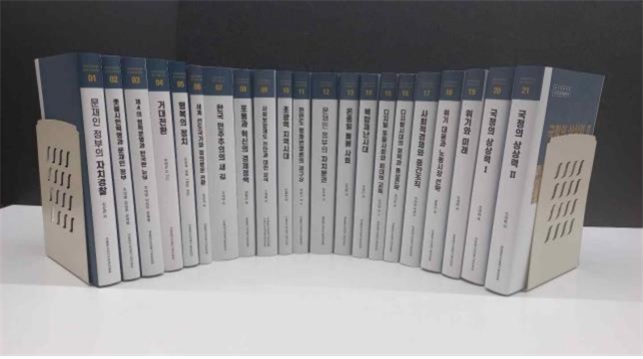
On the same day, the Policy Planning Committee held a publication ceremony at the Four Seasons Hotel in Jongno-gu, Seoul, unveiling the books that review the overall national policy tasks of the Moon administration and include content on establishing mid- to long-term national development strategies and policy directions.
Over time, the Policy Planning Committee accumulated diverse policy discourses through promoting and coordinating the 100 major national policy tasks, researching policies and current issues by national sectors, and conducting major national policy research requested by the president. The committee agreed on the importance of not letting these discussions go to waste but rather sharing them publicly by compiling them into books. Some other committees affiliated with the National Policy Task Council also joined this effort.
More than 150 participants, including Policy Planning Committee Chairman Cho Dae-yeop, committee members, and experts from various fields, took part extensively to identify the most critical issues needed in this era of great transformation and to capture the results of intense deliberations and discussions. Each volume involved between 2 to 18 authors.
The significance lies in creating a 'mountain range' of policy discourse spanning 7,389 pages across 21 volumes through collective intelligence.
Many of the volumes reflect the epochal challenges of responding to the civilizational crisis of the COVID-19 pandemic. 'Great Transformation - Social Changes in the Post-Corona Era' (Park Tae-gyun et al., 14 authors) presents a broad picture of Korean society before and after the pandemic, what the government and society must do, and just and innovative transitions.
'The Fourth Cooperative Civilization and the Korean New Deal' (Cho Dae-yeop et al., 3 authors) proposes the 'Era of Value Cooperation' as a response to crisis and anxiety, focusing intensively on the Korean New Deal as a vision and strategy for the great transformation. Additionally, 'World Leading Nation and Just Transition' (Kim Nam-guk et al., 4 authors) outlines the national policy direction Korea should take in the post-corona era. It establishes the concept of a leading nation, its conditions and tasks, and focuses on the role and strategies of social agreements for a just transition in response to climate change.
Besides broad social change discourses, in-depth analyses and recommendations on specific fields were also made. 'Era of Complex Disasters - Transition from Risk Society to Safety Society' (Choo Jang-min et al., 9 authors) comprehensively analyzes policy tasks for disaster safety, including responses to COVID-19 and public health care, climate disasters, urban safety, and industrial accidents. 'Digital Inclusive Society and Non-Face-to-Face Education' (Kim Mi-ryang et al., 4 authors) focuses on the normalized non-face-to-face education post-pandemic, identifying problems seen in schools, necessary policy support, and improvement tasks for non-face-to-face education policies.
'Diagnosis and Alternatives for Social Security Systems' (Noh Dae-myung et al., 15 authors) aimed to suggest directions for social security systems while recognizing the unequal exposure to infectious disease risks and insufficient public medical infrastructure. It addressed core issues such as income security systems, care services, Korean-style sickness benefits, and social security finances. 'All-day Care Society' (Kim Dae-hyun et al., 11 authors) particularly focused on care, examining cases from Germany and Sweden and proposing concrete methodologies for all-day care. 'Crisis Response and Labor Market Strategies' (Kwon Hyuk-jin et al., 4 authors) analyzed the labor market impacts of COVID-19, changes in household income and consumption, and discussed improvement measures for vulnerable groups’ support such as earned income tax credits and the national employment support system. It also analyzed employment retention and vocational training policies for workers responding to crises.
Characteristic changes and future tasks during the Moon Jae-in administration also form a key axis of the policy planning series. 'Candlelight Citizen Revolution and the Moon Jae-in Government' (Cho Dae-yeop et al., 3 authors) analyzed the historical significance from the candlelight protests, a major turning point in Korea’s constitutional history and democracy, through the inauguration of the Moon administration and the establishment of national policy tasks. 'A New Path for Korean Democracy - Institutionalization of Direct Democracy and Deliberation' (Cho Dae-yeop et al., 14 authors) serves as a comprehensive guidebook on the current status and new directions of Korean democracy five years after the candlelight revolution. It notably analyzes various domestic and international cases, including the US, UK, Germany, Switzerland, Finland, and Seoul’s Seodaemun-gu. 'Inclusive and Innovative Economic Policies' (Yang Jong-gon et al., 9 authors) evaluates the Moon administration’s core economic policy of income-led growth and presents the current status and development strategies in three sectors: bio, low carbon, and digital innovation economy. 'Policies and Trade Strategies in the Digital Age' (Choi Ji-eun et al., 11 authors) reviews domestic and international policies in the new environment of digital trade, proposing overseas digital leadership strategies through digital trade norms and trade preemption strategies via the metaverse. 'Social Economy and Intermediate Organizations' (Lee Jeong-hyun et al., 2 authors) emphasizes discovering new growth engines and social development models during the low-growth period, exploring concrete methods for social economy delivery and support systems. 'Autonomous Police of the Moon Jae-in Government' (Kim Soon-eun et al., 5 authors) and 'Decentralization of the Moon Jae-in Government' (Kim Soon-eun et al., 18 authors) contain groundbreaking local autonomy policy changes. They review the significance of the 'Decentralization 2.0' era, opened by the revision of the Local Autonomy Act for the first time in 32 years, along with future visions and implementation strategies.
'New Conception of Peace and Prosperity on the Korean Peninsula' (Baek Young-seo et al., 7 authors) aimed to propose a new vision for inter-Korean relations. Recognizing the importance of setting goals and visions that serve as guidelines amid increasing geopolitical uncertainties, it covered the reconstruction of the inter-Korean confederation theory, smart ecological city networks, inter-Korean confederation and East Asian cooperation, among others. Small-scale FGIs (Focus Group Interviews) were conducted with youth for research reference. 'Politics of Happiness - A Vision for the Era of Article 10 of the Constitution' (Kim Jin-wook et al., 4 authors) was based on the recognition that the pursuit of national happiness should be established as a core national policy task.
© The Asia Business Daily(www.asiae.co.kr). All rights reserved.
![Clutching a Stolen Dior Bag, Saying "I Hate Being Poor but Real"... The Grotesque Con of a "Human Knockoff" [Slate]](https://cwcontent.asiae.co.kr/asiaresize/183/2026021902243444107_1771435474.jpg)















