BoK Returns to 1.50% Annual Rate
Inflation Pressure Despite Governor Vacancy
May US Big Step Also Influences Rate Hike
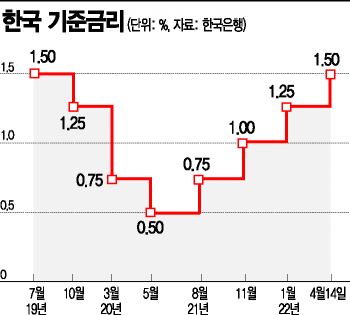
[Asia Economy Reporter Seo So-jeong] The Bank of Korea tightened its monetary tightening reins by raising the base interest rate again after three months since January, despite the governor position being vacant. As a result, the base interest rate returned to 1.50% per annum, the pre-COVID-19 level of July 2019.
The Monetary Policy Board of the Bank of Korea held a monetary policy meeting on the 14th and announced that it would raise the base interest rate by 0.25 percentage points from 1.25% to 1.50% per annum.
Previously, on March 17, 2020, anticipating an economic recession due to the COVID-19 pandemic, the Monetary Policy Board lowered the base interest rate by 0.50 percentage points at once, and through an additional cut on May 28 of the same year, reduced the rate by a total of 0.75 percentage points within two months.
After nine consecutive holds, the board signaled a 'normalization of monetary policy' by raising the rate by 0.25 percentage points on August 26 last year, the first increase in 15 months. Since then, the base interest rate has been raised four times by 0.25 percentage points each in November last year, January this year, and on this day, totaling an increase of 1.00 percentage point over about eight months.
The reason the Monetary Policy Board decided to make an additional hike abruptly despite the unprecedented situation of the governor's absence is that it judged the recent inflationary pressure to be at a level that cannot be ignored. Due to the impact of the Ukraine crisis causing a sharp rise in international oil prices, the consumer price index in March jumped 4.1% compared to the same month last year. A 4% increase rate is the first in 10 years and 3 months since December 2011 (4.2%).
The problem lies in the expectation that prices will rise further. Unless there is a major reversal in the current situation, concerns are growing that the annual consumer price inflation rate could soar to the 4% range, while the economic growth forecast could fall to the 2% range.
It is also mentioned as a factor for the base interest rate hike that the U.S. Federal Reserve may implement a 'big step' by raising rates by 0.5 percentage points at once as early as May to curb inflation.
Joo Sang-young, acting chairman of the Monetary Policy Board, said, "This year, the domestic gross domestic product (GDP) growth rate is expected to slightly underperform the February forecast (3%), and consumer prices are expected to continue a high rise in the 4% range for the time being. Since the domestic economy is expected to maintain its recovery trend and inflation is expected to exceed the target level for a considerable period, we will appropriately adjust the degree of monetary policy easing going forward."
Meanwhile, the Monetary Policy Board revised the interest rates on loans and deposits for financial institutions of the Bank of Korea on the same day, deciding to maintain the loan interest rate for the COVID-19 affected small and medium-sized enterprises and small business support program under the financial intermediation support loan at 0.25% per annum from the 2nd of next month, while raising the loan interest rate for other regular support programs from 0.25% to 0.50% per annum.
© The Asia Business Daily(www.asiae.co.kr). All rights reserved.
![Clutching a Stolen Dior Bag, Saying "I Hate Being Poor but Real"... The Grotesque Con of a "Human Knockoff" [Slate]](https://cwcontent.asiae.co.kr/asiaresize/183/2026021902243444107_1771435474.jpg)















