Won-Dollar Exchange Rate Surpasses 1,230 Won... Interest Rates Soar Consecutively Reflecting Anxiety
[Asia Economy Reporter Seo So-jeong] As the Bank of Korea's Monetary Policy Committee is scheduled to decide the base interest rate on the 14th, economic indicators such as inflation, interest rates, and exchange rates are all pointing towards an 'interest rate hike,' drawing attention. Although there is speculation that the rate hike timing might be delayed due to the absence of the Bank of Korea governor, the alarm signals from various economic indicators seem to strengthen the case for a rate increase in April.
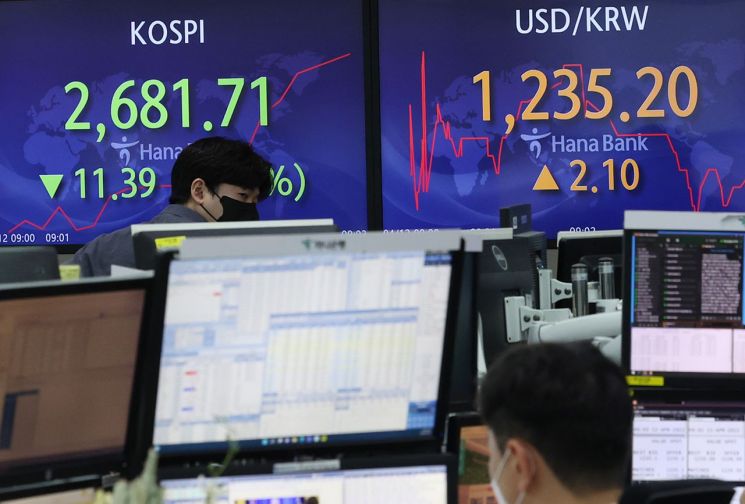
According to the market and the Bank of Korea on the 12th, the indicator recently attracting attention at the Bank of Korea ahead of the Monetary Policy Committee meeting is the won-dollar exchange rate. Ahead of the U.S. March Consumer Price Index (CPI) announcement scheduled for the afternoon in Korean time, concerns that the Federal Reserve's monetary policy normalization pace will accelerate have caused the won-dollar exchange rate to remain above 1,230 won, showing signs of instability. Additionally, expectations that the full lockdown of Shanghai might be prolonged have contributed to the dollar's strength, adding to the pressure.
Oh Chang-seop, a researcher at Hyundai Motor Securities, diagnosed, "The expectation of dollar strength is a fundamental factor driving the rise in the won-dollar exchange rate," adding, "With the continued trade deficit and foreign net selling from a supply-demand perspective, there is pressure for won depreciation." Oh further noted, "If we judge coldly, there are no factors for the exchange rate to fall, so the upward expectation remains alive. However, at the 1,200 won level, government monitoring is strengthened, and market intervention possibilities increase, making the 1,250 won level a strong resistance line."
Interest rates are also soaring daily, reflecting market anxiety. On the previous day in the Seoul bond market, the 3-year government bond yield closed at 3.186% per annum, up 19.9 basis points (1bp=0.01 percentage point) from the previous trading day, marking the highest level in 10 years. The break above 3% per annum is the first since December 12, 2013 (3.006% per annum). Amid the soaring interest rates, a Bank of Korea official said on the day, "We are closely monitoring the trend of government bond yields."
Domestic bond yields, which had been rising sharply ahead of the supplementary budget compilation, are showing an upward trend amid heightened caution ahead of the Monetary Policy Committee meeting on the 14th. The Federal Reserve's 'big step' of raising the base interest rate by 50 basis points at once, combined with the domestic consumer price index rising to the 4% range in March?the highest in over a decade?has intensified the sense of crisis that the rate hike can no longer be delayed.
Another source of concern is the further expansion of the trade deficit this month amid domestic and international instability. According to the Korea Customs Service, the trade deficit from the 1st to the 10th of this month was $3.518 billion, widening compared to the same period last year ($1.814 billion). This is due to a significant increase in imports of crude oil and gas caused by the Ukraine crisis.
Ahn Jae-gyun, a researcher at Shinhan Investment Corp., said, "As domestic inflationary pressures continue to remain high, it is highly likely that the Bank of Korea will proceed with an additional rate hike in April."
© The Asia Business Daily(www.asiae.co.kr). All rights reserved.
![Clutching a Stolen Dior Bag, Saying "I Hate Being Poor but Real"... The Grotesque Con of a "Human Knockoff" [Slate]](https://cwcontent.asiae.co.kr/asiaresize/183/2026021902243444107_1771435474.jpg)















