'Kim from Seoul' and 'Jung from Seongnam', Comparing Household Budget Prices from One Year Ago
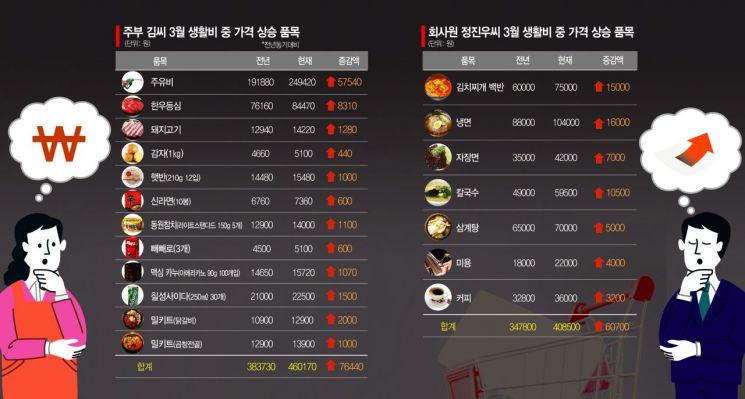
Kim Hana (38, pseudonym), a single-person household living in Mapo-gu, Seoul, was surprised last month while keeping a household expense card ledger. Kim refuels her 2000cc passenger car with 60 liters of gasoline twice a month for commuting and weekend outings to the suburbs. She minimized dining out and mainly spent on groceries for staying at home, but her expenses were nearly 100,000 won higher than in March last year, despite similar spending levels. Analyzing the increased items, fuel costs were the largest at 57,540 won, along with 12 other items including Korean beef sirloin, pork belly, potatoes, instant rice, ramen, tuna, coffee, snacks, carbonated drinks, and meal kits. In March last year, these 12 items cost 383,730 won, but in March this year, she spent 460,170 won. That means she spent 76,440 won more in one year.
Jung Jin-woo (37, pseudonym), an office worker living in Seongnam, Gyeonggi Province, also feels the impact of rising prices more than anyone else recently. Jung, who usually buys lunch and dinner outside, spent over 400,000 won on pocket money last month. He spent 75,000 won on kimchi stew set meals priced at 7,500 won each at a restaurant near his office and ate cold noodles eight times at his favorite cold noodle restaurant. Additionally, he ate jajangmyeon seven times, kalguksu seven times, samgyetang five times, and drank Starbucks Americano eight times. He also visited a hair salon once. Last year, eating and spending the same way cost only 347,800 won. Jung’s monthly dining-out expenses increased by 60,700 won (17.45%) in one year. On months when he saved money, he invested in small hobbies, but this year, even spending only on necessities feels tight.
Despite spending on the same items as a year ago, their wallets have become significantly lighter due to the impact of prices rising "except for wages." The most noticeable factor is the skyrocketing "fuel prices," driven by unstable international conditions. According to the Korea National Oil Corporation’s oil price information service Opinet on the 11th, the nationwide average gasoline price was 2,004 won per liter on the 16th of last month when Kim refueled for the first time. The average price in Seoul reached 2,091 won per liter. Although international oil prices have recently turned downward and government fuel tax cuts have helped stabilize the nationwide average to around 1,981 won, prices remain high.
Food prices have also become heavier. According to the Agricultural Products Distribution Information System (KAMIS), the price of Korean beef sirloin 1+ grade per 100g rose from 12,693 won last year to 14,079 won at the end of last month. Domestic refrigerated pork belly per 100g also increased from 2,156 won to 2,370 won during the same period. Potato prices rose from 466 won to 510 won per 100g. Prices of processed goods such as meal kits, ramen, and tuna, which are easy to prepare instantly, also increased simultaneously.
Dining-out prices are also rising one after another. According to the Korea Consumer Agency’s Chamgagaek, the price of kimchi stew set meals in Seoul is 7,154 won, up 5.6% from 6,769 won a year ago. Jajangmyeon costs an average of 5,846 won, 9.3% higher than 5,346 won a year ago. Kalguksu rose 8.7% from 7,462 won to 8,115 won. Noodle dishes are representative affordable and convenient meals for the working class, but now they are hard to enjoy lightly. The summer representative dish, cold noodles, increased 9.7% from 9,077 won to 9,962 won. Samgyetang, popular as a health food, rose slightly by 0.3% from 14,462 won to 14,500 won. Hair salon prices also increased 8.4% from 18,308 won a year ago to 19,846 won.
Experts say that prices follow global trends and patterns, and although various variables such as regime changes exist domestically, this upward trend is expected to continue for some time. Kim Si-wol, a professor of Consumer Studies at Konkuk University, predicted, "While export conditions and growth rates will enter a recovery phase, the pace will slow, but there is still considerable room for prices to continue rising."
© The Asia Business Daily(www.asiae.co.kr). All rights reserved.
![Clutching a Stolen Dior Bag, Saying "I Hate Being Poor but Real"... The Grotesque Con of a "Human Knockoff" [Slate]](https://cwcontent.asiae.co.kr/asiaresize/183/2026021902243444107_1771435474.jpg)















