Mixed Expectations and Concerns in the Science and Technology Sector
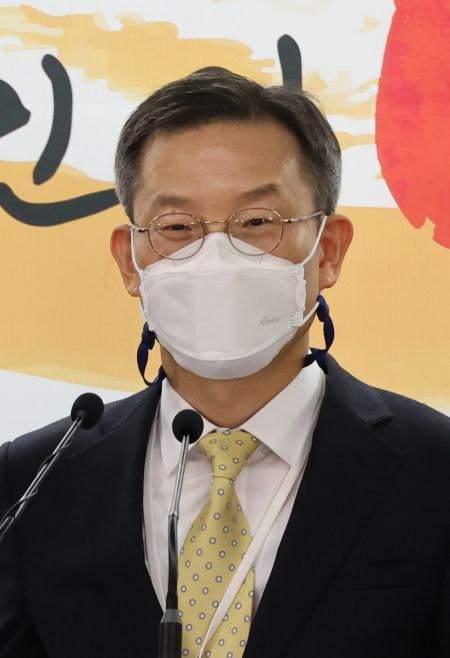 Minister of Science and ICT nominee Lee Jong-ho is attending the press conference announcing the appointment of ministerial candidates for eight ministries of the Yoon Suk-yeol administration at the Presidential Transition Committee in Tongui-dong, Jongno-gu, Seoul, on the afternoon of the 10th, answering reporters' questions. Photo by Transition Committee Press Photographers Group
[Asia Economy Reporter Kim Bong-su] President-elect Yoon Seok-yeol nominated Lee Jong-ho as the Minister of Science and ICT on the 10th. Lee, a semiconductor expert and former university professor who won a patent lawsuit worth 400 billion KRW against Samsung Electronics, is considered a somewhat unexpected choice. While the scientific community has high expectations for revitalizing the semiconductor industry, there are concerns that the appointment reflects a recurring pattern where personal connections with the core of power, rather than career, reputation, or insight, become the criteria.
◇ Samsung Electronics 400 Billion KRW Lawsuit... Enactment of the 'Lee Jong-ho Act'
Lee is well-known for receiving a substantial compensation in a 400 billion KRW semiconductor patent lawsuit against Samsung Electronics. According to domestic media reports on the 11th, in June 2018, a jury at the U.S. Eastern District Court of Texas ruled that Samsung Electronics must pay Lee 400 million USD in damages for patent infringement. Lee invented the 'Bulk FinFET' technology, patented in the U.S. in 2003. This three-dimensional transistor technology is used in smartphones and tablets, enabling faster mobile device performance. KAIST's intellectual property management subsidiary KIP, which was entrusted with Lee's patent rights, filed a lawsuit in 2016 at the U.S. Eastern District Court of Texas, claiming Samsung Electronics had used this technology since the Galaxy S6 without paying royalties. The jury ruled that the patent was valid and that Samsung had 'willfully infringed' it. Subsequently, KIP reportedly settled with Samsung Electronics before the final judgment, receiving a significant amount in compensation. Lee's side also received 10 billion KRW in royalties from Intel related to the same technology patent and demanded royalty payments from AMD last year.
Lee's intellectual property lawsuit led to the enactment of the so-called 'Lee Jong-ho Act.' On March 24 last year, the National Assembly passed an amendment to the Invention Promotion Act, known as the 'Lee Jong-ho Act,' which requires universities or public research institutions to return rights to inventors if they waive rights to inventions developed through their work. The amendment provides a basis for inventors to acquire patents waived by public institutions and relaxes restrictions on renewing exclusive licensing contracts for inventions made by government officials. The bill was inspired by cases where Lee, then a professor at Seoul National University, was unable to properly exercise and protect his patent rights. A source in the science and technology sector said, "Lee is known to have received the highest-ever patent royalties for a single patent, excluding fees related to patent rights delegation," adding, "The technology was so remarkable that it attracted considerable attention at the time, and the need to improve legal protections for patent rights led to the enactment of the law."
◇ Mixed Expectations and Concerns
Lee's nomination reflects President-elect Yoon's national policy philosophy emphasizing the semiconductor industry. Shortly after deciding to run for president, Yoon visited the Seoul National University Semiconductor Joint Research Center in May last year and received a four-hour 'private lesson' on semiconductors from Lee, which reportedly influenced his decision to nominate him. On the 7th, Yoon also showed special interest by touring Samsung Electronics' semiconductor plant in Pyeongtaek, Gyeonggi Province, by helicopter. In academia, Lee's appointment is seen as a move to appoint an expert in a situation where semiconductor technology development and industry revitalization could determine Korea's national fortune. A university professor commented, "Semiconductors have become one of the few industries that can serve as a pillar for Korea, which is caught in the 'sandwich' position amid the U.S.-China technological hegemony competition and the new Cold War," adding, "Appointing an expert expresses the intention to place semiconductors at the center of science and technology development and industrial promotion policies." Lee's long research focus, understanding of field hardships, engineering background rather than pure science, and administrative experience through various positions were also cited as strengths.
On the other hand, some voices of concern have emerged from government-funded research institutes. It is argued that Lee lacks the reputation, career, insight, and network to cover the entire science and technology sector, and that his sudden appointment as minister due to personal ties with the core of power repeats past precedents where ministers served as mere 'figureheads.' Critics also doubt his ability to devise practical solutions for economic and social challenges or to exercise bold and proactive administrative control, decision-making, and implementation beyond the 'bureaucratic barriers.' Particularly, some research institutes criticize, "Another professor?" A source from a research institute said, "Professors tend to have a mindset that selecting excellent individuals and training and researching them like at the Taeneung National Training Center is sufficient," adding, "They do not fully understand that steady progress based on a foundation and system is necessary to achieve results." The source continued, "While Lee may be knowledgeable in his field, science and technology have become so complex and broad that it is questionable whether he is aware of other fields or international trends," and expressed concern that, considering the appointment of Lee Chang-yang, a KAIST professor with administrative experience, as Minister of Trade, Industry and Energy, science and technology might again lose leadership to the Ministry of Trade, Industry and Energy in overseeing industrial policy coordination."
Meanwhile, during the upcoming parliamentary confirmation hearing next month, Lee, as a former national university professor, is expected to undergo scrutiny regarding overseas trips, research fund accounting, and plagiarism allegations. Questions are also anticipated about his insight and convictions concerning other science and technology fields beyond semiconductors, ICT, broadcasting, and telecommunications, which fall under the Ministry of Science and ICT's policy areas. Additionally, attention will focus on whether Lee proposes alternatives for supplying science and engineering talent in crisis, policies that simultaneously guarantee research autonomy, creativity, and efficiency, future directions for the delayed and ambiguous space development policy, strengthening basic science support, fundamental solutions to the semiconductor materials, parts, and equipment (SoBuJang) crisis, and the sluggish development of COVID-19 vaccines and therapeutics.
© The Asia Business Daily(www.asiae.co.kr). All rights reserved.
![Clutching a Stolen Dior Bag, Saying "I Hate Being Poor but Real"... The Grotesque Con of a "Human Knockoff" [Slate]](https://cwcontent.asiae.co.kr/asiaresize/183/2026021902243444107_1771435474.jpg)















