COVID-19 Pandemic Became an Opportunity... Successful Turnaround from Perennial Deficit to Surplus
Completion of 2nd Factory Enables Annual Production of 60 Million Units, Significant Increase in High-Margin HMR Purchases
[Asia Economy Beijing=Special Correspondent Jo Young-shin] Pulmuone China subsidiary 'Pumeituo (圃美多) Food' Plant 2, located in Pinggu District, Beijing, about 1 hour and 10 minutes by car from Chaoyang District, Beijing.
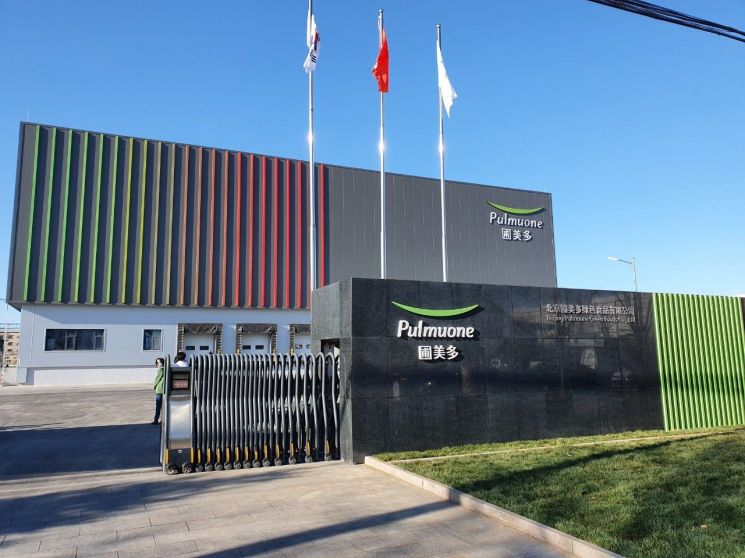
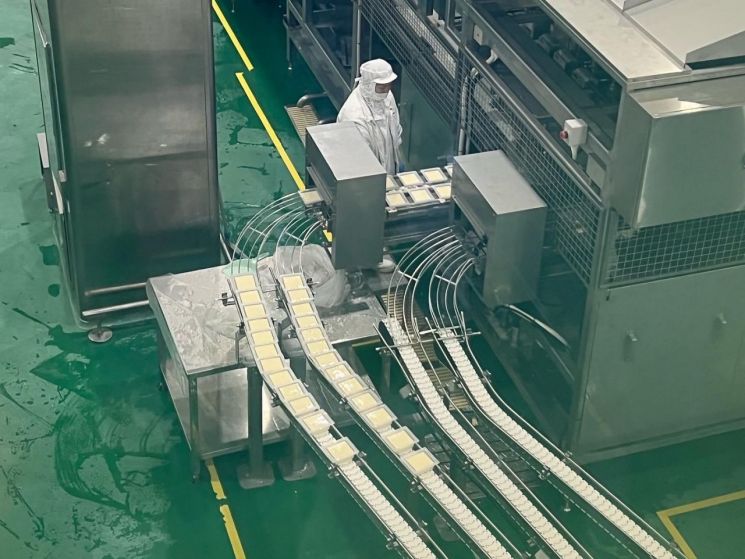
Construction of Pulmuone Beijing Plant 2, which was started at the end of 2020 when the global economy was shrinking due to COVID-19 and recently completed, is equipped with automated facilities capable of producing 60 million blocks of tofu annually. Plant 1's tofu production capacity is 15 million blocks. With the operation of Plant 2, tofu production capacity has expanded fourfold. As awareness of Pumeituo increased and more Chinese customers came, 30 billion KRW was invested to expand the production line.
Pulmuone stepped onto Chinese soil in 2010 with the cute idea of making and selling tofu directly in the land of tofu. They did not start making tofu from the beginning. The origin of tofu dates back to the Han Dynasty. It means that both the Chinese palate and distribution process were not easy. So they started with home meal replacements (HMR) such as udon noodles, cold noodles, rice cakes, and pasta.
Tofu production began in 2017. They produced 15 million blocks of tofu annually and supplied major first-tier cities such as Beijing, Shanghai, Guangzhou, and Shenzhen.
The China business, which started with a cute dream, was not easy. They could not even cover fixed costs. They had to face losses every year and watch the Seoul headquarters closely.
The big hit came from an unexpected place. At the beginning of 2020, the whole of China was engulfed in fear due to COVID-19.
Du Jin-woo, CEO of Pumeituo, also faced the unprecedented virus fear. He recalled at the time that he only thought, "Everything is ruined."
Feeling anxious, he personally visited offline stores selling Pulmuone products. He confirmed that tofu was sold out on the shelves. Although there was some hoarding, the real reason was that local Chinese companies, protective of their turf, could not produce tofu. Tofu supply was disrupted due to COVID-19.
The answer came. CEO Du gathered Chinese employees and ran the tofu production line at full capacity. To make up for the lack of manpower, even employees' families were mobilized. Most of the production workers at Plant 1 lived in nearby villages, so it was not difficult.
The result exceeded expectations. Pumeituo, the Chinese subsidiary struggling with perennial losses, posted a profit of 33.957 million yuan (about 6.5 billion KRW) that year. It was the first profit experienced in 10 years since entering China. They started the fiscal year thinking it would be fortunate just to cover fixed costs, but the crisis turned into an opportunity.
Chinese consumers who tasted Pulmuone tofu once or twice began to open their wallets for Pumeituo products. In common terms, purchasing power expanded to HMR products with high profit margins such as refrigerated pasta and frozen dumplings.
In fact, sales of refrigerated pasta surged by 55% compared to the previous year. As a result, last year's sales and net profit recorded all-time highs of 540.239 million yuan (103.3 billion KRW) and 48.571 million yuan (9.3 billion KRW), respectively.
Pumeituo plans to develop Plant 2 as a frontline base for noodle-centered HMR production, producing 60 million blocks of tofu annually, and expand pasta production capacity at Plant 1 from 45 million to 100 million units annually through line rearrangement.
Quickly detecting changes in Chinese consumers' purchasing channels also helped. Considering that economically empowered young Chinese consumers mainly purchase groceries online rather than offline stores, they started tapping into new online stores from 2019.
Another opportunity came. As Shanghai, China's economic capital and financial hub, entered sequential lockdowns, a similar phenomenon occurred in early 2020. Alibaba-affiliated Hema, China's largest online retailer, inquired whether they could immediately supply 200,000 blocks of tofu.
Pumeituo promised to supply 200,000 blocks of tofu by the agreed date and operated the factory 20 hours a day to meet Shanghai's demand. To safely supply 200,000 blocks of tofu, they decided to use a 'truck driver change' method. They sent trucks loaded with 40-foot containers to Shanghai quarantine points and handed over the trucks to Shanghai drivers there.
CEO Du said, "Shanghai is struggling due to COVID-19," and added, "We decided to send the promised tofu unconditionally."
Pumeituo plans to build frozen and refrigerated HMR production bases in Chongqing, Shanghai, and southern China, aiming to achieve sales of 3 billion yuan by 2025.
© The Asia Business Daily(www.asiae.co.kr). All rights reserved.
![Clutching a Stolen Dior Bag, Saying "I Hate Being Poor but Real"... The Grotesque Con of a "Human Knockoff" [Slate]](https://cwcontent.asiae.co.kr/asiaresize/183/2026021902243444107_1771435474.jpg)

















