Children Flooded with War Questions in European Classrooms... Teachers Embarrassed
Education Authorities of Each Country Provide Response Guidelines
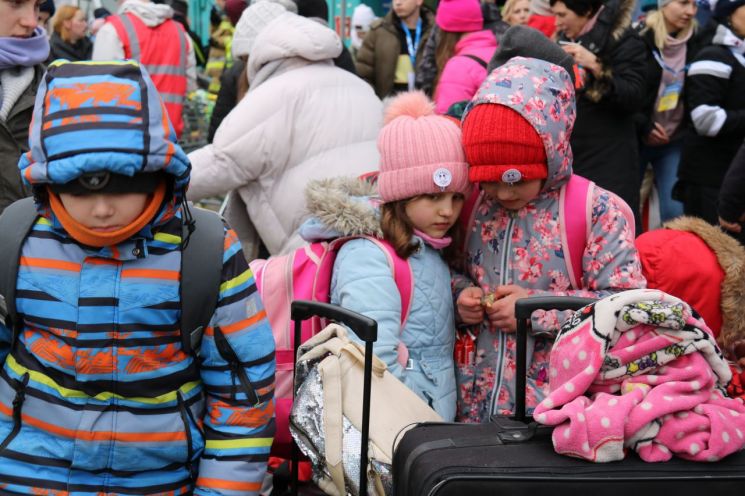 On the 5th of last month (local time), children are waiting in front of a temporary refugee shelter near the Korczowa border checkpoint in Poland. [Image source=Yonhap News]
[Asia Economy Reporter Hyunju Park] "Vladimir Putin, the President of Russia, killed children in the hospital."
In a third-grade classroom at an elementary school in Italy, a child said this. The teacher could only brush it off as an "accident." They could not bring themselves to tell the children that they were killing kids.
According to a report by the US daily The New York Times (NYT) on the 31st (local time), such awkward situations are occurring frequently in European classrooms.
As the war between Russia and Ukraine, which began in February, has continued for over a month, countries across Europe are witnessing the horrors of war through the constant stream of news.
Amid this, teachers confess that they lack both the time and information to properly explain to students what is happening right now. A teacher who teaches earth science at a high school in Bologna, northern Italy, said, "I've been asked about 100 questions. I'm afraid of having to give absurd answers."
Max, an 11-year-old attending an elementary school in southern England, asked, "Russia is big enough, so why do they want more land?" Other students asked their teachers, "Why are all the strange people men?" or "Teacher, will you also stay and fight?"
After much thought, the teacher replied, "It's difficult, isn't it? Yes, the teacher will also fight for the country."
In this way, students are expressing their worries, fears, and questions about the war in the classroom. An 18-year-old boy in Poland, a country bordering Ukraine, said he was worried about being drafted into the war, and a 10-year-old boy in France said he wanted to hide.
The NYT pointed out that students today have never experienced war firsthand, so they feel a huge gap between the stories they encounter on social media and reality. They were born well after the Bosnian War in the 1990s and were only infants when the Syrian civil war broke out in 2011.
Education authorities in each country are preparing guidelines to respond to these situations. The UK education authorities consider this an unprecedented situation for some teachers and schools, encouraging classroom discussions while also providing materials to refute fake news.
In France, guidelines sent to teachers instruct them to explain the history surrounding Russia and Ukraine to students. However, they caution that such explanations should not lead to hypotheses denying Ukraine's status as an independent country. The guidelines also specify that if students are reluctant to discuss the war, teachers should not force the discussion.
In Poland, a country bordering Ukraine, students are the ones requesting discussions. On the first day Russia invaded Ukraine, students in a classroom in Warsaw stopped the lesson and asked to talk about the situation in Ukraine. When the teacher asked students who wanted to speak to raise their hands, all of them raised their hands.
© The Asia Business Daily(www.asiae.co.kr). All rights reserved.