Regulatory Rationalization, Tax Burden Relief, and Lease Stability
Concentration on 'Smart One-Home Ownership' Expected to Intensify
The flow of real estate policies presented so far by the Presidential Transition Committee can be summarized as "market stabilization through deregulation and tax reduction." This reflects President-elect Yoon Seok-yeol's perception that "housing policies have been repeated 28 times but ultimately fueled a tremendous rise in house prices, as they ignored the market's natural laws." The plan is to restore market functions by expanding listings through deregulation, but there are concerns that demand concentration in certain areas such as Gangnam could intensify the phenomenon of owning a single valuable property.
◇ Deregulation and tax cuts... May as a turning point = On the 25th of last month, when the Ministry of Land, Infrastructure and Transport held its work report, President-elect Yoon personally attended the site and repeatedly reaffirmed the policy of "deregulation." It is known that the top priority discussion was on restoring the reconstruction safety inspection standards, which were tightened under the current administration. This diagnosis is based on the view that high regulatory barriers are blocking housing supply. Additionally, the "Three Lease Laws" (right to request contract renewal, rent ceiling for jeonse and monthly rent, and lease reporting system) are also planned to be reviewed. The Transition Committee reports that after the introduction of the Three Lease Laws, jeonse prices surged and the trend of jeonse turning into monthly rent intensified, worsening housing instability. Relaxation of the Loan-to-Value ratio (LTV) is also under consideration to resolve situations where homeownership is impossible due to excessive LTV regulations despite sufficient principal and interest repayment capacity.
While these measures aim to induce normalization of market functions, there is a particular focus on stabilizing the rental market. The Transition Committee has announced plans to promote registered rental and private rental housing. Registered rentals provide tax benefits to multi-homeowners in exchange for offering relatively affordable and stable rental housing to the market. The "New Stay" program, introduced in November 2015, is also under review by the Transition Committee as a short-term supply measure.
Plans to encourage multi-homeowners to release properties and secure short-term supply through tax burden relief are also being concretized. The Transition Committee intends to broadly ease real estate-related taxes such as capital gains tax, acquisition tax, and comprehensive real estate holding tax. Among these, the first measure introduced is the "one-year temporary exclusion of capital gains tax surcharges for multi-homeowners." The Moon Jae-in administration sought to induce property listings by strengthening tax burdens on multi-homeowners, but in reality, multi-homeowners countered through gifts and other means.
◇ If capital gains tax surcharges are exempted, capital gains tax on Banpo Xi will decrease by 200 million won = Among various measures, the effect of inducing listings by excluding the application of capital gains tax surcharge rates is expected to be significant. According to the current Income Tax Act, owning two houses in designated regulated areas results in an additional 20 percentage points surcharge on the basic capital gains tax rate (6-45%), and owning three houses results in a 30 percentage points surcharge. However, if the surcharge rate is exempted, only the basic tax rate of up to 45% applies.
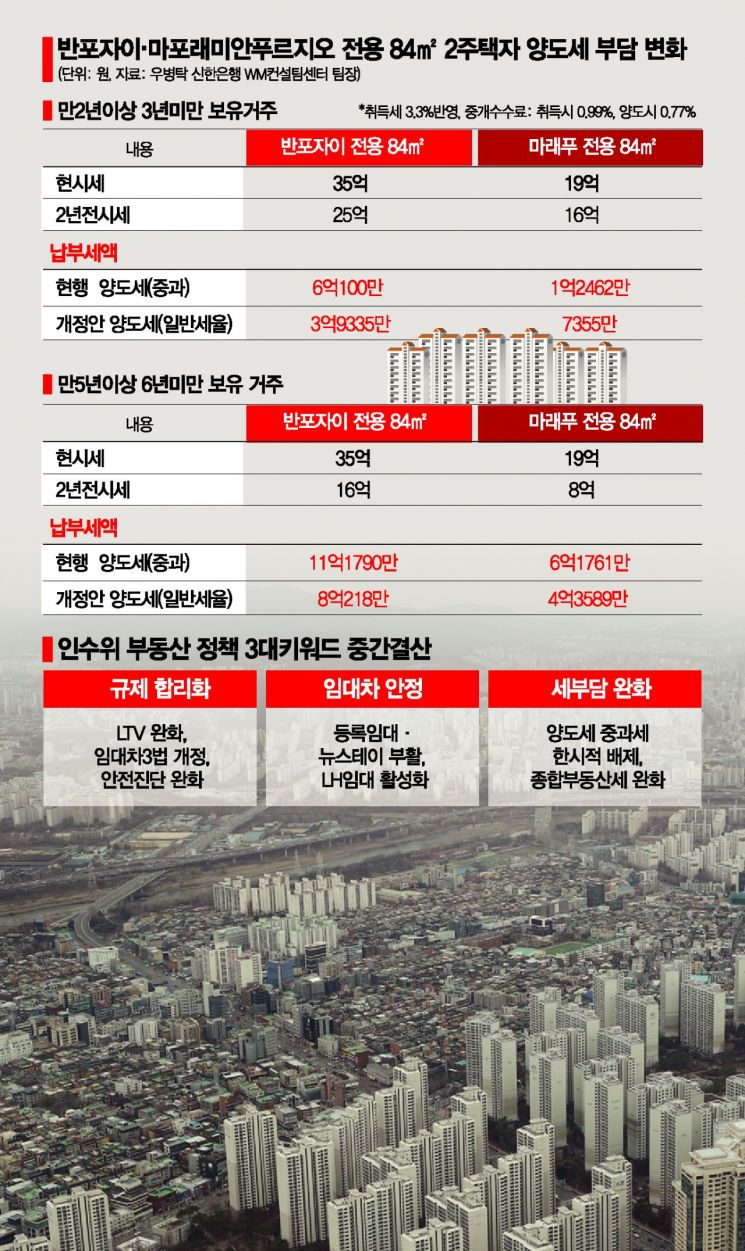
Asia Economy commissioned Woo Byung-tak, head of the Real Estate Team at Shinhan Bank WM Consulting Center, to estimate the change in tax burden before and after the application of the capital gains tax surcharge. It was found that a two-homeowner in a regulated area selling one Banpo Xi unit with an exclusive area of 84m² (owned for more than 2 years but less than 3 years, and occupied) in Seocho-gu, Seoul, would have to pay 610.1 million won under current law. However, if the surcharge is exempted, only 393.35 million won would be paid, a 35% reduction in tax. When selling one Mapo Raemian Prugio unit with an exclusive area of 84m² in Mapo-gu, Seoul, capital gains tax decreases from 124.62 million won to 73.55 million won, a 41% reduction.
If held for more than 5 years but less than 6 years, the tax payable when disposing of one Banpo Xi unit with an exclusive area of 84m² decreases from 1.1179 billion won to 821.8 million won, a 28% reduction. When selling one Mapo Raemian Prugio unit with an exclusive area of 84m², capital gains tax decreases from 617.61 million won to 435.89 million won, a 29% reduction in tax burden.
Ultimately, if these measures are swiftly implemented after the new government takes office and before the nationwide local elections on June 1, the market is expected to see an acceleration of the "smart single home" concentration phenomenon. The freeze on official property prices applies only to single-home households. The exclusion of capital gains tax surcharges reduces taxes when the number of homes is decreased. Additionally, becoming a single-homeowner from a two-homeowner reduces this year's holding tax burden. The easing of the 1.5 billion won loan ban also lowers the entry barrier for high-priced homes, making it easier to switch to a smart single home. From the perspective of multi-homeowners, it is expected that they will respond by disposing of homes in the outskirts of the metropolitan area or provinces and holding onto a smart single home.
© The Asia Business Daily(www.asiae.co.kr). All rights reserved.