Moon Administration Civil Servants Three Times Park Administration, Ten Times Lee Administration
Personnel Expenses for Civil Servants and Public Institutions Reach 100 Trillion Won
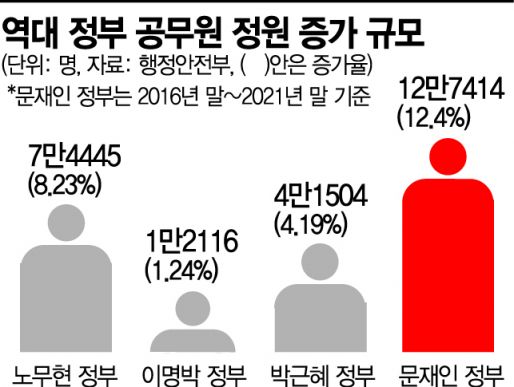
[Asia Economy Sejong=Reporters Kim Hyewon and Kwon Haeyoung] It has been revealed that the Moon Jae-in administration increased the number of public officials by nearly 130,000 over the past five years. This is the result of ‘job policies’ focused on the public sector, surpassing the previous Park Geun-hye administration (41,504) by three times and the Lee Myung-bak administration (12,116) by ten times. As the next government’s organizational reform plan is expected to be unveiled this week, there are urgent calls to improve the efficiency of the bloated government organization over the past five years.
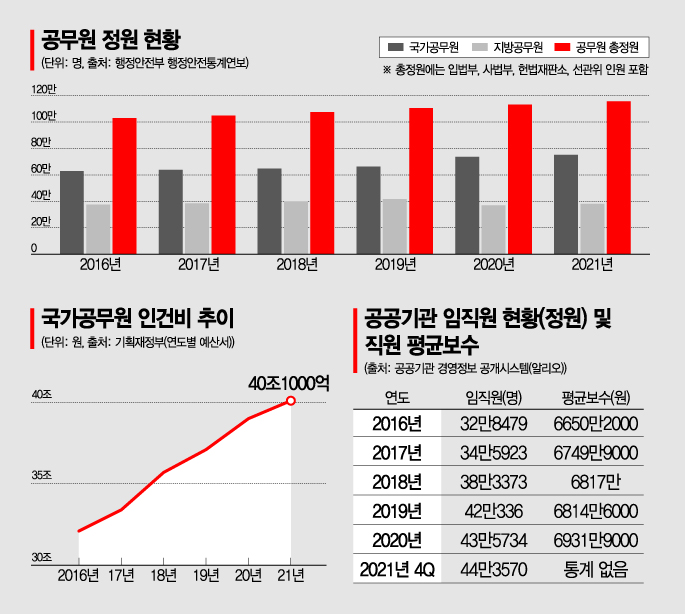
According to the office of Lee Myung-soo, a member of the People Power Party, and the Ministry of the Interior and Safety on the 28th, the total number of public officials in South Korea was counted at 1,156,952 as of the end of 2021. This includes national and local public officials (758,024 and 380,819 respectively), as well as public officials from independent institutions such as the legislative branch, judiciary, Constitutional Court, and Central Election Commission.
This represents a 12.4% (127,414) increase compared to the end of 2016 (1,029,538), the year before the Moon administration took office. This growth rate is higher than that of the previous Park Geun-hye administration (4.19%), Lee Myung-bak administration (1.24%), and even the Roh Moo-hyun administration (8.23%).
Focusing on 18 government ministries, the number of public officials increased by 6.8%, from 443,131 at the end of 2016 to 473,458 at the end of 2021. Except for the Ministry of Health and Welfare, which saw a decrease due to the separation of the Korea Disease Control and Prevention Agency, all 17 other ministries increased their staff.
The significant increase in public officials over the past five years is the result of the current administration’s commitment to creating 810,000 public sector jobs, mobilizing taxes to create public jobs in government and public institutions. The problem is that once the number of public officials increases, it is difficult to reduce, and the expansion of personnel expenses and pension payments continuously imposes a heavy burden on national finances. The expansion of government organizations can also lead to stricter regulations and hinder private sector vitality.
The Presidential Transition Committee’s recent requests during the Ministry of the Interior and Safety and the Ministry of Personnel Management’s work reports last week to discuss the issue of public official quotas and efficient personnel reallocation are closely related to this situation. There are urgent calls to shift from government-led to private sector-led economic growth, as promised by President-elect Yoon Seok-yeol, by transforming into a ‘small and efficient government.’
Professor Hong Kiyong of Incheon National University’s Department of Business Administration pointed out, "The Moon administration increased the number of public officials and public institution employees more as a welfare measure than to enhance administrative capacity, causing serious inefficiencies in administration and national financial expenditures. As the need for administrative personnel decreases due to digital transformation, the new government should prioritize public sector efficiency as a key task."
Under Moon Administration, Public Officials and Public Institution Personnel Expenses Exceed 100 Trillion Won
With the Moon Jae-in administration ushering in an era where annual personnel expenses for public officials exceed 100 trillion won, concerns are growing over the fiscal burden on the nation and its citizens. For President-elect Yoon Seok-yeol, who advocates for a ‘small government,’ the efficiency of the rapidly expanded government organization over the past five years has become an urgent issue to resolve.
Last year, the government’s expenditure on personnel expenses for national and local public officials and public institutions far exceeded 100 trillion won. According to the Ministry of the Interior and Safety’s Administrative Safety Statistical Yearbook and the Government Organization Management Information System, as of the end of last year, the total number of public officials was 1,156,952, with administrative national public officials accounting for 758,024 (64.9%) and local public officials 380,819 (32.9%). Based on the 2020 average monthly income of all public officials (5.35 million won), a simple calculation estimates that personnel expenses for these public officials alone approached 75 trillion won last year. National public officials’ personnel expenses exceeded 40 trillion won for the first time in history, and local public officials’ related budget has continued to rise since surpassing 30 trillion won in 2019 during the Moon administration.
Adding the average salaries of public institution employees, which have increased annually under the Moon administration, nearly 110 trillion won in fiscal resources are being spent on personnel expenses for public officials and public institutions. Analysis of the Public Institution Management Information System (Alio) shows that as of the fourth quarter of last year, the number of public institution employees was 443,570, a 35% increase compared to 2016 (328,479). Estimating their average salaries amounts to 31 trillion won. However, the financial soundness of public institutions is deteriorating. Public institution debt increased from 500.3 trillion won in 2016 to 544.8 trillion won in 2020, and local public enterprises hold 54.4 trillion won in debt amid net losses in the 2 trillion won range.
As the number of public officials increases, the future pension burden the state must bear also grows. Since the government is responsible for paying public officials’ pensions, similar to military pensions, the deficit must be covered by national finances. The National Assembly Budget Office projects that the public officials’ pension deficit will increase from 2.1 trillion won in 2020 to 32.1 trillion won by 2090, equivalent to 0.8% of GDP. Professor Sung Taeyoon of Yonsei University’s Department of Economics said, "The public officials’ pension system already has many problems. The overexpansion of public officials is structurally problematic because it involves not only huge immediate personnel expenses but also pension funding issues that future generations will have to bear."
Ministry of Employment Increased Staff by 50% in 5 Years... Industrial, Employment, and Ministry of Economy and Finance Increased Senior Officials Amid ‘Big Government’
The Ministry of Economy and Finance launched the ‘Economic Security Supply Chain Planning Group’ this month, just two months before the end of the Moon administration. As supply chain management became more important, the group aims to serve as a ‘control tower’ for supply chain organizations scattered across ministries including the Ministry of Trade, Industry and Energy. Although the Economic Security Supply Chain Planning Group is a temporary organization led by a director-level official, it is highly likely to be promoted to a regular bureau in the future, creating an additional senior official position. This has drawn criticism within and outside the government as a typical ‘old habit’ of bureaucrats expanding organizations and increasing positions at the end of an administration.
According to the office of Lee Myung-soo of the People Power Party, among the 18 major government ministries, the ministries that increased the number of senior officials (department and bureau chiefs) the most after the Moon administration took office were the Ministry of Trade, Industry and Energy, Ministry of Employment and Labor, and Ministry of Economy and Finance (based on headquarters from the end of 2017 to the end of 2021).
Both the Ministry of Trade, Industry and Energy and the Ministry of Employment and Labor increased their senior officials by four each, including one department head and three bureau chiefs. Additionally, the Ministry of Trade, Industry and Energy expanded its organization to a three vice-minister system last year by creating the ‘Energy Vice Minister’ position. Following these, the Ministry of Economy and Finance increased three bureau chiefs, the Ministry of Science and ICT added two department heads and one bureau chief, and the Ministry of SMEs and Startups increased three bureau chiefs. The bureaucratic community tends to actively expand organizations citing personnel stagnation, and this demand was further reflected due to the current administration’s ‘big government’ policy.
Based on headquarters, the organization with the most senior officials is the Ministry of Foreign Affairs, with nine department heads and 36 bureau chiefs, totaling 45. Next are the Ministry of Economy and Finance (38), Ministry of the Interior and Safety (38), Ministry of Trade, Industry and Energy (35), Ministry of Health and Welfare (27), and Ministry of Land, Infrastructure and Transport (27).
Among the 18 ministries, the Ministry of Foreign Affairs has the most department and bureau chiefs, with nine and 36 respectively. Next, the Ministry of Trade, Industry and Energy has the most department heads (8), and the Ministry of Economy and Finance has the most bureau chiefs (32).
Among the 18 ministries under the Moon administration, the Ministry of Employment and Labor increased its number of public officials the most over the past five years, rising from 5,837 at the end of 2016 to 8,682 at the end of 2021, a 48.7% increase. This was followed by the Ministry of the Interior and Safety (37.7%), Ministry of Environment (34.9%), Ministry of Oceans and Fisheries (16.7%), Ministry of SMEs and Startups (15.4%), Ministry of Foreign Affairs (12.8%), Ministry of Agriculture, Food and Rural Affairs (12.7%), and Ministry of Economy and Finance (12.4%). All these increases exceed the Moon administration’s five-year average growth rate of 12.4%.
The Ministry of Gender Equality and Family, which faces an uncertain future in the new government’s organizational reform, saw an 11.2% increase in public officials during the current administration. The Ministry of Health and Welfare was the only ministry to see a decrease in staff by 18.8%, but this was due to the separation of the Korea Disease Control and Prevention Agency in 2020. The Ministry of Employment and Labor explained that the increase was related to the National Employment Support System, which encourages employment among youth and low-income unemployed by providing cash and other support, leading to increased hiring. The Ministry of Environment explained that the increase in staff was due to the transfer of water management personnel from the Ministry of Land, Infrastructure and Transport and the expansion of organizations to respond to climate change.
© The Asia Business Daily(www.asiae.co.kr). All rights reserved.
![Clutching a Stolen Dior Bag, Saying "I Hate Being Poor but Real"... The Grotesque Con of a "Human Knockoff" [Slate]](https://cwcontent.asiae.co.kr/asiaresize/183/2026021902243444107_1771435474.jpg)
















