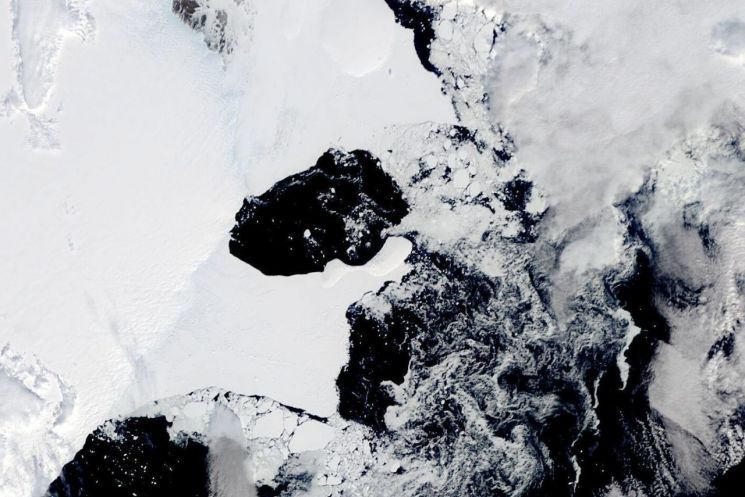
 The artificial satellite photo released by the National Aeronautics and Space Administration (NASA) last February shows the appearance of the 'Conger' ice shelf in East Antarctica before its collapse. [Image source=AP Yonhap News]
[Asia Economy Reporter Sumi Hwang] A block of ice the size of Rome in eastern Antarctica has completely collapsed.
On the 25th (local time), according to foreign media such as CNN and The Guardian, the U.S. National Ice Center (USNIC) announced that the 'Conger Ice Shelf,' covering an area of about 1,200㎢, collapsed around mid-month and released satellite images.
An ice shelf is a massive block of ice that flows down from glaciers on the Antarctic continent and floats on the sea. Ice shelves act as barriers that block the flow of warm currents approaching inland, helping to maintain glaciers. If these ice shelves shrink, the rate at which glaciers melt accelerates, which can speed up sea level rise.
The Conger Ice Shelf reportedly completely collapsed during a period when eastern Antarctica recorded unusually high temperatures. As of the 18th, the temperature at the Concordia Station, located inland in eastern Antarctica, soared to -11.8℃. This is more than 40℃ higher than the average temperature.
Scientists analyzed that this collapse occurred unusually quickly. Dr. Katherine Walker, a geophysicist working at NASA and the Woods Hole Oceanographic Institution, said that although the Conger Ice Shelf began shrinking in the mid-2000s, the rate was gradual until early 2020. However, as of the 4th of this month, the ice shelf's area had decreased by more than half compared to January.
Dr. Walker added that although the Conger Ice Shelf is relatively small, it is considered a significant event on the Antarctic continent since the collapse of the Larsen Ice Shelf B in the early 2000s. The Larsen Ice Shelf B on the Antarctic Peninsula rapidly collapsed in 2002, highlighting the severity of the climate crisis.
Peter Neff, a research assistant professor and glaciologist at the University of Minnesota, expressed surprise at the collapse of the ice shelf in eastern Antarctica. According to current knowledge, due to structural differences between ice and rock, eastern Antarctica cannot melt at the same rate as the western part.
In fact, eastern Antarctica, which holds an overwhelmingly large amount of ice compared to the continent, has been considered less threatened than West Antarctica.
Assistant Professor Neff added that if the collapse of this ice shelf was caused by the high temperatures observed during the 'atmospheric river' phenomenon in mid-month, further research on the process is necessary.
Recently, abnormal high-temperature phenomena have been continuously reported in eastern Antarctica. Scientists point to the atmospheric river phenomenon, where a large amount of water vapor moves in the atmosphere in a long, river-like band, as the cause.
This atmospheric river made landfall on the southeastern Antarctic coast on the 15th, bringing heavy rain, which caused nearby glaciers to melt and moisture to spread inland. At the same time, an unusually strong heat dome appeared, concentrating this moisture in eastern Antarctica without dispersing it, thus maintaining the heat.
Scientists predict that the collapse of the Conger Ice Shelf will not have a significant impact on sea level rise but urge that it should be regarded as a warning sign of the climate crisis.
© The Asia Business Daily(www.asiae.co.kr). All rights reserved.
![Clutching a Stolen Dior Bag, Saying "I Hate Being Poor but Real"... The Grotesque Con of a "Human Knockoff" [Slate]](https://cwcontent.asiae.co.kr/asiaresize/183/2026021902243444107_1771435474.jpg)















