Remote test takers must use the online system
No separate score report provided for remote test takers
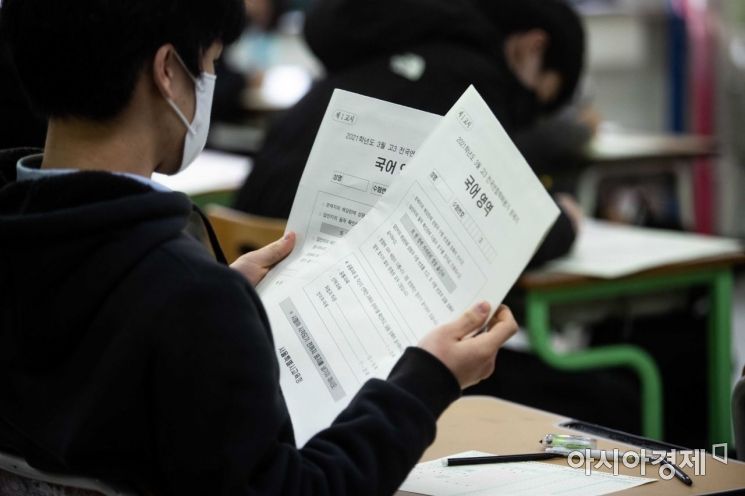 On March 25 last year, students are checking their exam papers at Gyeongbok High School in Jongno-gu, Seoul, where the nationwide mock exam for high school seniors was held. Photo by Jinhyung Kang aymsdream@
[Asia Economy Reporter Han Jinju] On the 24th, the first mock exam aligned with the College Scholastic Ability Test (CSAT) system, the National Joint Academic Achievement Evaluation, will be conducted nationwide.
On the 23rd, the Seoul Metropolitan Office of Education announced that the National Joint Academic Achievement Evaluation will be administered on the 24th to approximately 950,000 students from 1st to 3rd year high school nationwide.
Unlike last year, when the exam was conducted separately by grade, this year all 1st to 3rd year high school students will take the exam on the same day starting at 8:40 a.m.
To create a safe testing environment amid COVID-19 and to reduce student crowding in the cafeteria during lunch, the lunch break was extended from 50 minutes to 60 minutes, an increase of 10 minutes. Instead, the break after the first period was shortened from 20 minutes to 10 minutes. The end time of the final fourth period is 4:37 p.m., the same as the CSAT.
Students who cannot attend school due to confirmed COVID-19 cases, self-quarantine, or home study can take the exam remotely. Exam papers for each period will be provided through the National Joint Academic Achievement Evaluation online system according to the start time of each subject area. Remote test takers will not receive separate score reports, but can estimate their scores through the score analysis materials provided to schools starting April 14.
The National Joint Academic Achievement Evaluation has produced a separate answer sheet for Korean History in the fourth period to align with this year’s CSAT system. For 3rd year students, the Korean and Math sections will be taken in a common subject + elective subject structure. 2nd and 3rd year students can select up to two subjects from 13 inquiry subjects (9 social studies and 4 science inquiry subjects) regardless of their academic track.
Kim Byungjin, Director of the Etoos Educational Evaluation Research Institute, said, "The March academic evaluation is not administered by the Korea Institute for Curriculum and Evaluation, which is the CSAT test agency, and graduates do not take it. The test scope also differs from the CSAT, so it is difficult to directly link the results to the CSAT or college admissions." He advised, "Rather than being overly concerned with the scores themselves, it is advisable to use the results from a learning perspective, such as checking one’s competitiveness for the CSAT."
Woo Yeoncheol, Director of the Jinhaksa Admissions Strategy Research Institute, explained, "After the academic evaluation, 3rd year students should compare their evaluation scores with their 1st and 2nd year school record grades to conduct a mid-term check on which admission track is advantageous for applying to their desired universities." He added, "If the university’s school record admission track applies a minimum CSAT score requirement, students should not neglect managing their CSAT subject grades to meet the criteria."
© The Asia Business Daily(www.asiae.co.kr). All rights reserved.
![Clutching a Stolen Dior Bag, Saying "I Hate Being Poor but Real"... The Grotesque Con of a "Human Knockoff" [Slate]](https://cwcontent.asiae.co.kr/asiaresize/183/2026021902243444107_1771435474.jpg)
















