0.4% Increase... Up for 2 Consecutive Months
Significant Impact from Rising Raw Material Prices
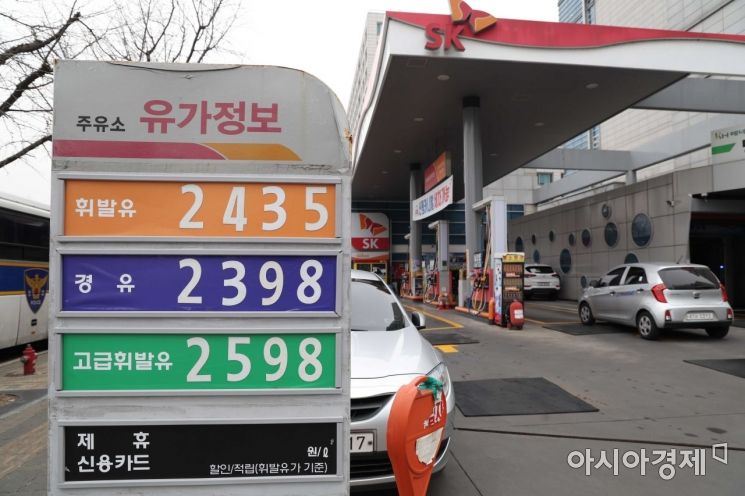 Due to Russia's invasion of Ukraine, international oil prices have surged sharply, causing domestic fuel prices to continue soaring day after day. On the 23rd, gasoline and diesel were being sold at a Seoul gas station for well over 2,000 won per liter. Photo by Moon Honam munonam@
[Asia Economy Reporter Seo So-jung] Due to Russia's invasion of Ukraine, international commodity prices, including crude oil, have risen, causing the Producer Price Index (PPI) to reach an all-time high. Producer prices affect consumer prices with a time lag, so inflationary pressures are expected to increase further this year.
According to the Bank of Korea on the 23rd, the provisional Producer Price Index for February was 114.82 (based on 2015 = 100), marking a record high. Last month, the PPI rose 0.4% month-on-month, led by manufactured goods, marking two consecutive months of increase. Compared to the same month last year, it rose 8.4%, continuing an upward trend for 15 consecutive months.
The Producer Price Index measures price changes of goods and services supplied by domestic producers to the market and is used as an economic indicator. Producer prices rose for 13 consecutive months until November last year, remained unchanged in December, and have been rising again since January.
Due to Russia's invasion of Ukraine, international crude oil prices (WTI basis) surpassed $120 per barrel earlier this month. If producers pass on the burden of raw material costs to consumer prices, inflationary pressures will inevitably increase further.
Son Jin-sik, head of the Price Statistics Team at the Bank of Korea's Economic Statistics Department, explained, "Producer prices, especially for manufactured goods, have risen significantly due to increases in raw material prices such as international crude oil," adding, "In particular, manufactured goods and services continued their upward trend."
Month-on-month, agricultural, forestry, and fishery products fell 5.1% due to decreased demand after the Lunar New Year holiday, but manufactured goods such as coal and petroleum products and chemical products rose 1.1% due to rising raw material prices including international crude oil. The coal and petroleum products index and the chemical products index recorded 166.79 and 117.36, respectively, marking the highest levels in nine years since February 2013 (170.07 and 117.62, respectively). Electricity, gas, water, and waste services fell 0.1%.
Services showed a flat trend. Although restaurants and accommodation (0.8%) rose, reaching an all-time high of 119.33, financial and insurance services (-3.2%) declined, hitting the lowest level since July 2020 (94.73).
The Domestic Supply Price Index, which measures price changes of goods and services supplied domestically, also rose for two consecutive months. Raw materials (6.2%) and intermediate goods (0.8%) increased, resulting in a 1.1% month-on-month rise. Compared to the same month last year, it rose 13.2%, continuing an upward trend for 13 consecutive months.
The Total Output Price Index, which measures price changes of goods and services based on total production including domestic shipments and exports, also rose 0.7% month-on-month, led by manufactured goods (1.4%). Compared to the same month last year, it increased 11.3%.
© The Asia Business Daily(www.asiae.co.kr). All rights reserved.
![Clutching a Stolen Dior Bag, Saying "I Hate Being Poor but Real"... The Grotesque Con of a "Human Knockoff" [Slate]](https://cwcontent.asiae.co.kr/asiaresize/183/2026021902243444107_1771435474.jpg)















