Democratic Party "Risk of Security Gap if Ministry of National Defense Moves for President Yoon's Office"
People Power Party "No Security Gap in Fact"
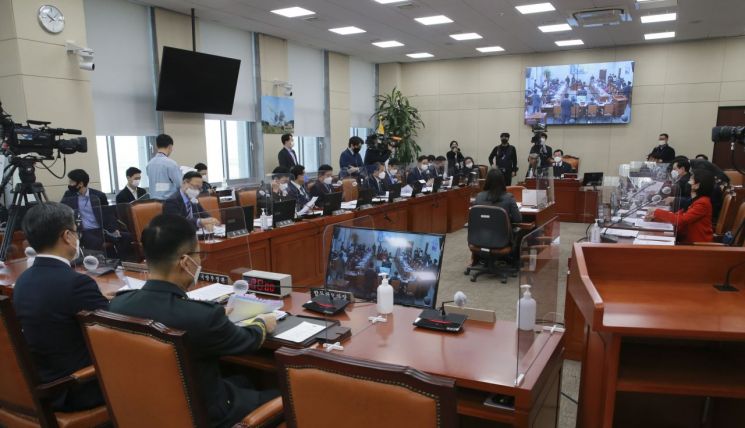
[Asia Economy Reporter Naju-seok] Conflict erupted between ruling and opposition party lawmakers on the 22nd at the National Defense Committee of the National Assembly over President-elect Yoon Seok-yeol's plan to relocate the Yongsan office. Democratic Party lawmakers pointed out that the Ministry of National Defense's process of vacating the building to secure the office was hasty. Lawmakers from the People Power Party actively refuted the argument about a security vacuum.
Democratic Party lawmaker Hong Young-pyo said regarding Yoon's relocation plan, "In the past, perhaps at some National Security Council or similar, relocating hastily as if conducting an unimaginable military operation is a big problem and inevitably causes a security vacuum." He added, "There are laws when relocating military facilities, and this should be calmly reviewed and promoted based on such laws." He criticized, "Pushing to vacate rooms within just about ten days is absolutely not helpful to our national security and defense."
Hong also stated, "(The Ministry of National Defense) is the last bastion related to national security, and its relocation is a major national issue," and criticized, "The Ministry of National Defense is being split into six parts, and the Joint Chiefs of Staff must move some functions elsewhere, which will lead to a chain reaction of military unit relocations. Does the military judge this so lightly?"
Democratic Party lawmaker Kang Byung-won said, "If the decision to relocate the Blue House had taken time to sufficiently discuss with former Joint Chiefs of Staff chairs, the Ministry of National Defense, residents, and the National Assembly, such controversy might have been avoided," and pointed out, "Considering North Korea's movements, including the Day of the Sun and the Foundation Day, we must anticipate and prepare for intercontinental ballistic missiles (ICBMs)."
Kang added, "Until midnight on May 9, the commander-in-chief of the armed forces is President Moon," and questioned, "If the transition team pressures the incumbent president to make decisions for which he is responsible, and this causes security gaps or vulnerabilities leading to harm to the people, who should be held accountable?"
Democratic Party lawmaker Kim Byung-joo noted, "It took an average of 3 to 5 years to relocate a battalion," and said, "The Blue House operates a crisis management center that handles not only military matters but also disaster and emergency issues, with more than 50 different systems. Setting up these systems anew, rewiring, and monitoring takes at least three months."
Kim stated, "It is false that there is unused space at the Joint Chiefs of Staff," clarifying, "There are no idle offices." Additionally, regarding air defense, Kim said, "The Ministry of National Defense area is not as extensive as the Blue House and is vulnerable," adding, "Installing additional anti-aircraft posts is inevitable."
Lawmaker Kim Jin-pyo said, "In the past, North Korea always caused security anxiety and provocations during regime changes," and remarked, "The best way is to prevent risk factors in advance so that the North does not misjudge." He criticized, "Even if the president-elect wants to proceed, there is no need to rush. As announced by the Blue House, all procedures with the Ministry of National Defense and the Joint Chiefs of Staff should be fully prepared before moving. Why hurry?" He warned, "As a temporary measure, the Ministry of National Defense leadership and the Joint Chiefs of Staff worked together in the Joint Chiefs building. How long would it take to fully normalize the Joint Chiefs and Ministry of National Defense? I think it would take at least two to three years. During that period, the president, defense minister, and Joint Chiefs chair would work in the same building, which would make them the primary targets for a strong strike."
Democratic Party lawmaker Kim Min-ki said, "When spending taxes, appropriate prior procedures must be followed, and only after completing those procedures can legitimacy be granted, and then the budget can be spent," criticizing, "Currently, it is being spent like someone's petty cash." Regarding the Ministry of Economy and Finance's allocation of 49.6 billion won in contingency funds for the president's office relocation, Kim said, "It was made to meet the exemption criteria for preliminary feasibility studies," calling it "a significant trick."
People Power Party lawmaker Shin Won-sik mentioned cases such as wartime command posts, noting that the command system can be moved in a short period. Shin said, "Two months for moving and administrative processing may be tight, but it can be done minimally," and argued, "There will be no security vacuum. If war breaks out, the Joint Chiefs chair must pack up and move south, so saying there will be a security vacuum is wrong."
People Power Party lawmaker Sung Il-jong said, "Just because a new presidential office is established, does that mean there will be gaps in Joint Chiefs operations?" and argued, "During the power transition process, if the current and incoming powers cooperate, this distrust issue can be resolved."
Lawmaker Heo Eun-ah stated to Defense Minister Seo Wook, "If you thought the security vacuum was important, you should have reported directly to President Moon," and insisted, "The Ministry of National Defense should not engage in politics."
© The Asia Business Daily(www.asiae.co.kr). All rights reserved.
![Clutching a Stolen Dior Bag, Saying "I Hate Being Poor but Real"... The Grotesque Con of a "Human Knockoff" [Slate]](https://cwcontent.asiae.co.kr/asiaresize/183/2026021902243444107_1771435474.jpg)















