Discussion on Forming Energy Policy Transition TF
Reviewing Re-promotion of Nuclear Power Plan Canceled in 2017
Revision of Power Supply Plan Inevitable
"Sustained Eco-friendly Investment, Reduced Fossil Power
Nuclear Policy Restoration, Complementing Renewables"
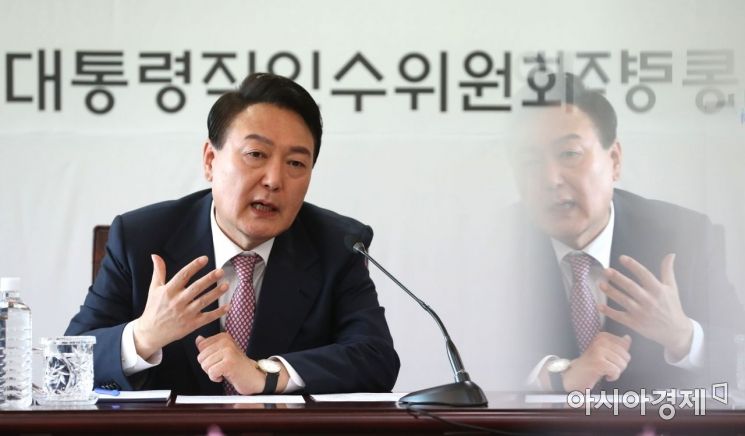 President-elect Yoon Suk-yeol is attending the transition committee secretariat meeting held at the Presidential Transition Committee in Tongui-dong, Jongno-gu, Seoul on the 22nd, delivering opening remarks. Photo by Dongju Yoon doso7@
[Asia Economy Reporter Jeong Dong-hoon] President-elect Yoon Seok-yeol is expected to push for the resumption of the Cheonji Units 1 and 2 and Daejin Units 1 and 2 nuclear power plant projects, which were canceled in 2017, immediately after the new government takes office. This reflects his intention to completely break away from the current administration's energy policy of phasing out nuclear power and to include all previously considered nuclear power plans in the construction targets. If the share of nuclear power increases in line with the carbon neutrality trend, revisions to the power supply and demand plan will also be inevitable.
A key official from the transition team said on the 22nd, "We are reviewing the resumption of construction for the four nuclear reactors canceled in 2017 (Cheonji Units 1 and 2, Daejin Units 1 and 2, each with a generation capacity of 1500 MW), including Shin Hanul Units 3 and 4, which were halted by the Moon Jae-in administration," adding, "We will have no choice but to revise the power supply and demand plan and the basic energy plan." It is known that the transition team is discussing the formation of a task force (TF) related to the energy policy shift, involving stakeholders such as the Economic Subcommittees 1 and 2, the Ministry of Trade, Industry and Energy, and Korea Electric Power Corporation.
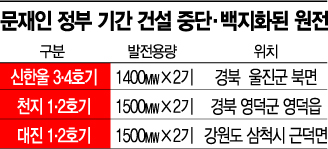
◆Must Align with Renewable Energy=Cheonji Units 1 and 2 underwent design services and site acquisition during the Park Geun-hye administration in 2016, and Daejin Units 1 and 2 also proceeded with services for licensing. However, all were canceled in May 2017 following the Moon Jae-in administration's nuclear phase-out policy. Approximately 3.45 billion KRW was spent on service fees for licensing for Daejin Units 1 and 2. Cheonji Units 1 and 2 are estimated to have incurred a total cost of about 97.92 billion KRW, including site acquisition costs (54.62 billion KRW) and construction and service fees (25.99 billion KRW).
If President-elect Yoon pushes forward with these nuclear power plans, energy policy is expected to change significantly. A transition team official said, "In the global carbon neutrality trend, investment and dissemination of eco-friendly energy such as wind and solar power should continue, while power generation based on fossil fuels like coal and liquefied natural gas (LNG) should be reduced," adding, "We need to restore nuclear power policy to complement renewable energy."
President-elect Yoon was elected with one of his top ten pledges being "achieving feasible carbon neutrality and building a nuclear power superpower." Unlike the current administration, which prohibits extending the lifespan of aging nuclear power plants, he stated that even for nuclear plants whose operating licenses expire, safety will be verified and continued operation will be permitted. It is highly likely that the lifespan extensions of six nuclear reactors whose design lives expire during Yoon's term?including Kori Units 2, 3, and 4, Hanbit Units 1 and 2, and Wolsong Unit 2?will be implemented. Yoon has set a goal to maintain the share of nuclear power at around 30% of the total power generation by increasing nuclear power usage. Under the current administration's nuclear phase-out scenario, the share of nuclear power, currently around 29%, is projected to fall to 6.1?7.2% by 2050.
◆Industrial Value of Nuclear Power=The industrial value of nuclear power is a reason for the decision to restore nuclear power. In South Korea's manufacturing-centered economy, energy prices are directly linked to cost issues. It is a reality that industries such as shipbuilding, steel, refining, semiconductors, and automobiles falter whenever the international prices of fossil fuels rise due to concerns over profit erosion. A business community official said, "Korea fundamentally imports energy and raw materials and exports manufactured goods with added technology," adding, "Export and price competitiveness inevitably disappear when energy prices rise."
Last month, when international natural gas prices surged due to the Russia-Ukraine war, the cost of liquefied natural gas (LNG) power generation exceeded 240 KRW per kWh (kilowatt-hour), which was more than three times higher than the nuclear power generation cost of about 67 KRW during the same period.
© The Asia Business Daily(www.asiae.co.kr). All rights reserved.
![Clutching a Stolen Dior Bag, Saying "I Hate Being Poor but Real"... The Grotesque Con of a "Human Knockoff" [Slate]](https://cwcontent.asiae.co.kr/asiaresize/183/2026021902243444107_1771435474.jpg)
















