[Seoul District News] Yongsan-gu Launches Smart City Infrastructure, Activates Public-Private-Academic Governance, Implements Data-Driven Scientific Administration in 4 Areas with 42 Projects and 7.4 Billion KRW Investment... Converts Waste PET Bottles Collected in Seongdong-gu into High-Quality Recycled Materials for Products Sold to Seongdong Residents... Guro-gu Installs Transparent PET Bottle Collection Bins in Detached Housing Areas
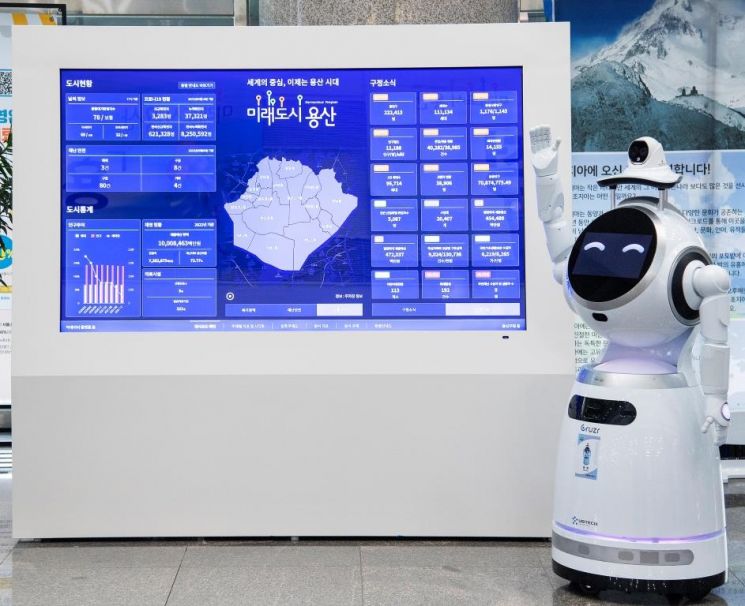 On the 18th, Yongbot is smiling brightly in front of the big data installation in the lobby of Yongsan-gu Comprehensive Administrative Town.
[Asia Economy Reporter Park Jong-il] Yongsan-gu (Mayor Seong Jang-hyun) has established the '2022 Comprehensive Smart City Promotion Plan' to realize a smart future city in Yongsan.
The main contents include ▲ Establishment of smart city infrastructure ▲ Operation of public-private-academic governance ▲ Implementation of data-driven scientific administration ▲ Systematic project management ▲ Participation in external institution contests.
The establishment of smart city infrastructure covers 42 projects in four areas: administration & education, health & welfare, transportation & safety, and culture, tourism & environment. The total project cost is 7.4 billion KRW.
Key projects include the construction of a digital twin public office building, the establishment of a metaverse-based digital Yongsan Craft Museum, advancement of the smart Yongsan network, construction of CCTV smart poles, and improvement of smart sewage odor control.
The operation of public-private-academic governance is a network project enabling cooperation among residents, experts, universities, and companies. The district plans to organize and operate the Smart City Policy Advisory Committee, run a Smart City Policy School, promote cooperation projects between Yongsan-gu and universities/private companies, and hold a Smart City Idea Contest.
A district official said, "We will operate the Smart City Policy School for the first time this year," adding, "With active participation from residents, experts, and various sectors, we will create a smart city Yongsan together."
The implementation of data-driven scientific administration will be promoted through the operation of a big data platform, expansion of public data openness, and quality management. In the second half of this year, a data utilization competition will be held for Yongsan-gu public officials.
The district systematically manages detailed smart city projects. The progress of 42 detailed projects is checked quarterly, and issues are analyzed to ensure thorough project promotion. Separate public officials are assigned to support general smart city, data, IT & informatization, and information & communication fields to facilitate smooth progress of complex informatization projects. At the end of the year, six outstanding employees in smart city promotion will be selected and awarded.
Additionally, the district actively participates in external institution smart city contest projects. In 2021, it challenged external institution contests and secured four projects with 1.3 billion KRW in national and city funds.
Seong Jang-hyun, Mayor of Yongsan-gu, said, "We have comprehensively prepared a smart city implementation strategy to proactively respond to the acceleration of digital transformation," adding, "We will innovate organizational culture to provide future-oriented policies and scientific administrative services based on data."
Last year, the district established a dedicated smart city promotion department, enacted the Yongsan-gu Smart City Creation and Operation Ordinance, and began establishing smart city infrastructure.
In the first half of this year, the district will complete ▲ smart city planning ▲ big data platform construction ▲ digital-based safety management system for aging hazardous facilities, accelerating full-scale smart city promotion.
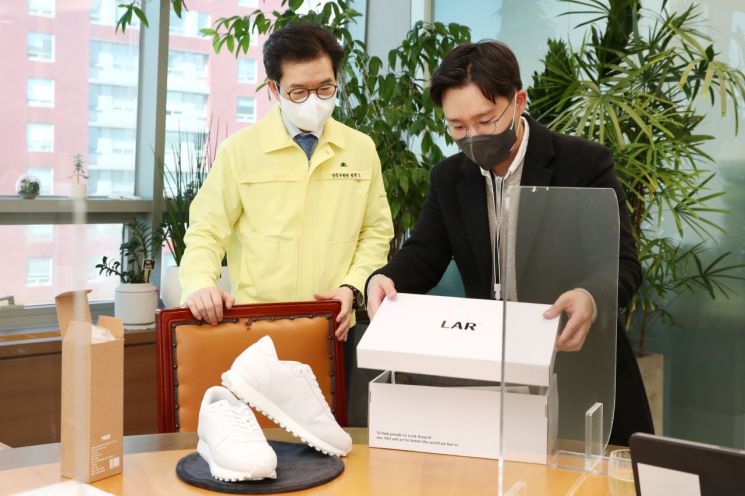 Last October, LAR donated 50 pairs of eco-friendly sneakers to workers at the Seongdong-gu Resource Recovery Center.
Seongdong-gu (Mayor Jung Won-oh) is starting a project to recycle discarded PET bottles from residents into resource-recirculating 'goods' such as shoes and eco-bags for Seongdong-gu residents.
The district signed a business agreement on the 7th with three private companies?RM (CEO Lim Beom-jin), H2 (CEO Hong Dong-woon), and LAR (CEO Gye Hyo-seok)?to establish and utilize a high-quality recycled raw material production system for Seongdong-type waste PET bottles. This establishes a public-private cooperation system to produce products for Seongdong residents using waste PET bottles generated in Seongdong-gu and begins full-scale project promotion.
Waste PET bottles collected through separate collection are crushed, washed, and dried to become flakes (small pieces of PET bottles) used as recycled raw materials. High-quality flakes are reused as long fibers, PET bottles, sheets, containers, films, etc., while low-quality flakes are used as raw materials for household and industrial products such as nonwoven fabrics, cushion fillings, agricultural wire, hangers, and building insulation materials.
Among these waste PET bottles, transparent PET bottles are recycled into high-quality recycled raw materials. Through a refining process for high-quality processing, long fibers are produced and can be used as fabric.
In the collection and recycling process of these waste PET bottles, RM and H2 are responsible for producing high-quality recycled raw materials using recycling technology and machinery for waste PET bottles collected in Seongdong-gu. LAR then designs, develops, produces, and sells products such as shoes, slippers, and eco-bags for Seongdong residents using these high-quality recycled raw materials.
Notably, LAR is a social enterprise that produces and sells sneakers, bags, and other products using waste plastics. It is one of the representative companies that grew in Seongu Anshim Shopping Mall located in Seongsu-dong, established by Seongdong-gu as part of its gentrification prevention policy.
Last October, LAR donated 50 pairs of eco-friendly sneakers called 'Seoul Forest Edition' made from waste PET bottles to workers at the Seongdong Resource Recovery Center.
Starting with this agreement, Seongdong-gu plans to complete the establishment of a high-quality recycled raw material production system for waste PET bottles, brand naming, item selection, design, and commercialization by June this year in cooperation with the three private companies.
Seongdong-gu operates 112 'Seongdong Purumi Recycling Stations,' where mobile separate collection bins are installed at residential area hubs every Thursday and Sunday, and resource managers and residents participate in separate recycling by item, with transparent PET bottles separately sorted and processed.
According to the district's analysis, the collection rate at recycling stations increased from an average of 17% last year to 19% early this year among the total recycling collection volume in Seongdong-gu, indicating that a proper recycling separation culture is taking root.
Jung Won-oh, Mayor of Seongdong-gu, said, "This project meaningfully returns products made from recycled PET bottles discarded by our residents as Seongdong-gu branded products to the residents," adding, "Proper separation and disposal increase the quantity of high-quality recyclables, reduce waste disposal costs, and contribute to resource circulation through recycling. We ask for continued interest and cooperation from residents."
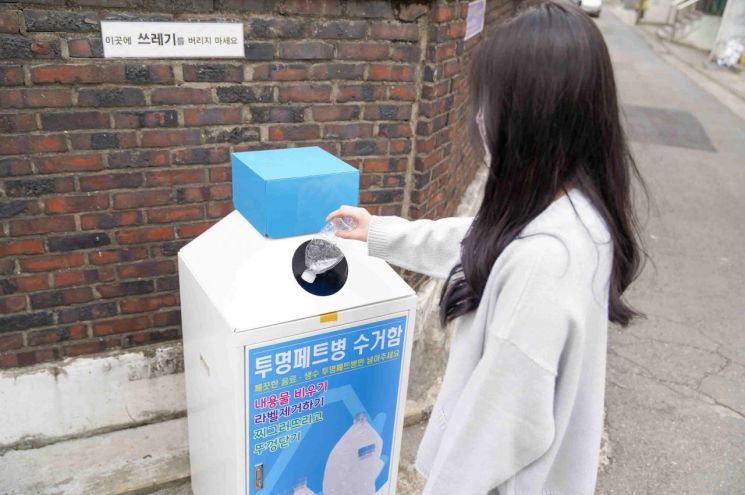
Guro-gu (Mayor Lee Sung) has installed transparent PET bottle collection bins in the detached housing area of Gaebong 1-dong.
Guro-gu announced on the 21st, "From December 25 last year, the 'Transparent PET Bottle Separate Collection System' was fully enforced for detached houses," adding, "To improve convenience in transparent PET bottle disposal and stabilize the system, we are conducting a pilot operation of transparent PET bottle collection bins."
Unlike apartment complexes, detached housing areas lack managers, and all recyclables are mixed and placed in front of houses, causing low recycling rates for transparent PET bottles.
To address this, Guro-gu selected 10 locations in Gaebong 1-dong, where detached houses are densely located, and installed transparent PET bottle collection bins. Residents should check the designated collection days by disposal area: for Sunday, Tuesday, Thursday areas, collection is on Thursday; for Monday, Wednesday, Friday areas, collection is on Friday. Residents place transparent PET bottles in the bins accordingly.
When disposing of transparent PET bottles, residents must empty all contents, remove labels, flatten the bottles, and close the caps before disposal.
Guro-gu plans to gradually expand the installation of collection bins by monitoring disposal status and resident satisfaction with the transparent PET bottle collection bins.
A Guro-gu official said, "Transparent PET bottles are high-quality recycled raw materials used to produce clothing, bags, and other recycled products, so proper separation and disposal are crucial," adding, "We will do our best to promote the successful establishment of the transparent PET bottle separate collection system."
© The Asia Business Daily(www.asiae.co.kr). All rights reserved.
![Clutching a Stolen Dior Bag, Saying "I Hate Being Poor but Real"... The Grotesque Con of a "Human Knockoff" [Slate]](https://cwcontent.asiae.co.kr/asiaresize/183/2026021902243444107_1771435474.jpg)

















