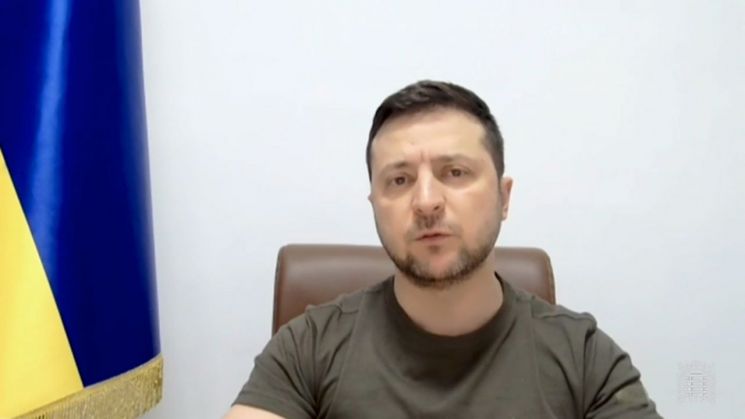
[Asia Economy Reporter Jeong Hyunjin] In the UK, Winston Churchill, the former British Prime Minister, and Shakespeare were mentioned; in the US, the Pearl Harbor attack and the 9/11 terror attacks; and in Germany, the Berlin Wall. Ukrainian President Volodymyr Zelensky, who has been enduring Russian airstrikes for four weeks, recently chose history as a way to appeal for support in speeches to major countries' parliaments.
On the 17th (local time), the daily newspaper The Guardian analyzed and reported that President Zelensky is focusing on each country's history in his parliamentary speeches to appeal for help from the audience. As a former actor, he is emphasizing historical facts that can resonate with the opposing countries, adding to his strengths in delivery and persuasiveness.
In a video speech to German Bundestag members that day, President Zelensky appealed to German Chancellor Olaf Scholz, saying, as former US President Ronald Reagan did in 1987 to Mikhail Gorbachev, then General Secretary of the Soviet Communist Party, in divided Berlin, "tear down this wall." He asked for support to resolve the situation where Russia is erecting a wall between freedom and bondage in Central Europe.
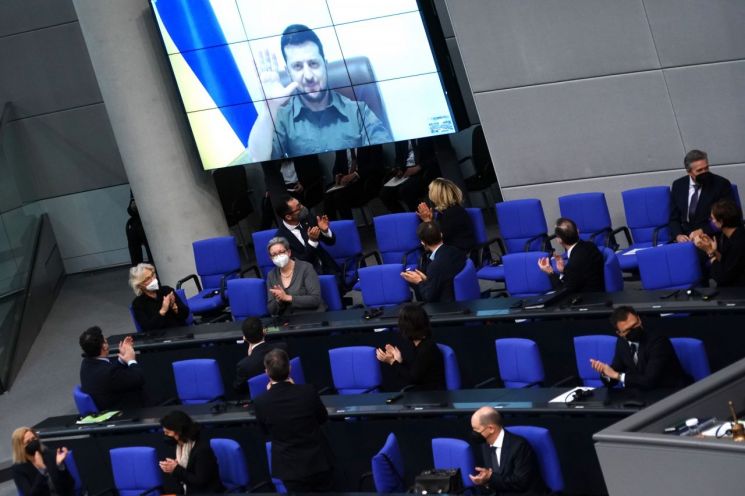
President Zelensky also mentioned the historical similarities between Ukraine's current situation and World War II and the Holocaust, pressing Germany by asking, "What is historical responsibility?" This is interpreted as pointing out that Germany, which carries a sense of historical debt, should take on a significant role in this crisis.
Earlier, in his speech to the British Parliament on the 8th, he drew a parallel to Churchill's speech during World War II, where Churchill declared, "We shall fight on the beaches," rallying Britain's fighting spirit, emphasizing Ukraine's determination and receiving a standing ovation. He said, "When the Nazis tried to take your country, you did not want to lose your country and fought for Britain," adding, "Ukrainians are also showing heroic qualities against the Russian army." He continued, "We will not give up, and we will not be defeated. We will fight in the forests, in the fields, on the beaches, and in the streets."
 Volodymyr Zelensky, President of Ukraine, delivering a speech via video conference at the UK Parliament on the 8th. [Image source=EPA Yonhap News]
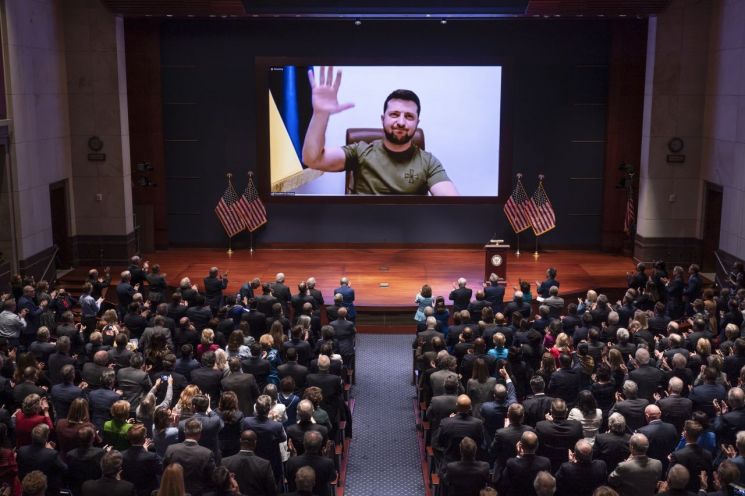 Volodymyr Zelensky, President of Ukraine, delivered a speech via video conference to the U.S. Congress on the 17th and raised his hand in greeting. [Image source=EPA Yonhap News]
The day before, in the US Congress, he appealed to remember the 1941 Japanese attack on Pearl Harbor in Hawaii and the 2001 9/11 terror attacks. President Zelensky said, "Remember the terrible day when the devil tried to turn your city and sovereign territory into a battlefield. Innocent people were attacked," adding, "Just as no one expected it, you could not stop it either. Our country experiences the same thing every day." He also directly requested US President Joe Biden in English without an interpreter to "be a leader of the world."
President Zelensky's speeches have been receiving more attention since the Russian airstrikes began. His video speech to the European Union (EU) on the 1st became a topic of discussion due to the tears and emotional interpretation by interpreter Viktor Shevchenko, who was moved by it. The Guardian quoted Ukrainian government officials saying, "The speechwriters for President Zelensky prepare drafts to make it easier for him to start speaking," and added, "Although his appeals, such as for the establishment of a no-fly zone, have not resulted in outcomes, they were not completely unheeded."
Meanwhile, President Zelensky is scheduled to deliver a speech to the Italian Parliament on the 22nd.
© The Asia Business Daily(www.asiae.co.kr). All rights reserved.
![Clutching a Stolen Dior Bag, Saying "I Hate Being Poor but Real"... The Grotesque Con of a "Human Knockoff" [Slate]](https://cwcontent.asiae.co.kr/asiaresize/183/2026021902243444107_1771435474.jpg)

















