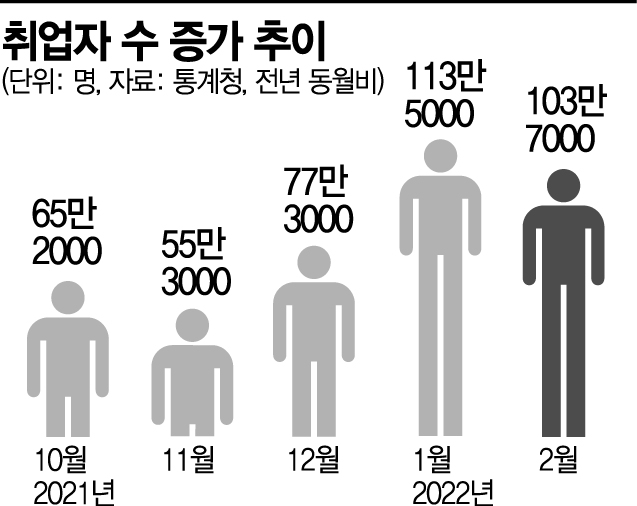
[Asia Economy Sejong=Reporter Kim Hyewon] Despite the spread of the COVID-19 Omicron variant, the number of employed persons increased by more than one million for two consecutive months this year. Although the base effect from the sharp decline of nearly 500,000 to 1 million at the beginning of last year was significant, the employment numbers have shown a clear recovery trend with an increase sustained for 12 months. However, 7 out of 10 new jobs were for people in their 50s and those aged 60 and above, indicating a persistent age gap.
According to the 'February Employment Trends' released by Statistics Korea on the 16th, the number of employed persons last month was 27,402,000, an increase of 1,037,000 compared to the same period last year. Although the increase was slightly smaller than January's (1,135,000), it remained above one million for the second consecutive month. In terms of February figures, this was the largest increase in 22 years since February 2000 (1,362,000). Statistics Korea analyzed that this was largely due to the base effect, strong exports, and industrial structural changes such as non-face-to-face and digital transformation.
Employment increased for two consecutive months across all age groups: those aged 60 and above (451,000), 50s (272,000), 20s (219,000), 40s (37,000), and 30s (15,000). The share of '50s and 60 and above' accounted for 69.7%. The Ministry of Economy and Finance explained that considering the population decline effect for those in their 30s and 40s, the actual increase should be seen as around 100,000.
By industry, employment in accommodation and food services, a sector severely affected by COVID-19, increased by 55,000, continuing the growth trend for three consecutive months. Employment also rose in health and social welfare services (254,000), transportation and warehousing (135,000), and information and communication (128,000), but decreased in wholesale and retail trade (-47,000), associations and organizations, repair and other personal services (-32,000), and finance and insurance (-4,000).
February's employment rate and unemployment rate broke previous records. The OECD-standard employment rate for ages 15-64 in February was 67.4%, up 2.6 percentage points from the same month last year. This is the highest February figure since statistics began in July 1982. The employment rate for those aged 15 and above also reached a record high of 60.6%.
The number of unemployed persons was 954,000, down 399,000 from the same period last year. The unemployment rate fell by 1.5 percentage points to 3.4%, the lowest February figure since the change in survey standards in June 1999. The economically inactive population was 16,857,000, a decrease of 412,000, marking 12 consecutive months of decline.
Hong Nam-ki, Deputy Prime Minister and Minister of Economy and Finance, held a meeting with related ministers (Green Room Meeting) on the morning of the same day and said, "In February, despite the base effect from last year being significantly reduced compared to January, the increase in employment was comparable to January." He added, "While the improvement trend in major employment indicators continues, there are also effects from the temporary expansion of quarantine personnel needs and the full-scale implementation of government job projects," and diagnosed, "Difficulties persist in sectors and groups affected by COVID-19, such as wholesale and retail trade and daily workers."
© The Asia Business Daily(www.asiae.co.kr). All rights reserved.
![Clutching a Stolen Dior Bag, Saying "I Hate Being Poor but Real"... The Grotesque Con of a "Human Knockoff" [Slate]](https://cwcontent.asiae.co.kr/asiaresize/183/2026021902243444107_1771435474.jpg)















