Science and Technology Education Division Transition Team
Expected to Include Many Figures from the Lee Myung-bak Administration
Ministry of Foreign Affairs and Trade Also Mentioned Again
Resource Diplomacy Likely to Regain Momentum
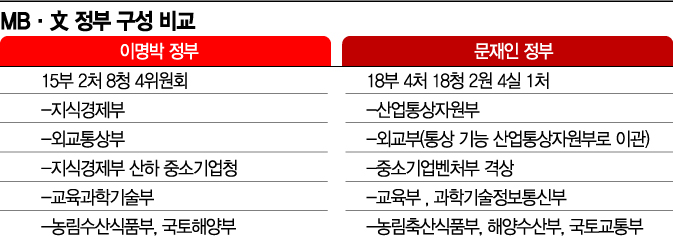
[Asia Economy Reporters Hyunju Lee, Chae-eun Koo, Gimin Lee] It has been reported that the Yoon Suk-yeol presidential transition committee is positively considering a plan to merge the Ministry of Science and ICT and the Ministry of Education.
The Ministry of Education, Science and Technology was maintained during the Lee Myung-bak administration but was split into the Ministry of Future Creation and Science and the Ministry of Education during the Park Geun-hye administration, continuing through the Moon Jae-in administration. If the establishment of the Ministry of Education, Science and Technology is finalized, it is expected that the new government’s organization will resemble that of the Lee Myung-bak administration.
A source from the transition team said, "The Planning and Coordination Subcommittee of the transition committee will handle government organization matters, but the plan to merge the Ministry of Science and Technology and the Ministry of Education is also being closely watched." The transition committee currently has a Science and Technology Education Subcommittee. The secretaries and transition committee members are undergoing personnel verification procedures and will be announced soon.
The Ministry of Education has emphasized reducing its role to the extent that Chairman Ahn pledged to abolish it, so the ministry that was split into the Ministry of Education and the Ministry of Future Creation and Science at the start of the Park Geun-hye administration could revert to the form of the Ministry of Education, Science and Technology during the Lee Myung-bak administration. A government reorganization plan is emerging as an alternative, where science and technology take center stage in line with the Fourth Industrial Revolution era, and education supports this.
The revival of the Ministry of Foreign Affairs and Trade, which was an organization during the Lee Myung-bak administration, is also still valid. Kim Seong-han, secretary of the Foreign Affairs and Security Subcommittee of the transition committee, said, "We will listen to all opinions regarding the Ministry of Foreign Affairs and the Ministry of Industry and make a decision from the perspective of national interest."
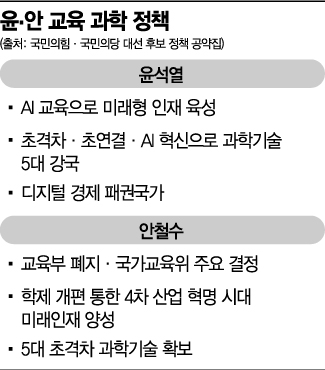
Both the Ministry of Education, Science and Technology and the Ministry of Foreign Affairs and Trade changed their names after the Lee Myung-bak administration. In particular, most transition committee members were appointed during that administration, increasing the likelihood of these changes. Kim, secretary of the Foreign Affairs and Security Subcommittee, served as the 2nd Vice Minister of the Ministry of Foreign Affairs and Trade during the Lee Myung-bak administration. Transition committee member Kim Tae-hyo was the Blue House Foreign Strategy Secretary, and transition committee member Lee Jong-seop was responsible for security policy at the Blue House. Additionally, Ahn Cheol-soo, chairman of the presidential transition committee, pledged that "the Ministry of Industry should only handle industry and energy, focusing on energy convergence strategies, and trade should be separated and moved to the Ministry of Foreign Affairs."
Trade affairs have historically been a point of contention between the Ministry of Industry and the Ministry of Foreign Affairs during regime changes, drawing more attention. Currently, under the Moon Jae-in administration, trade policy is managed by the Ministry of Trade, Industry and Energy, following the structure of the Park Geun-hye administration. During the Park Geun-hye transition committee, opposition to this reorganization was expressed, and reasons why the Ministry of Foreign Affairs and Trade should handle trade were directly conveyed to the National Assembly.
If the Ministry of Foreign Affairs reverts to the Ministry of Foreign Affairs and Trade, the "resource diplomacy" policy from the Lee Myung-bak administration is expected to regain momentum. Although President-elect Yoon did not explicitly mention resource diplomacy in his pledges, he stated in the economic revitalization section that "we will securely stabilize the supply chain of key raw materials and parts to firmly prevent a second urea solution crisis." To this end, Yoon proposed alternatives such as △establishing emergency measures for highly externally dependent items △establishing a policy coordination system covering technology, security, and trade △diversifying import sources △strengthening inventory maintenance.
The business and industrial sectors have repeatedly emphasized the need for resource diplomacy in conjunction with the launch of the Yoon Suk-yeol administration. South Korea, which heavily depends on raw material imports, experienced a shortage of urea solution last year when the Chinese government halted exports. Earlier, in 2019, the Japanese government imposed export restrictions, causing significant damage. Because of this, the resource diplomacy policy is likely to gain renewed momentum. The Lee Myung-bak administration, launched in 2008, pursued resource diplomacy from the early days of its term with a plan to raise the energy self-sufficiency rate from the 4% range to 25% during its tenure. He also conducted 13 overseas trips and signed 24 memorandums of understanding related to resource development.
© The Asia Business Daily(www.asiae.co.kr). All rights reserved.
![Clutching a Stolen Dior Bag, Saying "I Hate Being Poor but Real"... The Grotesque Con of a "Human Knockoff" [Slate]](https://cwcontent.asiae.co.kr/asiaresize/183/2026021902243444107_1771435474.jpg)
















