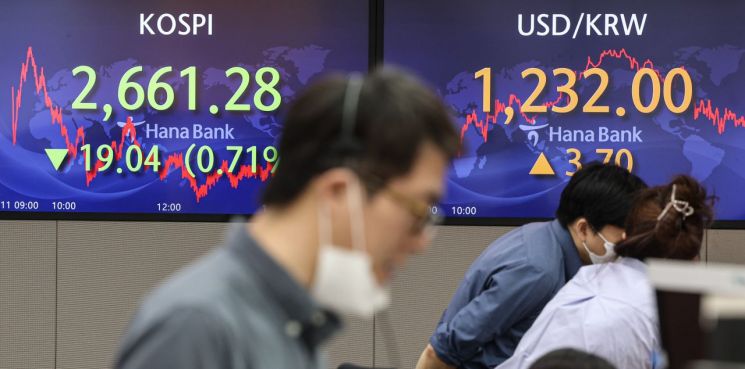
[Asia Economy Reporter Lee Jung-yoon] Due to the impact of COVID-19, the lockdown of Shenzhen City in Guangdong Province, China, and the sharp rise in the won-dollar exchange rate, foreign selling continued, leading to a decline at the close.
On the 14th, the KOSPI closed at 2,645.65, down 0.59% (15.63 points) from the previous trading day. The KOSPI started off flat and recovered to the 2,660 level around 9:20 a.m., but ended lower as foreigners poured out sell orders. Foreigners net sold 639.4 billion KRW in the KOSPI market, pulling the index down. Individuals net bought 625.2 billion KRW, and institutions net bought 5 billion KRW.
With Shenzhen City health authorities issuing a stay-at-home order and city lockdown from today until the 20th, foreign selling intensified further. Shenzhen is home to Shenzhen Port, the third largest in China in terms of cargo volume, so exceptions were made for logistics-related sectors such as transportation, but import-export customs procedures are inevitably operating abnormally. Additionally, Foxconn, the world's largest electronics contract manufacturer, plans to suspend operations at its iPhone production plant due to the Shenzhen lockdown and transfer production volume elsewhere.
Seo Sang-young, a researcher at Mirae Asset Securities, explained, "Many companies including Foxconn have halted their factories, causing capital outflows from the Chinese stock market, which also affected the domestic market," adding, "The depreciation of the won likely influenced the foreign selling trend as well." On this day, the won-dollar exchange rate surpassed 1,240 won for the first time in 1 year and 10 months since May 2020, closing at 1,242.3 won.
Concerns over interest rate hikes by the U.S. Federal Reserve (Fed) also dampened investor sentiment. The Federal Open Market Committee (FOMC) is expected to raise interest rates by about 0.25 percentage points this week. Kim Hyung-ryul, head of the research center at Kyobo Securities, said, "Although the rate hike is a foregone conclusion, the period when investor sentiment is less affected will likely be after at least three rate hikes, during which an adjustment period will occur."
Among the top market capitalization stocks, LG Energy Solution recorded the largest drop, falling more than 7%. This was followed by LG Chem (-3.18%), Hyundai Motor (-2.66%), Kia (-1.71%), and SK Hynix (-0.85%). On the other hand, Samsung SDI (2.08%), Kakao (1.97%), Samsung Biologics (1.52%), and Samsung Electronics (0.29%) showed gains, while Naver (NAVER) remained flat.
By sector, textiles and apparel (-7.2%), chemicals (-2.47%), transportation equipment (-1.67%), non-metallic minerals (-1.61%), mid-cap stocks (-1.52%), and distribution (-1.49%) declined. Telecommunications (3.24%), steel and metals (1.8%), transportation and warehousing (1.41%), banking (1.39%), insurance (0.75%), and pharmaceuticals (0.62%) rose.
On the same day, the KOSDAQ index closed at 872.44, down 2.16% (19.27 points) from the previous session. The index opened at 893.18, up 0.16% (1.47 points) from the previous day, but turned lower early in the session and widened its losses. Foreigners and institutions net sold 332.9 billion KRW and 153.1 billion KRW respectively, while individuals net bought 505.9 billion KRW.
Among the top market capitalization stocks, Celltrion Healthcare and Celltrion Pharm, which resolved uncertainties related to accounting fraud after four years, closed up 5.11% and 6.09%, respectively. Conversely, second battery-related sectors such as L&F (-8.56%) and EcoPro BM (-5.7%) saw large declines. Game-related sectors like Wemade (-5.59%) and Kakao Games (-2.14%) also fell.
© The Asia Business Daily(www.asiae.co.kr). All rights reserved.
![Clutching a Stolen Dior Bag, Saying "I Hate Being Poor but Real"... The Grotesque Con of a "Human Knockoff" [Slate]](https://cwcontent.asiae.co.kr/asiaresize/183/2026021902243444107_1771435474.jpg)















