Decline in the First 1-2 Years After the Last Four Presidential Elections
Surge Toward the End of the Term... Policy Lag, etc.
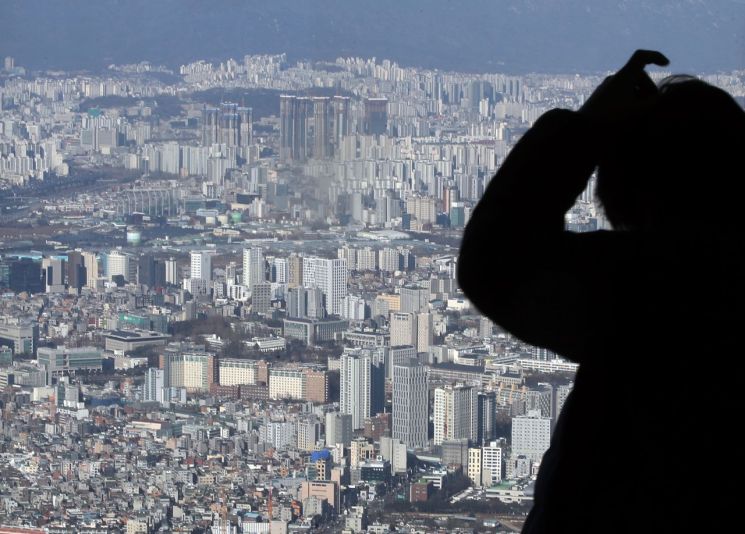 View of city apartments from 'Seoul Sky,' the observation deck of Lotte World Tower in Songpa-gu, Seoul
 Although rumors that "housing prices rise after the presidential election" are spreading in the real estate market, empirical data suggest that this is far from the truth. In the four recent elections, housing prices either remained stable or declined in the following year. On the other hand, housing prices have repeatedly shown greater volatility toward the end of administrations, which can be attributed to the "policy lag"?the time it takes for policies established early in the administration to impact the market.
According to KB Real Estate Housing Statistics as of the 8th, the housing price change rate in 2002, the year of the 16th presidential election, sharply dropped from 16.43% to 5.74% the following year. The downward trend continued the next year, with the 2004 change rate recording -2.07%. This pattern of peaking in the election year and declining in the first one to two years of the administration was observed in most elections. In 2007, the year of the 17th presidential election, the housing price change rate was 3.14%, which then fell to 3.11% in 2008 and 1.46% in 2009. In 2017, the year of the 19th election, it was 1.24%, rebounded to 3.16% the following year, but the increase slowed to 0.24% the year after.
Volatility tends to increase toward the latter half of administrations rather than the beginning. The housing price change rates surged to 11.60% in 2006, 6.86% in 2011, and 4.42% in 2015, corresponding to the third to fourth years of those administrations. This pattern was also repeated during the Moon Jae-in administration, with the 2021 change rate reaching 14.97%, the highest since 2002.
Past governments have launched numerous real estate policies early in their terms aimed at either stabilizing or stimulating the market, with the effects typically manifesting in the later years of their terms. For example, the Lee Myung-bak and Park Geun-hye administrations focused on revitalizing the real estate market by significantly easing regulations. Early in Lee Myung-bak’s term, amid worsening domestic and international conditions such as the 2008 global financial crisis and concerns over a housing market crash, his administration promoted transaction activation. Measures included easing Loan-to-Value (LTV) ratios, relaxing reconstruction and resale regulations, and substantially lifting speculative overheating zone restrictions. Similarly, the Park Geun-hye administration used real estate as a tool for economic stimulus, implementing policies such as temporary capital gains tax exemptions, first-time homebuyer acquisition tax exemptions, and easing LTV and Debt-to-Income (DTI) ratio regulations during the first one to two years. Housing price change rates, which had remained in the 0% range early in the term, rebounded to 2.10% in 2014 and 4.42% in 2015.
Conversely, the Roh Moo-hyun administration implemented policies aimed at stabilizing housing prices during its first one to two years, including the introduction of comprehensive real estate tax, strengthening capital gains tax on multiple homeowners, tightening LTV ratios, and mandating actual transaction price reporting. As sellers flooded the market, the 2004 housing price change rate turned negative for the first time since the 1997 financial crisis. However, the results were contrary to expectations. The surge in multiple-homeowner listings led to a shortage of rental properties. As rental market instability grew, tenant demand rapidly shifted to purchase demand. In the third year of the administration, 2005, the housing price change rate rebounded to 4.01%, then soared to 11.60% the following year. This is similar to the "panic buying" phenomenon observed in the mid-term of the Moon Jae-in administration.
Presidential candidates for the 20th election are also promising a barrage of policies aimed at stabilizing the real estate market. Although there are differences in scale?such as supplying 2 to 3 million housing units, easing reconstruction and redevelopment regulations, and relaxing holding and capital gains taxes?the general direction is to reduce the burden on market participants. As before, policy effects are more likely to appear gradually with a time lag rather than immediately. Lim Byung-chul, Senior Researcher at Real Estate 114, stated, "Given that the large-scale housing supply plans proposed by the two leading presidential candidates will take considerable time to have an actual effect on the market, it is likely that the real estate market fluctuations observed during previous administrations will be repeated."
© The Asia Business Daily(www.asiae.co.kr). All rights reserved.
![Clutching a Stolen Dior Bag, Saying "I Hate Being Poor but Real"... The Grotesque Con of a "Human Knockoff" [Slate]](https://cwcontent.asiae.co.kr/asiaresize/183/2026021902243444107_1771435474.jpg)















