Lockheed Martin Demanded Reverse Cost Sharing in F-35 Contract
No Accountability Imposed on Defense Acquisition Program Administration Despite Project Delays
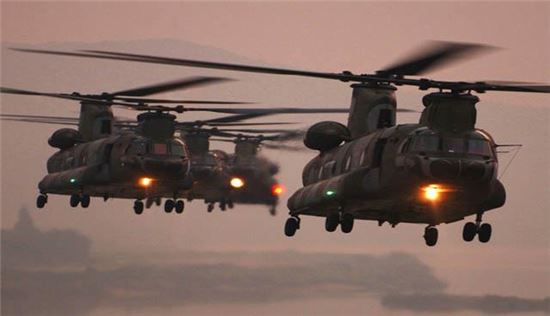
[Asia Economy Yang Nak-gyu, Military Specialist Reporter] The Army's large-scale mobility helicopter project is set to commence in earnest. This project involves importing large mobility helicopters from abroad to replace the aging CH-47D (Chinook) currently operated by the Army, with a project budget exceeding 1 trillion KRW.
On the 7th, a government official stated, "On the 4th, a business briefing was held for overseas defense companies, and approximately 1.31 trillion KRW will be invested by 2032 to introduce about 20 large mobility helicopters."
The Defense Acquisition Program Administration (DAPA) halted the performance upgrade project for the Army's CH-47 large mobility helicopter in 2020. At that time, DAPA explained, "After comprehensively considering schedule, performance, and cost, the Defense Acquisition Program Committee decided to discontinue the CH/HH-47D performance upgrade project."
In the large mobility helicopter project, candidates are expected to include the U.S. companies Boeing and Lockheed Martin, as well as European companies Leonardo and Airbus Helicopters. Boeing plans to offer the latest 'Chinook Block II,' while Lockheed Martin will present the CH-53K King Stallion, produced by its subsidiary helicopter manufacturer Sikorsky.
Some voices are calling for sanctions if overseas defense companies unilaterally evade responsibility during the process of importing weapons from abroad.
In 2013, when Lockheed Martin's F-35A was selected as South Korea's next-generation fighter, Lockheed Martin agreed to provide one military communications satellite as an offset deal. However, they delayed the project by one year and six months by demanding excessive cost-sharing from the Korean government. In response, DAPA held the 97th Defense Acquisition Program Committee meeting in November 2016 and announced, "The 'Military Communications Satellite Project,' which was promoted as part of the offset deal for introducing Lockheed Martin's F-35 fighter but was suspended, will be implemented as originally planned." However, they also stated, "The project will resume on the condition that no responsibility is assigned for the delay," which led to criticism that Lockheed Martin was being favored. At that time, DAPA did not disclose the original contract amount or how much the project costs had increased.
DAPA has raised performance bonds for highly important projects to prevent recurrence of such incidents, but there are criticisms that this has limitations. To enhance the performance capability of overseas defense companies, it is suggested that the exemption criteria for liquidated damages should be eliminated. Liquidated damages are a type of penalty imposed by DAPA when defense companies fail to meet delivery deadlines.
Inside and outside the military, there is backlash over the severe disparity in liquidated damages imposed on domestic and foreign defense companies, and the exemption criteria are criticized as ambiguous, described as "like a nose ring if attached to the nose, or an earring if attached to the ear." Article 26 of the National Contract Act, which specifies exemption reasons for defense companies, includes natural disasters, government policies, strikes, fires, wars in the exporting country, undiscovered technical supplements due to national reasons, and specification changes.
An industry official said, "If regulations for domestic and foreign companies vary depending on the situation, issues of fairness and equity inevitably arise," adding, "Clear standards are necessary when importing weapons from abroad."
© The Asia Business Daily(www.asiae.co.kr). All rights reserved.
![Clutching a Stolen Dior Bag, Saying "I Hate Being Poor but Real"... The Grotesque Con of a "Human Knockoff" [Slate]](https://cwcontent.asiae.co.kr/asiaresize/183/2026021902243444107_1771435474.jpg)














