'Mid-term Plan for Food Ecology Transition Education' to be promoted until 2024
Annual local food and fruit vouchers provided once a year to students
Modernization of cafeterias and expansion of cooking staff allocation
Green Meal Day increased from twice a month to 3-4 times a month starting 2024
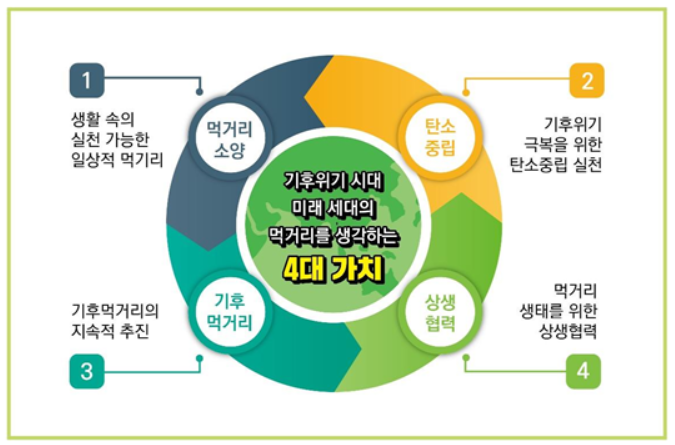
[Asia Economy Reporter Han Jinju] The Seoul Metropolitan Office of Education announced on the 6th that it has established the 'Mid-term Development Plan for Food Ecological Transition Education' and will gradually implement it by 2024 to shift the paradigm of school meals toward food carbon neutrality.
The mid-term development plan for food ecological transition education is based on four core principles: ▲ Everyday food practices that can be implemented in daily life ▲ Carbon neutrality practices to overcome the climate crisis ▲ Continuous promotion of climate-friendly food ▲ Win-win cooperation with local communities for food ecology.
According to a survey conducted last month by the Seoul Metropolitan Office of Education targeting 12,332 Seoul students, parents, and teachers, 92.6% responded that our food supply could become insufficient due to the climate crisis. Many (90.6%) also believe that food production and consumption methods can impact climate change.
More than half responded that eating less meat can reduce carbon emissions (68.4%) and that they are willing to practice intermittent vegetarianism (55.5%). Regarding the frequency of Green Meal Days, once a week (42.1%) was the most common, followed by the current twice a month (8.8%).
The Seoul Metropolitan Office of Education plans to improve awareness by encouraging student participation, providing local food and fruit vouchers to new students once a year, and holding climate food student cooking competitions. It will develop educational material-type menus that indicate vegetarian levels and allergies with symbols or colors to enhance inclusivity. Food ecological transition education will also be conducted for citizens, including faculty and parents.
An integrated support platform for 'Ontong Green' food ecological transition education will be developed. Content curation and metaverse contests will also be held. The modernization project of school cafeterias to reduce carbon footprints will be activated.
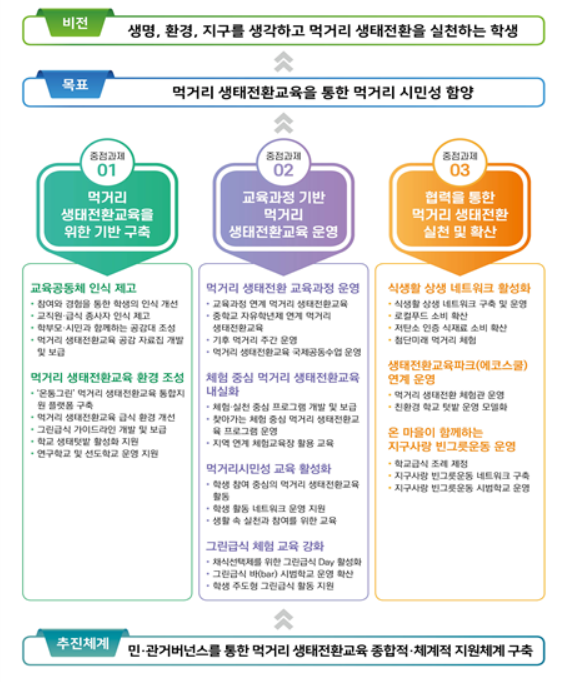
Budget support will be provided to use organic or domestically produced ingredients for school meals, and local food consumption will be promoted. Guidelines for 'Green Meals,' including quality standards for school meal ingredients, will be established, and standard green meal recipes will be distributed. Support will be given to operate school ecological gardens in cooperation with local communities, and research and leading schools for food ecological transition will be operated.
The staffing standards for cooking workers will also be expanded. Currently, the average number of meals per cooking worker in elementary schools is 113.6, which is higher in Seoul compared to Daejeon, Incheon, and Busan, and more than twice the average of 51.1 in 11 major public institution cafeterias. The proportion of schools in Seoul exceeding the average number of meals per worker is 81.4%, compared to the national average of 42%, reaching 1.5 to 2 times the average.
The 'Green Meal Day' for vegetarian options will be gradually increased from the current recommendation of twice a month to 3-4 times a month starting in 2024. The number of pilot schools for the 'Green Meal Bar' will increase from 20 elementary, middle, and high schools this year to 30 schools next year and 40 schools in 2024.
To provide leftover food, mostly composted at schools, to local communities, the Seoul Metropolitan Office of Education is promoting the enactment of a school meal ordinance for the 'Earth Love Empty Bowl Movement.' The number of pilot schools for this movement will expand from 22 schools this year to 110 schools in 2024.
Cho Hee-yeon, Superintendent of the Seoul Metropolitan Office of Education, said, "We will continue to strive to support Seoul students not as passive consumers who simply accept the food system but as citizens with the rights and responsibilities to ensure food security and sustainability, consuming food while connecting their consumption to producers and growing as active participants in civic agriculture."
© The Asia Business Daily(www.asiae.co.kr). All rights reserved.
![Clutching a Stolen Dior Bag, Saying "I Hate Being Poor but Real"... The Grotesque Con of a "Human Knockoff" [Slate]](https://cwcontent.asiae.co.kr/asiaresize/183/2026021902243444107_1771435474.jpg)
















