Hyundai Motor and 4 Affiliates Have Been Waiting Since Last Year
As Approval Procedures Slow Down, Companies Say "Not Clinging"
Strengthening Korea-Style RE100 Implementation and Carbon Reduction Projects
[Asia Economy Reporter Moon Chaeseok] The approval process for joining 'RE100,' organized by the UK-based nonprofit The Climate Group, has been slow, causing frustration among companies. Rather than obsessing over joining RE100, a growing number of companies are focusing on implementing a Korea-style RE100 and strengthening carbon reduction projects. RE100 is a campaign to produce products using electricity generated solely from renewable energy. It excludes coal-fired power, oil, as well as 'new energies' like hydrogen and fuel cells, allowing only 'renewable energy' sources such as solar and wind power.
According to the industrial sector and the international Carbon Disclosure Project (CDP), the Korean regional partner of RE100, Hyundai Motor, Kia, Hyundai Mobis, Hyundai Wia, and Hyundai Transys?five affiliates?have been waiting for approval from The Climate Group since announcing their intention to join at the end of July last year. Although the announcement was made at the group level, each affiliate is independently proceeding with the application process based on their own carbon reduction projects. Mobis submitted eligibility documents around the end of July, and Wia around early August.
The problem is that the approval process conducted by The Climate Group and CDP, which are responsible for membership approval, has been slow. A CDP Korea Committee official stated, "For Hyundai Motor affiliates, the membership approval is under review, but we cannot confirm the timing of approval." The Climate Group and CDP are known for meticulously scrutinizing the main business and carbon emissions of applicant companies according to RE100 criteria. Coal-fired power companies and oil refiners are excluded from membership. Petrochemical companies must also undergo thorough verification of their main business and carbon emissions. Even industries like holding companies that do not directly emit carbon can be excluded if any of their affiliates are coal-fired power companies or oil refiners. Especially as The Climate Group has shifted its policy to not increase the number of member companies, the approval process is becoming more stringent.
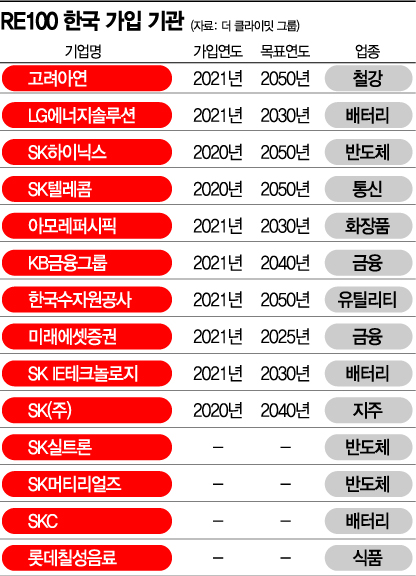
A CDP Korea Committee official said, "Until the year before last, when SK became the first domestic company to join, we encouraged companies to join, but now we understand that most major companies are conducting internal reviews, and we also plan not to accept too many companies." He added, "This is because there is a risk that companies might misuse RE100 as a 'greenwashing' tool?pretending to be environmentally friendly by joining but not taking action."
In this situation, companies are showing a stance of not being overly concerned about joining RE100. Hanwha Solutions has decided to pursue a 'Korea-style RE100' by converting 100% of the electricity, which accounts for 70% of its total greenhouse gas emissions, to renewable energy. LG Chem recently signed a joint response memorandum of understanding (MOU) with Namdong Power to achieve RE100, but separately stated that it cannot confirm whether it will join the global RE100.
SK Energy, an oil refiner that cannot join RE100, is actively engaged in 'RE100-related activities' such as the 'Energy Super Station' project, which produces renewable energy at gas stations to supply electric vehicle chargers. GS Caltex signed an MOU with Korea Electric Power Corporation (KEPCO) as early as September 2020 and is accelerating the installation of electric vehicle charging stations at over 2,800 gas stations nationwide. An industry insider noted, "Joining RE100 is seen mainly as a risk-hedging strategy for some major companies with overseas operations in Europe and elsewhere, rather than something to be overly concerned about." He added, "Rather than joining RE100, it would be more reasonable for companies to conduct eco-friendly business based on their own carbon neutrality manuals and respond to major issues such as the carbon border tax systems and emissions trading scheme price trends that will be implemented in Europe and the U.S. in 2023 and 2025, respectively, as they arise."
© The Asia Business Daily(www.asiae.co.kr). All rights reserved.
![Clutching a Stolen Dior Bag, Saying "I Hate Being Poor but Real"... The Grotesque Con of a "Human Knockoff" [Slate]](https://cwcontent.asiae.co.kr/asiaresize/183/2026021902243444107_1771435474.jpg)
















