Government to Propose 'Resource Security Special Act' in First Half of This Year... Aiming for Enactment Within the Year
Comprehensive Coverage of Renewable Energy and Rare Minerals... Strengthening Supplier Stockpiling Obligations
Concerns Over 'Government-Controlled Management'... "Significant Corporate Opposition Expected"
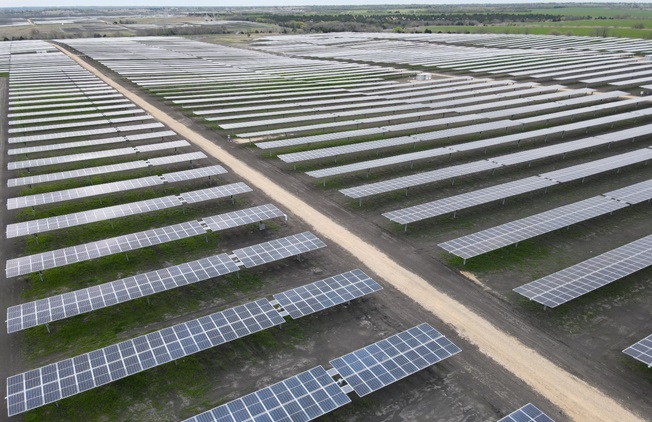 Hanwha Q CELLS' solar power plant located in Texas, USA. The photo is unrelated to specific expressions in the article.
 Photo by Asia Economy DB
[Asia Economy Sejong=Reporter Lee Jun-hyung] The government is pushing for a plan to mandate the stockpiling of renewable energy through the enactment of a special law. The core rare minerals, such as rare earth elements, which are key materials for secondary batteries, will be designated as ‘energy transition strategic minerals’ to strengthen supply chain management. As major countries increasingly weaponize resources, the government aims to establish a national supply management system that encompasses all resources.
According to related ministries on the 14th, the Ministry of Trade, Industry and Energy is promoting the enactment of the ‘Resource Security Special Act’ with the goal of passing it through the National Assembly within this year. The ministry plans to propose the bill in the form of a member’s bill in the first half of this year. The bill’s main sponsor will be Representative Hwang Un-ha of the Democratic Party of Korea. Since the second half of last year, the Ministry of Trade, Industry and Energy has been reviewing discussions related to the special law with Representative Hwang. Considering the imminent presidential election situation, the timing of the bill’s proposal is reportedly being coordinated for after April this year.
The government’s push for the special law stems from the judgment that the supply management system for renewable energy and key minerals is weak. Unlike traditional energy sources, renewable energy lacks a legal basis for the government to control supply and demand through stockpiling or release. While some key minerals such as rare earth elements and tungsten have stockpiles secured through the Public Procurement Service and Korea Mineral Resources Corporation, the government cannot intervene in the private sector.
The core is to establish a crisis response system. This involves developing a ‘Korean-style Resource Security Crisis Response Manual’ that can respond to various situations in the event of a resource crisis, such as the shortage of urea solution that emerged at the end of last year. As part of crisis response, the government will also push to mandate stockpiling by resource and renewable energy suppliers. For renewable energy converted into electricity, such as wind and solar power, stockpiling of raw materials necessary for energy generation will be mandatory. For example, the stockpiling obligation will be set for polysilicon, a key material for solar panels. Ammonia, optimized for hydrogen transport, will also be subject to mandatory stockpiling. Rare minerals such as rare earth elements will become subject to stockpiling obligations once the Minister of Trade, Industry and Energy designates them as energy transition strategic minerals.
Some voices express concerns about ‘government-led (官治) management.’ There are criticisms that the bill strengthens government intervention in the private sector, which could lead to excessive interference in management rights.
Professor Kang Cheon-gu of the Department of Energy Resources Engineering at Inha University said, “The plan to strengthen stockpiling obligations for private suppliers will likely face significant opposition from companies,” adding, “Resource security strategy should involve both resource development and stockpiling, but the bill is focused only on stockpiling.”
© The Asia Business Daily(www.asiae.co.kr). All rights reserved.
![Clutching a Stolen Dior Bag, Saying "I Hate Being Poor but Real"... The Grotesque Con of a "Human Knockoff" [Slate]](https://cwcontent.asiae.co.kr/asiaresize/183/2026021902243444107_1771435474.jpg)















