Dongdaemun 'Beauty Convergence' New District Designation 추진... Yeouido - Planning, Yangjae - District Designation to be Completed Within the Year
Acquisition Tax Reduction, Excellent Autonomous District Funding Support and Other District Designation Incentives Strengthened
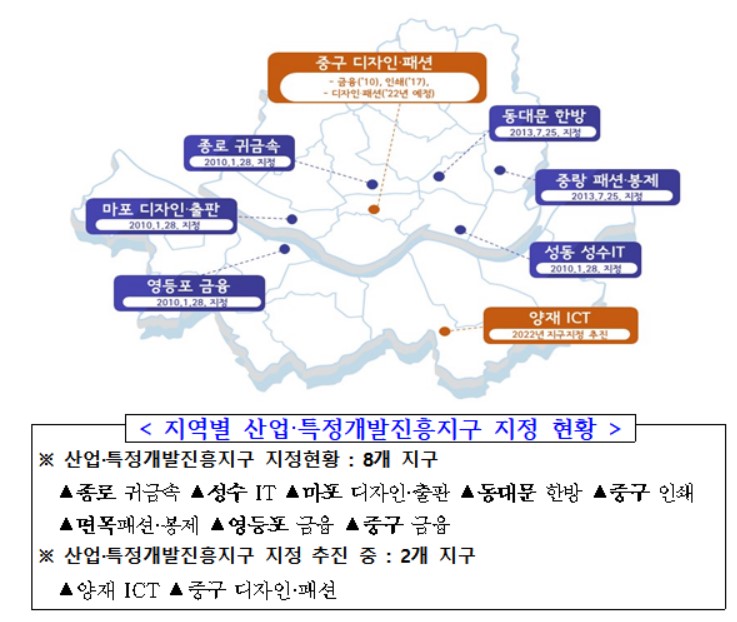
[Asia Economy Reporter Lim Cheol-young] The Seoul Metropolitan Government is undertaking a major overhaul of the ‘Industrial and Specific Development Promotion District’ system. Through ‘Seoul Vision 2030,’ Seoul aims to actively utilize the ‘Industrial and Specific Development Promotion District’ system to revitalize the industrial ecosystem and enhance urban competitiveness, ensuring that the strategic industry development plans can flourish around related regional hubs.
According to Seoul on the 13th, the main improvements to the ‘Industrial and Specific Development Promotion District’ system include ▲designation of new districts and revitalization of existing districts for strategic industry development ▲strengthening benefits for district designation such as acquisition tax reductions and incentives for autonomous districts ▲simplification of the district designation process to shorten the required period (from 8 years and 6 months to within 2 years for district designation and within 4 years for district unit plans).
First, to foster strategic industries that will be Seoul’s future growth engines, a new designation is being pursued for the Dongdaemun area (beauty convergence). The sluggish Yeouido area (finance) will complete its promotion plan within the year. Yangjae, selected as a candidate site last year, will finalize its district designation within the year. Yeouido was designated as a ‘Financial Specific Development Promotion District’ in 2010, but the follow-up financial activation promotion plan has not been established. The city plans to closely cooperate with Yeongdeungpo-gu, the entity responsible for the plan, to ensure the promotion plan is established within the year in connection with the ‘Asia Financial Hub City, Seoul Basic Plan’ announced last year.
Additionally, the DDP area will be expanded and re-designated as the ‘Dongdaemun Beauty Convergence Specific Development Promotion District,’ encompassing the beauty industry and Hallyu-linked culture and tourism content industries. The Yangjae-dong area in Seocho-gu, newly selected as a candidate site for the ‘Specific Development Promotion District’ to foster AI and ICT industries, will proceed with formal designation as a promotion district through the Promotion District Deliberation Committee and Urban Planning Committee within the year.
Conversely, districts where conditions have changed and project progress is sluggish after designation will be encouraged to reconsider their business plans, including industry conversion or district scope adjustments. If requested by autonomous districts and local communities, designation cancellation will also be considered. An industrial community will be formed within the districts to operate organizations where stakeholders from industry, academia, and government directly participate in revitalization efforts.
Incentives for district designation will also be strengthened. In addition to existing incentives such as relaxed building regulations, financial loans, and anchor facility creation, acquisition tax reductions and financial support for autonomous districts will be newly promoted starting this year. The city is re-pursuing acquisition tax reductions, which were initially planned in 2010 but were abandoned due to deteriorated financial conditions caused by the financial crisis and concerns over real estate speculation. Reflecting changes over the past decade, the city plans to revise related ordinances within the year to allow acquisition tax reductions when recommended industries are attracted to each district.
Financial support for autonomous districts, the main actors in district revitalization, will also begin next year. Based on evaluations of district project performance and future revitalization plans, outstanding autonomous districts will receive an average of 400 million KRW per district as ‘District Revitalization Funds.’ This is expected to provide the momentum for industrial revitalization projects that autonomous districts have been unable to undertake due to budget constraints.
Furthermore, the district designation process will be greatly simplified, reducing the usual 8 years and 6 months required for the process including district unit plans to within 4 years. This measure is based on the city’s own analysis that the existing designation process is complex and time-consuming, limiting responsiveness to rapidly changing industrial trends. Starting this year, public viewing and council opinion hearings will be conducted collectively at the district designation proposal stage, and the designation of promotion districts and the establishment and approval of promotion plans will proceed simultaneously. Pre-consultations with experts will also be supported to shorten deliberation times.
Alongside this overhaul of the ‘Industrial and Specific Development Promotion District’ system, Seoul will actively pursue designation under the central government’s industrial site system. Additionally, the city plans to make every effort to revitalize strategic industries, including continuing negotiations regarding the metropolitan exclusion clause in the government’s Regulatory Free Zone system.
The Yangjae area, being developed as an AI industry hub, will pursue designation as a ‘Regional Specialized Development Zone’ to create synergy with the city’s ‘Specific Development Promotion District.’ The ‘Venture Business Promotion Zone,’ which offers acquisition and property tax reduction benefits, currently has five locations, and a full survey of autonomous districts is underway to allow for additional designations.
Hwang Bo-yeon, Director of Seoul’s Economic Policy Office, said, “Industries such as artificial intelligence, finance, and beauty are core sectors for Seoul’s leap as a global economic city. To strengthen the competitiveness of these industries, we will concentrate the city’s institutional capabilities, including activating specific development promotion districts and providing acquisition tax reduction incentives.” He added, “If we fully utilize not only Seoul’s systems but also the central government’s Regional Specialized Development Zones and Venture Business Promotion Zones, Seoul’s future industrial competitiveness will advance significantly.”
© The Asia Business Daily(www.asiae.co.kr). All rights reserved.
![Clutching a Stolen Dior Bag, Saying "I Hate Being Poor but Real"... The Grotesque Con of a "Human Knockoff" [Slate]](https://cwcontent.asiae.co.kr/asiaresize/183/2026021902243444107_1771435474.jpg)
















