296 Factories in Industrial Complex... Major Companies' Factories Located Within 500m~3km
Companies United on CEO Punishment Issue, Calling for Establishment of "Safety and Health Management System"
First Company Sampyo Industry CEO Booked... CEO Punishment Becoming a Reality
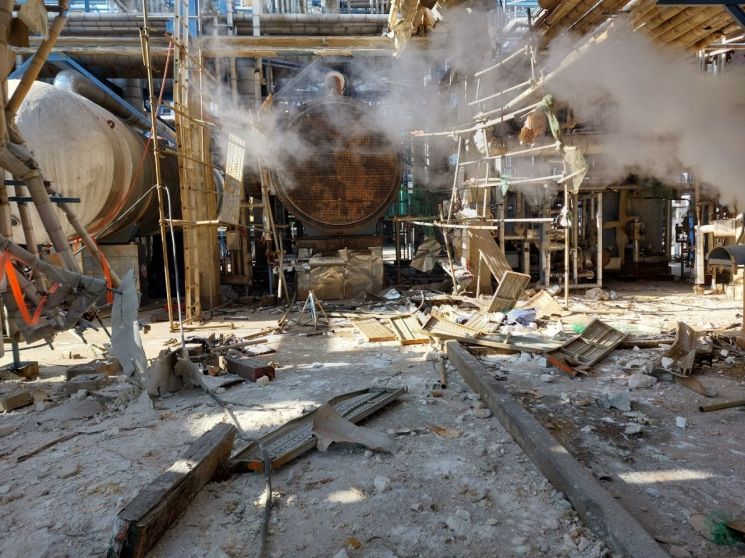 At 9:26 a.m. on the 11th, an explosion occurred during a heat exchanger leak test at Yeocheon NCC Plant 3 in Hwachi-dong, Yeosu-si, Jeollanam-do National Industrial Complex, resulting in 4 deaths and 4 serious injuries so far. The scene of the exploded factory. (Image source=Yonhap News)
[Asia Economy Reporter Moon Chaeseok] As eight workers died or were injured while inspecting a heat exchanger at Yeocheon NCC Plant 3 within the Yeosu National Industrial Complex in Jeollanam-do on the 11th, major companies operating factories in the Yeosu Industrial Complex are on high alert. This is because some companies employ thousands of workers each.
Companies unanimously stated that they are securing safety and health management organizations at the corporate level. This is because the only way to prevent criminal punishment of the CEO in the event of a serious accident is to prove to investigators that the legally mandated safety and health management obligations were properly fulfilled.
The government’s investigation into the first violation case under the Serious Accidents Punishment Act, involving SAMPYO Industry and its CEO Lee Jong-shin, including a raid on the headquarters around 9 a.m. that day, made companies even more sensitive.
According to the Fire Agency, an explosion occurred at around 9:26 a.m. at Yeocheon NCC Plant 3 in Hwachi-dong, Yeosu-si, Jeollanam-do. Four of the eight workers on site died, and the remaining four sustained serious or minor injuries. It was reported that just before the accident, the workers were conducting a heat exchanger leakage test to check for air leaks. No fire broke out after the explosion. Most of the casualties were subcontractor employees.
Yeocheon NCC is a company established with equal investment shares by Hanwha Solutions and DL Chemical in a naphtha cracking facility (NCC). It produces hundreds of tons annually of basic petrochemical feedstocks such as ethylene and propylene. A Yeocheon NCC official said, "We are internally investigating the detailed circumstances," and added, "We will officially announce the company’s position once the investigation is complete."
According to Yeosu City, companies such as Yeocheon NCC, Hanwha Solutions, Hanwha Energy, LG Chem, GS Caltex, Kumho Petrochemical, Lotte Chemical, Kolon Industries, BASF Korea, and Hyosung Engineering are located near the accident site. A total of 296 factories have been built. It is reported that some companies employ about 3,000 regular workers (including production engineers, office staff, and support personnel) in the Yeosu Industrial Complex, excluding subcontractor employees.
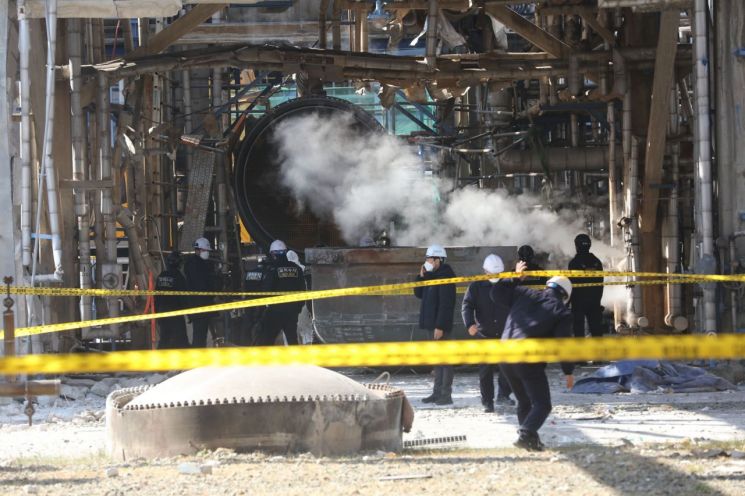
Companies Thoroughly Establish Safety and Health Management Systems
Following the Yeocheon NCC accident, companies located in the Yeosu Industrial Complex unanimously stated that they are thoroughly working on establishing 'safety and health management systems.'
They responded that they are striving to comprehensively build 'safety systems' across the entire company. Lotte Chemical announced plans to strengthen management by investing about 500 billion KRW in safety management by next year. LG Chem stated that since June 2020, it has been thoroughly implementing the 'Magnolia Project,' which reviews environmental and safety measures at all global business sites and adjusts them to global standards, including at the Yeosu Industrial Complex.
Resident companies expressed that it is difficult to immediately set specific measures such as regular maintenance and budget increases for particular equipment like the 'heat exchanger' involved in the Yeocheon accident, or issuing specific guidelines to related workers. Rather, they emphasized that managing the company-wide safety and health management system is more important.
A representative from Company A said, "Maintenance work on aging equipment should be conducted continuously, and focusing management only on specific industrial complex facilities (such as Yeosu) is meaningless," adding, "We will strengthen external expert consulting related to work guidelines for on-site workers."
A representative from Company B said, "It is difficult to comment specifically on our equipment, but worker safety has been a top priority in the industry long before the Serious Accidents Punishment Act was enforced or accidents occurred," and added, "We are mobilizing all methods including safety and environmental policies, risk assessment methods, post-response measures, and focused on-site worker training through labor law firms."
The Yeosu Industrial Complex has seen about 3,400 casualties since its operation began in 1970. An industry insider said, "It is difficult to confirm whether the Yeosu Industrial Complex is particularly vulnerable compared to other industrial complexes, but I believe the petrochemical industry needs to conduct regular maintenance of major facilities such as NCC every one, two, or four years."
Under the Serious Accidents Punishment Act, if a serious accident results in one or more deaths or two or more injuries requiring treatment for six months or longer due to the same accident, the CEO can be criminally punished. However, if the CEO is recognized by investigators as having taken measures such as 'establishing and implementing a safety and health management system with necessary personnel and budget for accident prevention' and 'establishing and implementing measures to prevent recurrence after an accident' as stipulated in Article 4, Paragraph 1 of the law, they can avoid punishment. In other words, if investigators determine that Yeocheon NCC did not properly establish the system, it could lead to CEO punishment.
© The Asia Business Daily(www.asiae.co.kr). All rights reserved.
![Clutching a Stolen Dior Bag, Saying "I Hate Being Poor but Real"... The Grotesque Con of a "Human Knockoff" [Slate]](https://cwcontent.asiae.co.kr/asiaresize/183/2026021902243444107_1771435474.jpg)
















