December transaction volume at lowest level in 13 years... Unsold units increase by 25.7%
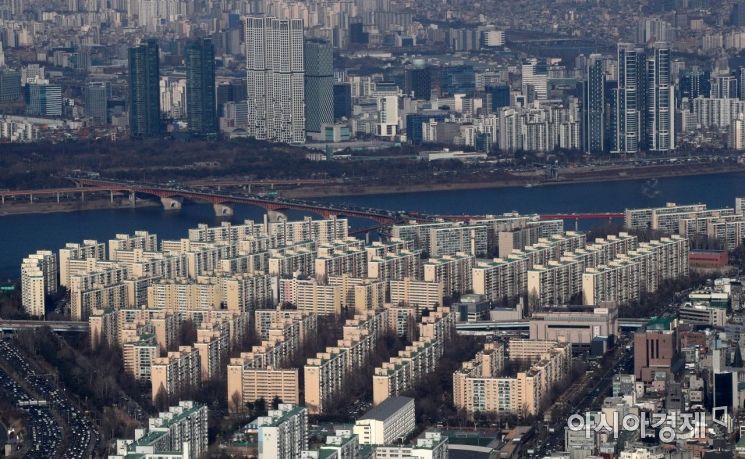
The housing transaction volume has shrunk to its lowest level in 13 years, and with a government-led supply surge also anticipated, the real estate market is facing a stormy calm. The likelihood of abundant funds in circulation flowing into real estate appears low.
◇ Transactions Halted in Nowon, Dobong, Gangbuk= Currently, real estate brokerage offices are complaining about an unprecedented drought in transactions. Due to strengthened government loan regulations, buyers are finding it difficult to obtain loans, but asking prices have not noticeably dropped, and the atmosphere is one of frozen sales transactions. An agent at A Real Estate Agency in Ssangmun-dong, Dobong-gu, Seoul said, "Last month, for every 5 seller inquiries, there was only about 1 buyer inquiry," adding, "Buyers only ask about prices but do not actually proceed with transactions." Another agent at B Real Estate Agency in the same area said, "Since buyers cannot get loans, sales contracts requiring large funds are rarely made," and "Most of the listings currently available are for jeonse (long-term deposit lease) or monthly rent."
Even relatively low-priced urgent sales are not easily transacted. A real estate agent at C Real Estate Agency in Sanggye-dong, Nowon-gu, Seoul said, "A property priced at 700 million KRW was listed at 650 million KRW but remains unsold," and "In our case, sales contracts have stopped since July last year."
In fact, housing transaction volume is at its lowest level in 13 years. According to the Ministry of Land, Infrastructure and Transport, housing sales transactions in December last year were 53,774 units, down 19.9% from the previous month (67,159 units) and 61.7% from the same month last year (140,281 units). The 53,774 transactions in December is the lowest figure since 2008 (about 40,000 units) for the month of December.
◇ Increase in Unsold Units and Supply Bomb Expected= While transactions are stagnant, unsold housing units are increasing not only in provincial areas but also in the metropolitan area. As of the end of December, nationwide unsold housing units increased by 25.7% from the previous month to 17,710 units. Some provinces have become 'graves of unsold units,' but the government is pushing ahead with a housing supply speed race. Including 70,000 pre-sale units, about 460,000 units are expected to be supplied nationwide this year alone, about 30% more than usual. In the mid to long term, housing supply is expected to continue increasing after this year. The Ministry of Land, Infrastructure and Transport explained, "From 2023 onwards, with the full-scale implementation of supply measures such as the 3rd New Towns, an average of 560,000 housing units will be supplied nationwide annually," adding, "With the government's supply measures and Seoul City's New Town Planning (26,090 units annually) being actively promoted, public and private sectors working together will create synergy, and mid to long-term supply conditions are expected to improve further."
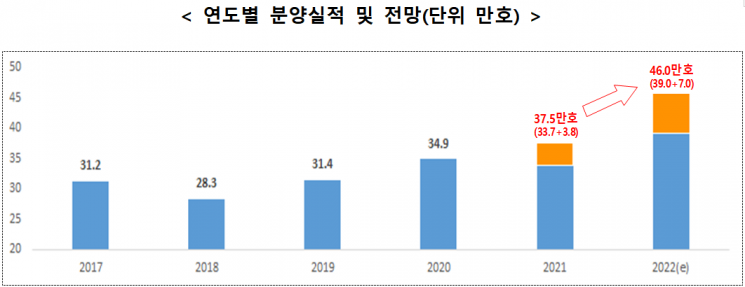
◇ Despite Large-Scale Liquidity Supply... Market Impact Expected to Be Limited= The variable is liquidity. The Democratic Party plans to increase the supplementary budget submitted by the government from 14 trillion KRW to 35 trillion KRW and process it before the 15th. Additionally, land compensation payments expected to be released nationwide this year alone are projected to reach 32.0628 trillion KRW. Typically, when liquidity is supplied to the market, there is an expectation that it will flow into asset markets such as real estate, positively affecting real estate sentiment. Liquidity in circulation remains abundant. According to the Bank of Korea, as of November last year, the money supply (M2) in circulation reached 3,589 trillion KRW.
However, it seems difficult for the recent real estate downturn to rebound with short-term liquidity supply. This supplementary budget is limited to small business owners and self-employed individuals, so the money released through the supplementary budget is unlikely to flow directly into the real estate market. Ham Young-jin, head of the Zigbang Big Data Lab, said, "Due to the expanded implementation of the Debt Service Ratio (DSR) regulation, interest rate hikes, and recognition of housing price peaks, the real estate market is hesitant, so the market is unlikely to be significantly affected by related liquidity funds immediately."
There is also an opposing view that unless the government tightens liquidity through rapid interest rate hikes, the real estate market will trend upward after the presidential election. Seo Jin-hyung, president of the Korea Real Estate Society (professor at Gyeongin Women's University), said, "There is a market distortion phenomenon caused by a transaction cliff from people postponing transactions until after the presidential election," adding, "Since abundant liquidity remains, unless interest rate hikes are rapidly pursued, the real estate market will trend upward after the presidential election."
© The Asia Business Daily(www.asiae.co.kr). All rights reserved.
![Clutching a Stolen Dior Bag, Saying "I Hate Being Poor but Real"... The Grotesque Con of a "Human Knockoff" [Slate]](https://cwcontent.asiae.co.kr/asiaresize/183/2026021902243444107_1771435474.jpg)
















