Last Year Reflected in National Top-Level Plans for Airports and Railroads
Establishment of Mid- to Long-Term Development Strategy for Daegu-Gyeongbuk New Airport
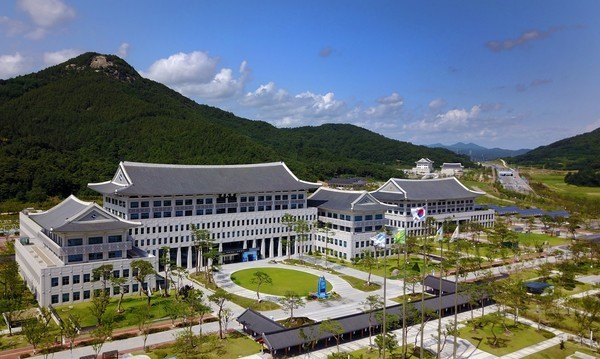
[Asia Economy Yeongnam Reporting Headquarters, Reporter Kim Gwiyeol] Gyeongbuk Province announced its development strategy for this year on the 30th, aiming to accelerate large-scale projects such as the construction of the new airport.
In the first half of last year, the cancellation of the Gimhae New Airport and the controversy over the Gadeokdo Special Act caused much concern and worry among many city and provincial residents. In the second half, the provincial council experienced twists and turns over the incorporation of Gunwi County into Daegu City.
Amid these circumstances, Gyeongbuk Province devoted administrative efforts to airport construction and achieved results.
In the 6th Comprehensive Airport Development Plan, it was designated as a hub airport and recognized as the gateway airport for the southeastern region. The phrase "short-haul international routes," which had limited the role of Daegu Airport, was removed, laying the foundation for operating medium- and long-haul routes to destinations such as the Americas and Europe.
The 4th National Railroad Network Construction Plan included an airport railway connecting West Daegu, the new airport, and Uiseong.
It is also highly likely that the 2nd Expressway Construction Plan, to be announced soon, will include the expansion of the Jungang Expressway to six lanes, which is expected to completely resolve concerns about accessibility that have been raised so far.
Additionally, a bipartisan consultative body supporting the construction of Daegu-Gyeongbuk New Airport has been formed. Even without a special law, continuous contact with the government and political circles is being maintained to build the airport bigger and faster while reflecting regional demands.
Based on last year's achievements, Gyeongbuk Province plans to advance projects more rapidly this year.
Daegu City's basic plan service and the Ministry of Land, Infrastructure and Transport's preliminary feasibility study for the private airport are expected to be completed in the first half of this year. Gyeongbuk Province is accelerating the discovery of projects linked to the construction of the airport new town.
As a follow-up to the "Integrated New Airport Urban Concept and Metropolitan Transportation Network Plan Study" completed last year, Gyeongbuk Province will conduct a study to establish a mid- to long-term development strategy for the airport new town and the aviation cluster.
The study will analyze residential and industrial demand in the airport new town and establish phased development plans. A research project to foster the "Daegu-Gyeongbuk New Airport" as an economic and logistics airport will also be conducted.
Based on the analysis of export-import air cargo by city and province, strategies will be prepared to absorb air cargo from other regions and attract global air logistics companies.
This study is expected to include an analysis of conditions and preliminary preparations for designating the new airport logistics complex as a free trade zone.
Individual projects such as the Food Valley and theme parks planned to be established in the airport surrounding area have completed their basic concepts and will begin specific discussions such as site selection.
Gyeongbuk Province will also challenge the urban air mobility industry, which has recently attracted attention as an eco-friendly and low-noise next-generation mobility.
The Ministry of Land, Infrastructure and Transport plans to select a testbed for demonstration in semi-urban areas in the first half of this year, aiming for commercialization by 2025.
Gyeongbuk Province is preparing to apply with Daegu-Gyeongbuk New Airport as a base.
If the region’s excellent related industrial base, including the latest airport facilities, geographical and environmental advantages, and advanced materials for drones, electronics, and electricity, is well utilized, the K-UAM project can be fostered as a new growth engine leading the region.
A public-private cooperation system will also be established to strongly promote the construction of the new airport "Daegu-Gyeongbuk New Airport" together with residents.
The so-called "Flying Gyeongbuk" pan-provincial promotion committee will play a role in spreading consensus among city and provincial residents on the construction of a sufficiently large airport and administrative and financial support, conveying this to the government and political circles, and seeking cooperation measures.
Centered on the pan-provincial promotion committee, publicity that residents can feel will be promoted. "Visiting briefings" will be held by city and county to explain the airport construction progress and airport-linked development strategies by region and county to residents and collect local opinions.
The on-site communication consultation office will be further expanded and operated.
In preparation for future compensation for incorporated land, legal and tax experts will be stationed full-time to provide high-quality consultation services, and conflicts between regions and residents will be actively managed in advance.
Along with the construction of Daegu-Gyeongbuk New Airport, efforts will be made to expand aviation infrastructure and establish an industrial base.
Ulleung Airport, which will be a milestone for small airports in island areas, aims to open in 2025, with plans to increase the progress rate to 30% this year.
During the first half of this year, Pohang Airport will be renamed "Pohang-Gyeongju Airport," expected to raise Gyeongju’s city brand and greatly contribute to tourism revitalization.
The Korean Aviation Academy (KAA) base center will be attracted to Uljin Airfield to establish a system for training aviation professionals, and an aviation industry job information fair will also be hosted.
Lee Cheol-woo, Governor of Gyeongbuk Province, said, "2022 is an important year in which the scale of facilities for Daegu-Gyeongbuk New Airport and the blueprint for the development of surrounding areas are finalized," adding, "We will ensure that Daegu-Gyeongbuk New Airport develops into an economic and logistics airport representing the central region beyond Daegu and Gyeongbuk."
© The Asia Business Daily(www.asiae.co.kr). All rights reserved.